
YouTube is not just for entertainment – it’s a powerful platform for businesses to connect with decision-makers. With over 2.7 billion monthly users and advanced targeting options through Google Ads, YouTube allows B2B marketers to reach audiences actively searching for solutions. Video content helps simplify complex topics, build trust, and drive engagement, making it an essential tool for lead generation.
Key Takeaways:
- Why YouTube Works: Combines search engine power, high engagement rates, and precise ad targeting.
- Channel Setup: Use professional branding, keyword-rich descriptions, and playlists tailored to the buyer’s journey.
- Content Strategy: Create how-to videos, product demos, and case studies to guide prospects through the sales funnel.
- Ad Formats: Skippable in-stream ads for awareness, bumper ads for quick messaging, and in-feed ads for high-intent viewers.
- Metrics to Track: Focus on click-through rates, audience retention, and conversions using tools like UTM parameters and AI-based features.
YouTube can transform your marketing strategy by combining educational content, targeted ads, and actionable insights to turn viewers into qualified leads.
Setting Up Your YouTube Channel for Lead Generation
Turn your YouTube channel into a powerful lead-generation tool by building a professional, engaging presence that appeals to B2B decision-makers.
Optimize Your Channel Branding and Description
Start by setting up a Brand Channel instead of a personal one. A Brand Channel allows multiple team members to manage the account without sharing login credentials, ensuring your business retains control even if employees leave. Make sure your channel visually aligns with your website by using your logo and matching banner art. This consistency helps establish instant recognition and builds trust with your audience.
Your “About” section is a prime spot to speak to both viewers and search algorithms. Use this space to craft a clear, keyword-rich description that highlights your offerings. Include essential details like your contact information, website, and social media profiles. For instance, National Instruments (NI) uses trackable bit.ly links in their video descriptions to direct viewers to specific product pages. This approach helps them measure which videos drive traffic and generate potential leads.
Don’t forget to include a channel trailer. This short video should communicate your value proposition and explain the problem you solve. Keep it concise and make sure it stays relevant and up-to-date.
Organize Playlists for the Buyer’s Journey
Once your channel’s branding and description are in top shape, focus on structuring your content with playlists that align with the buyer’s journey. Playlists not only keep your channel organized but also help guide prospects through each stage of their decision-making process. Tailor your playlists to the three main stages of the B2B buyer’s journey: awareness, consideration, and decision-making.
For the awareness stage (top of the funnel), create playlists filled with educational content, such as how-to guides and industry trend analyses. These videos should address the broader challenges your audience faces. In the consideration stage (middle of the funnel), group content such as buyer’s guides, client success stories, and FAQ videos. These materials build trust and showcase your expertise. Finally, for the decision-making stage (bottom of the funnel), organize solution-focused content such as detailed product demos, data-driven case studies, and technical comparisons.
LucidWorks, a company specializing in AI-powered search technology, uses this strategy effectively. Their playlists cover complex topics such as “NLP vs. NLU” and “Clustering vs. Classification”, with some videos receiving over 2,600 views from their targeted B2B audience. To boost visibility, optimize each playlist title and description with relevant keywords. This not only improves your search rankings on YouTube and Google but also helps YouTube’s algorithm understand how your videos connect, increasing the likelihood that your content will be recommended to the right viewers.
Creating B2B Video Content That Drives Leads
Once your channel is set up, the next challenge is creating videos that grab the attention of decision-makers and turn them into leads. With your channel optimized, your video content should now focus on delivering value tailored to where your prospects are in their buying journey.
Video Content Types That Generate Leads
Educational and how-to videos are a great way to attract new audiences. Did you know that 70% of YouTube users turn to the platform for help with job-related issues? These videos can position you as an authority by tackling industry-specific challenges. Think tutorials, trend analyses, or myth-busting clips that directly answer the questions your prospects are asking.
Product demonstrations are an excellent way to showcase complex solutions. A visual walkthrough can explain intricate features far better than text ever could. Pair these with case studies or testimonials featuring real numbers to further qualify leads. For example, Midsummer Agency ran a video ad campaign for a dental healthcare client in September 2025. The campaign featured a doctor discussing services while giving viewers a glimpse of the clinic. The result? A 308% jump in conversions and a 68% improvement in cost-per-lead efficiency over just 30 days.
Gated webinars work well for capturing leads at the top of the funnel, while FAQ or explainer videos are perfect for addressing objections in the middle stages. As prospects move closer to making a decision, personalized videos from sales reps can make all the difference. These videos, which might answer specific questions or walk through proposals, have been shown to boost close rates by up to 41%.
Now that you know which types of videos to create, let’s look at how to make them more engaging.
Best Practices for Engaging B2B Viewers
The first 15 seconds of your video are make-or-break. Get straight to the point and deliver on the promise of your title without wasting time on long intros or heavy branding. To keep viewers engaged, switch things up every 20–30 seconds with on-screen graphics, B-roll footage, or changes in camera angles.
Your thumbnail matters more than you think – it needs to grab attention at a glance. Use high-contrast colors and keep text to a maximum of four words. Thumbnails featuring human faces with clear reactions tend to outperform generic product shots. And don’t forget: every video should have one clear call-to-action (CTA), whether it’s “Book a demo,” “Download the guide,” or “Schedule a consultation.” Avoid cramming multiple CTAs into a single page, as this can confuse viewers and lower conversion rates.
To boost discoverability, start your video titles with primary keywords and include a full transcript in the description. This makes it easier for both YouTube and Google to index your content. Since many viewers watch videos without sound, adding closed captions is essential to keep them engaged and make your content accessible.
Using YouTube Tools and Ads for Lead Generation
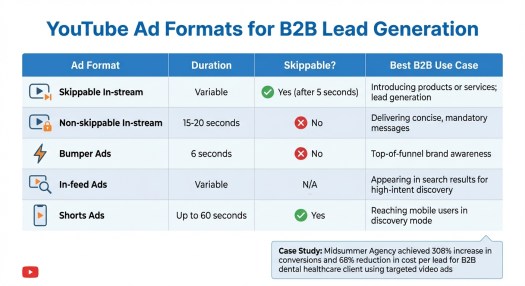
YouTube Ad Formats for B2B Lead Generation Comparison
YouTube offers powerful tools and ad formats to help you turn engaged viewers into leads. By using these features, you can collect contact information and connect with decision-makers at every stage of the buying process.
Set Up Lead Forms and CTAs
To maximize engagement, include clear calls-to-action (CTAs) at key points in your videos – early on, during peak engagement, and at the end. YouTube’s End Screens are especially useful because they let you showcase CTAs in the last 5–20 seconds of your video. These can direct viewers to your website, a landing page, or other relevant content. For capturing leads, embed lead forms directly into your YouTube ads or link to mobile-friendly landing pages with opt-in forms.
For better targeting, use “In-Market” audiences and “Custom Intent” keywords. Pair this with bidding strategies like “Maximize Conversions” or “Target CPA”, which allow Google to optimize for actual leads.
Once your targeting and CTAs are set, leverage YouTube’s diverse ad formats to strategically deliver your message throughout the buyer’s journey.
YouTube Ad Formats for B2B
Choosing the right ad format is essential for reaching B2B audiences effectively. Skippable in-stream ads, for instance, are great for introducing your product or service to new viewers. To make an impact, ensure your value proposition is clear within the first 5 seconds. On the other hand, bumper ads, which last just 6 seconds, are ideal for building brand awareness and reinforcing your message through repeated exposure.
In-feed ads (formerly Discovery ads) appear in search results or alongside related videos, making them ideal for reaching high-intent viewers actively searching for solutions. Short ads, which run up to 60 seconds in vertical format, are great for connecting with mobile-first professionals in a discovery mindset. For time-sensitive promotions or key-feature announcements, non-skippable in-stream ads (15–20 seconds) ensure your full message is seen.
Here’s a quick overview of YouTube’s ad formats and their best use cases for B2B:
| Ad Format | Duration | Skippable? | B2B Use Case |
|---|---|---|---|
| Skippable In-stream | Variable | Yes (after 5s) | Introducing products or services; lead generation |
| Non-skippable In-stream | 15–20 seconds | No | Delivering concise, mandatory messages |
| Bumper Ads | 6 seconds | No | Top-of-funnel brand awareness |
| In-feed Ads | Variable | N/A | Appearing in search results for high-intent discovery |
| Shorts Ads | Up to 60 seconds | Yes | Reaching mobile users in discovery mode |
For example, in August 2025, Midsummer Agency launched a YouTube video ad campaign for a B2B dental healthcare client. The campaign featured doctors discussing specialized treatments while highlighting the clinic’s facilities. Over 30 days, the campaign achieved a 308% increase in conversions and a 68% reduction in cost per lead compared to previous benchmarks. The success came from aligning ad formats with the audience’s position in the buying journey and delivering value within the first few seconds.
sbb-itb-0bbf42a
Measuring Performance with YouTube Analytics and AI
To make your B2B YouTube campaigns shine, tracking the right metrics is key. YouTube Analytics provides detailed insights into how your videos perform, while AI tools can fine-tune your targeting and improve lead conversions.
These insights help shape your content strategy and enhance the effectiveness of your ads.
Key Metrics to Track for B2B Success
Start by keeping an eye on your Impressions Click-Through Rate (CTR). This metric shows how well your titles and thumbnails grab attention. For B2B content, a CTR below 4% suggests your video packaging might not be connecting with your audience. If that’s the case, experiment with new thumbnail designs – try bold colors and minimal text for a cleaner, more striking look.
Retention data is another crucial area to monitor. It tells you where viewers stay engaged and where they drop off. High retention means your content is hitting the mark, while sharp declines indicate areas that may need trimming or reworking.
Card clicks are a great way to measure how effectively your calls-to-action (CTAs) are performing. Additionally, analyzing traffic sources and keywords helps you optimize your video metadata, attracting viewers who are more likely to convert into leads.
For tracking conversions, UTM parameters are a must. These allow you to see which videos are driving the most action in Google Analytics, whether that’s demo requests, sign-ups, or other key goals.
| Metric | What It Tells You | How to Improve |
|---|---|---|
| Impressions CTR | Measures the appeal of your title and thumbnail | A/B test thumbnails and titles if below 4% |
| Audience Retention | Tracks how well your content holds attention | Edit out sections with steep drop-offs |
| Card Click Rate | Gauges engagement with CTAs and lead magnets | Place high-performing cards earlier in videos |
| Traffic Sources | Identifies where your audience finds your content | Focus on high-converting channels |
| UTM Conversions | Tracks which videos lead to actual conversions | Invest in topics that drive the most results |
On top of these metrics, AI tools add a layer of precision, helping you target and retarget your audience more effectively.
AI Tools for Targeting and Retargeting
YouTube’s Promote feature allows you to target viewers based on their interests – like technology or business – rather than just demographic data. AI models analyze user behavior across YouTube and Google to identify these categories, making it easier to reach decision-makers actively searching for solutions in your space.
Third-party tools like VidIQ and TubeBuddy offer valuable insights into SEO and competitor strategies. They can help you discover the topics and keywords that resonate most with your audience.
For deeper analysis, YouTube Studio’s Advanced Mode is a powerful resource. It lets you create custom charts and export data to understand how specific audience segments engage with your content. Keep an eye on the “New Viewers Who Returned” metric – it’s a great indicator of how well your retargeting efforts are working, especially in longer B2B sales cycles.
YouTube’s new “Ingredients to Video” AI tool is another game-changer. This tool creates eight-second Shorts from text prompts and reference images, making it easy to produce quick, engaging retargeting clips. Pair these AI-generated Shorts with UTM parameters to measure which campaigns lead to actions like demo bookings or whitepaper downloads.
Conclusion
Let’s bring it all together: YouTube is a powerful tool for driving B2B leads when used strategically. By refining your channel branding, crafting videos that address real-world business challenges, and fully leveraging YouTube’s built-in features, you can connect with decision-makers actively seeking solutions.
Think of YouTube as an integral part of your marketing funnel. Use educational videos to build awareness, case studies to establish trust, and personalized demos to seal the deal. By aligning your video strategy with your broader marketing goals and keeping an eye on key metrics, YouTube can transform from a content platform into a revenue driver.
Key Takeaways for B2B Success on YouTube
- Build a branded, keyword-optimized channel to establish authority and attract your target audience.
- Focus on problem-solving content rather than generic sales pitches. Use the first 5 seconds to grab attention and include pattern interrupts every 20–30 seconds to keep viewers engaged.
- Utilize YouTube’s lead capture tools by incorporating calls-to-action in your videos and linking to dedicated landing pages. For paid ads, experiment with formats like skippable in-stream ads for introductions and non-skippable ads for delivering key messages.
- Track key metrics like click-through rates, audience retention, and conversions. Use UTM parameters to link video performance to ROI, and integrate YouTube data with your CRM or marketing automation tools for timely follow-ups.
Experts agree: YouTube’s unique mix of organic reach and targeted advertising can boost both visibility and revenue.
FAQs
How can I effectively optimize my YouTube channel to generate B2B leads?
To make your YouTube channel a powerhouse for B2B lead generation, start by identifying exactly who you’re speaking to. Build detailed buyer personas that highlight their job roles, industries, and the challenges they face. This way, your content will directly address their pain points and catch the attention of decision-makers.
Next, make sure your channel looks polished and professional. Choose a clear, memorable name, write a keyword-rich description, and design custom visuals that represent your brand. Add links to your website or landing pages for easy navigation. Don’t forget to craft concise, attention-grabbing video titles and pair them with eye-catching thumbnails. Strong calls-to-action (CTAs) in your video descriptions and end screens can encourage viewers to take the next step, such as visiting your site or downloading a resource.
When it comes to content, focus on what your audience finds valuable. Think product demos, case studies, and thought-leadership videos that showcase your expertise. To capture leads directly, include on-screen CTAs, QR codes, or links to gated resources like whitepapers or webinars.
Finally, keep an eye on YouTube Analytics. Use the data to see what’s working, tweak your approach, and improve your results over time. If you’re looking for expert help to execute these strategies, Smart Web Marketing is a great resource to guide you.
What types of YouTube videos are most effective for engaging B2B decision-makers?
The best YouTube videos for B2B decision-makers align with the different stages of the buying journey. At the top of the funnel, educational content – like webinars or industry explainer videos – can grab attention and position your brand as a leader in your field. Moving to the middle of the funnel, product demos and case studies shine by showing how your solutions address specific challenges and deliver measurable outcomes. When prospects reach the bottom of the funnel, personalized one-on-one videos created by sales reps can help build trust and encourage them to take the next step.
Content that feels genuine, such as behind-the-scenes looks or day-in-the-life videos, can also make your brand more relatable and keep potential clients engaged throughout the process. By strategically combining these video formats, you can boost engagement and attract high-quality leads. If you’re looking for professional, tailored video content to align with your business goals, WSI Smart Web Marketing offers expertise in creating videos that deliver results.
What are the best YouTube ad formats for each stage of the B2B buyer’s journey?
YouTube provides specific ad formats designed to fit each stage of the B2B buyer’s journey, making it easier to connect with potential customers at the right time:
- Awareness Stage: To create a quick, lasting impression, try Bumper ads (6-second, non-skippable) or TrueView Discovery ads. These formats are perfect for introducing your brand or sharing industry insights with prospects at the top of the funnel.
- Consideration Stage: At this point, TrueView In-Stream ads (skippable after 5 seconds) and longer video ads are effective. Use these to highlight product demos, case studies, or thought-leadership content that help decision-makers weigh their options.
- Decision Stage: To encourage action, opt for Non-skippable In-Stream ads (15 seconds) or Overlay/Sponsored Card ads. These formats are great for delivering strong calls-to-action like “Schedule a demo” or “Download the whitepaper”, nudging prospects toward the next step.
By matching the right ad format to each stage of the journey, you can smoothly guide B2B buyers from initial awareness to conversion.
The post How to Use YouTube Tools for B2B Lead Generation appeared first on Smart Web Marketing.