
Want to connect with buyers at the right time? Mapping content to the buyer journey ensures your content aligns with what buyers need at every stage. Here’s how to do it in five steps:
- Create Buyer Personas: Build detailed profiles of your target audience, including their roles, challenges, and decision-making criteria.
- Map Buyer Journey Stages: Understand the three stages – Awareness, Consideration, and Decision – and the unique questions buyers ask at each step.
- Identify Touchpoints: Pinpoint where buyers interact with your brand (e.g., website, trade shows) and tailor content for those moments.
- Build a Content Mapping Matrix: Organize content by persona and journey stage to identify gaps and ensure full coverage.
- Launch, Track, and Improve: Distribute content strategically, measure performance, and refine based on what works.
Key Stats to Know:
- 60% of B2B buyers prefer independent research before contacting sales.
- 47% consume 3–5 pieces of content before engaging with a salesperson.
- Only 4% of your market is actively buying, while 40% are exploring options.
Mapping content to the buyer journey ensures you’re ready to guide buyers at every stage, from problem awareness to vendor selection.
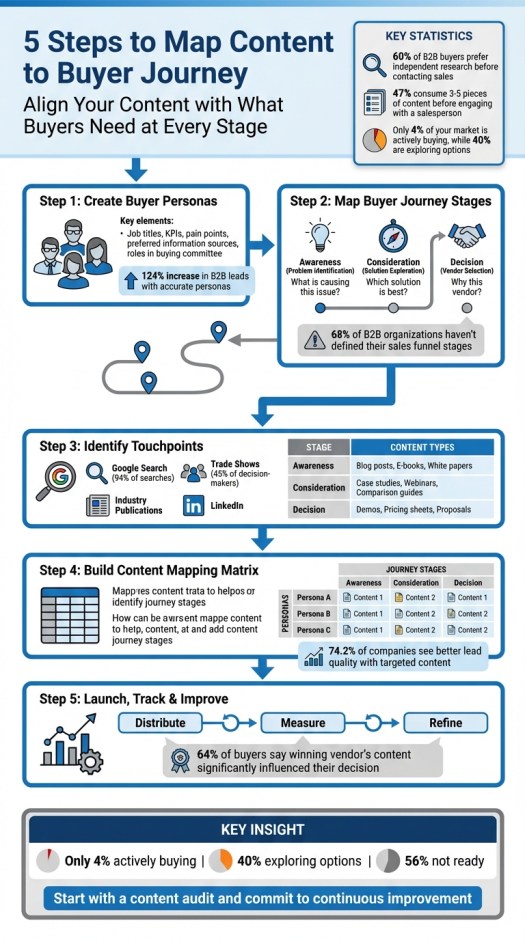
5-Step Content Mapping Framework for B2B Buyer Journey
CONTENT STRATEGY: How to Map Content to Each Stage of the MARKETING FUNNEL
sbb-itb-0bbf42a
Step 1: Create Buyer Personas
To effectively reach your audience, start by building detailed buyer personas. These profiles should outline the challenges, decision-making criteria, and information habits of your potential buyers.
Why does this matter? Accurate buyer personas can increase B2B leads by an impressive 124%. Yet many companies fall into the trap of creating overly generic personas that fail to capture the complexities of B2B manufacturing purchases. In this industry, decisions often involve multiple stakeholders and significant financial commitments.
In manufacturing, decisions are rarely made by a single person. Take, for example, a mechanical engineer focused on technical specs – they have entirely different priorities than a CFO who must approve the budget or a plant manager responsible for overseeing implementation. Stacy Bouchard from Weidert Group emphasizes that marketing to engineers requires technical depth rather than flashy visuals.
Here’s how to craft and refine personas tailored to the B2B manufacturing space.
How to Build Buyer Personas
Begin by tapping into the insights of your sales and customer support teams. They’re on the front lines and frequently hear the same objections, questions, and concerns from prospects. Interview them to uncover the recurring themes in buyer behavior – what questions do prospects ask? What factors make or break a deal?
Key elements to include in your personas:
- Job titles and professional backgrounds
- KPIs and operational pain points
- Preferred information sources (e.g., trade shows, LinkedIn, Google, industry publications)
- Roles within the buying committee (e.g., decision-maker, technical evaluator, financial gatekeeper)
- Trigger events that spark purchasing (e.g., equipment failures, capacity issues)
Dive into customer data to spot trends and key actions that lead to sales. What content do they engage with? Which touchpoints seem most influential? It’s also worth interviewing customers who chose a competitor to identify gaps in your content or messaging.
Customizing Personas for B2B Manufacturing
In manufacturing, buyer personas must reflect the high-stakes, multi-stakeholder nature of purchasing decisions. These deals often involve significant investments – sometimes reaching millions of dollars – which means longer decision cycles and more thorough evaluations.
Understand the buying committee. Develop distinct personas for each key stakeholder:
- Technical evaluators (engineers need detailed specs and performance data)
- End users (plant managers value ease of implementation and training)
- Financial gatekeepers (CFOs focus on ROI and total cost of ownership)
- Executive decision-makers (C-suite leaders prioritize strategic alignment and long-term business outcomes)
Each persona will require tailored content and messaging to address their unique concerns. For instance, engineers might look for technical white papers, while CFOs might want ROI calculators or cost-comparison tools.
Manufacturing buyers expect vendors to demonstrate expertise. Flashy marketing won’t cut it – they’re looking for technical knowledge, product specs, and evidence that you understand their industry. In fact, 68% of B2B buyers choose vendors who show a clear understanding of their needs, and 59% select vendors with deep industry knowledge.
Also, consider the dynamics of the buying team. An engineer might appreciate a technical white paper, but they’ll need tools like ROI calculators to convince the CFO. By creating content that’s easy to share across the buying committee, you empower all stakeholders to make informed decisions.
These well-crafted personas will become the backbone of your strategy, helping you deliver targeted content at every stage of the buyer journey.
Step 2: Map the Buyer Journey Stages
Now that you’ve crafted your buyer personas, the next step is to examine how those buyers progress through the purchasing process. In the world of B2B manufacturing, this journey typically unfolds in three stages: Awareness, Consideration, and Decision. Each stage reflects a different mindset, set of questions, and emotional state.
Here’s a surprising stat: 68% of B2B organizations haven’t clearly defined the stages in their sales funnels. Without this clarity, it’s no wonder so many companies struggle to engage buyers effectively. If you don’t understand the journey, you’re left guessing at what content to create and when to deliver it.
But here’s the thing – the buyer journey isn’t always a straight path. As Stacy Bouchard of Weidert Group explains:
“The buyer’s journey for today’s prospects is filled with starts and stops, detours, forward leaps, reversing course and, at times, starting at the beginning all over again”.
For example, a plant manager might jump straight to the Decision stage if they’ve made similar purchases before. On the other hand, they might circle back to the Awareness stage if new challenges arise.
What Happens at Each Stage
Awareness Stage (Problem Identification): At this stage, buyers recognize a problem but have not yet identified the root cause. For instance, a facilities manager might notice that their storage capacity is maxed out but isn’t sure whether they need welded steel, concrete, or polyethylene tanks. Their questions are broad, like “What type of tank works best for crude oil storage?” They’re exploring the issue to determine whether it’s solvable.
Consideration Stage (Solution Exploration): Here, buyers have identified their problem and are actively seeking solutions. That same facilities manager may have narrowed their options to steel tanks and is now comparing bolted versus welded steel for crude oil storage. At this stage, they’re focused on evaluating approaches and building a list of technical requirements rather than deciding on specific vendors.
Decision Stage (Vendor Selection): By now, the buyer has chosen a solution type and is evaluating vendors in detail. For example, they’ve decided on welded steel tanks and are comparing two vendors – Acme and XYZ – based on pricing, technical specs, maintenance contracts, and overall fit. They need solid data to justify their choice to internal stakeholders.
Understanding these behaviors at each stage allows you to create content that speaks directly to buyers’ needs.
Understanding Buyer Needs at Each Stage
Buyers’ questions and emotions vary by stage, so your content must adapt accordingly. Tailored content builds on the insights you’ve already gathered through your buyer personas.
- Awareness Stage: Buyers here are frustrated and uncertain. They need vendor-neutral content that helps them understand their problem without a sales pitch. Think blog posts, how-to videos, tip sheets, and white papers that explain industry challenges and potential solutions.
- Consideration Stage: At this stage, buyers are curious and eager to explore solutions. They want to weigh the pros and cons of different approaches. Case studies, comparison guides, webinars, and demo videos are especially helpful here.
- Decision Stage: Buyers now need evidence to support their choice. They’re looking for spec sheets, pricing guides, ROI calculators, customer testimonials, and detailed case studies. In B2B manufacturing, your contact often has to “sell” your solution internally to other stakeholders.
Here’s a quick breakdown of buyer behavior and content types across the journey:
| Stage | Buyer’s Focus | Key Questions | Emotions | Content Types |
|---|---|---|---|---|
| Awareness | Symptoms & Problems | “What is causing this issue?” | Frustration, uncertainty | Blogs, eBooks, how-to videos, infographics |
| Consideration | Solution Categories | “Which type of solution is best?” | Eagerness, curiosity | Case studies, white papers, webinars, demos |
| Decision | Specific Vendors | “Why is this vendor better?” | Need for justification, caution | Trials, pricing guides, testimonials, spec sheets |
A critical takeaway: you need more Awareness-stage content than anything else to reach the widest audience. Here’s why: only 4% of your market is actively buying at any given time, while 40% are just starting to explore options, and 56% aren’t ready or don’t have a current need. If you focus solely on Decision-stage content, you’re missing 96% of your potential market. By aligning your content with all three stages, you remain visible and build trust long before buyers are ready to commit.
Step 3: Identify Touchpoints and Content Requirements
Now that you’ve outlined the buyer journey stages, it’s time to pinpoint the specific touchpoints and content needs that will bring your strategy to life. This step is where planning turns into actionable execution. Essentially, you’re figuring out where potential buyers interact with your brand and what kind of content they need at those moments.
Here’s something to consider: 60% of B2B buyers prefer to avoid speaking with a company representative until they’ve done their own research. This means your content needs to be present and effective across all touchpoints. Buyers are already forming opinions about your brand, often without your awareness. That’s why it’s so important to show up in the right places with the right content.
Finding Key Touchpoints
A touchpoint is any interaction a buyer has with your brand. This could be anything from finding your blog through a Google search to attending one of your webinars or downloading a product spec sheet. To identify these moments, focus on actual buyer behavior rather than relying on assumptions.
Start by diving into your historical data. Look at your customers’ purchase paths – what pages did they visit? What content did they download? This analysis can uncover “sales-trigger actions”, those interactions that often signal a lead is moving closer to making a decision. For example, you might notice that downloading a comparison guide followed by visiting the pricing page often indicates a lead is nearing a decision.
Your sales and marketing teams are also goldmines of insight. Sales reps, in particular, can tell you which content pieces prospects frequently mention during calls or which questions come up repeatedly. Ask them something like, “Which content downloads typically signal that a lead is ready for a sales conversation?” Their answers will help refine your strategy.
Don’t forget about touchpoints outside your website. 94% of internet searches happen on Google or Google-owned platforms, making organic search a critical channel. Additionally, 45% of B2B technology decision-makers rely on information gathered at conferences and trade shows. More recently, AI has become another channel buyers use to do research and make comparisons. For industries like manufacturing, other key sources include industry publications, professional associations, LinkedIn groups, and trade shows.
Keep in mind that buyers often consume multiple pieces of content before engaging directly. This highlights the importance of offering a variety of assets tailored to different stages of the buyer journey, rather than relying on just one or two.
Matching Content Types to Journey Stages
Once you know where buyers interact with your brand, the next step is to align the right content formats with the right touchpoints and journey stages. The goal isn’t to produce more content – it’s to produce targeted content that meets buyers’ needs at each stage.
In the Awareness Stage, buyers are exploring their problems and looking for educational, non-promotional content. They’re asking big-picture questions like, “What causes excessive downtime in chemical management systems?” Content formats that work well here include blog posts, infographics, how-to videos, checklists, and white papers.
In the Consideration Stage, buyers have identified their problem and are evaluating potential solutions. They’re looking for content that explains how different approaches can address their challenges. Case studies, eBooks, expert webinars, product demos, and comparison guides are effective formats for this use.
Finally, during the Decision Stage, buyers compare vendors and need solid evidence to justify their choice. This is especially important when they need to advocate for your solution within their organization. Content like free trials, live demos, free consultations, pricing sheets, testimonials, and spec sheets can provide the validation they’re looking for.
Here’s a handy breakdown:
| Buyer Journey Stage | Common Touchpoints | Content Formats |
|---|---|---|
| Awareness | Google Search, Social Media, Industry Blogs, Trade Shows, research, and information from AI | Blog posts, Infographics, Checklists, How-to videos, White papers |
| Consideration | Email Newsletters, Webinars, Comparison Sites, research, and information from AI | Case studies, eBooks, Product demos, Comparison guides |
| Decision | Pricing Pages, Review Sites, and Direct Consultation | Free trials, Live demos, Testimonials, Spec sheets, Consultations |
To align your content with buyer intent, use stage-specific keywords. For example, terms such as “learn,” “identify,” and “troubleshoot” are ideal for Awareness content. In the Consideration stage, phrases such as “choose,” “select,” or “compare” resonate well. For Decision-stage buyers, words such as “pricing,” “review,” and “versus” can reinforce your message.
Lastly, conduct a content audit. Use a simple spreadsheet to list all your existing content assets and map them to the relevant journey stages and touchpoints. This will help you identify gaps and ensure you have a balanced content strategy that supports buyers throughout their journey.
With a clear understanding of touchpoints and matching content, you’re ready to organize everything using a content mapping matrix.
Step 4: Build a Content Mapping Matrix
Now that you’ve defined your personas, mapped out the journey stages, and pinpointed key touchpoints, it’s time to turn that groundwork into an actionable plan. A content mapping matrix is your tool for doing just that. Think of it as a spreadsheet that highlights where your content is strong and where it’s missing. Given that 74.2% of companies see better lead quality with targeted content, this matrix ensures you’re addressing every buyer’s specific needs.
How to Structure Your Matrix
Start with a straightforward spreadsheet – Excel or Google Sheets will do the trick. Organize it so that your buyer personas are listed vertically (down the rows) and the buyer journey stages – Awareness, Consideration, and Decision – are laid out horizontally (across the columns). Each cell represents a unique intersection, like “Operations Manager in the Awareness Stage” or “Plant Engineer in the Decision Stage.”
In each cell, fill in the details of your existing content. Include the content title, its format (e.g., eBook, video, case study), and a brief summary explaining what pain point or question it solves. This summary acts as a quick reference for your sales team. For instance, instead of just listing “CNC Maintenance Guide”, you could write: “CNC Maintenance Guide (PDF) – Helps operations managers plan preventive maintenance schedules to minimize downtime.”
“A content matrix is a map for your content creation. It guides you and your team to help prioritize the content that nurtures leads.” – Brandon Hickie, Marketing Manager, OpenView
Once your matrix is set up, spotting gaps becomes much easier. These gaps will guide your next steps in creating content that fills the void.
Finding Content Gaps
With your matrix in hand, it’s time to evaluate it for missing pieces. Blank cells are your red flags – they indicate where buyers lack the information they need. This is critical because 47% of B2B buyers consume three to five pieces of content before engaging with a salesperson. Missing content at key stages could mean stalled deals or, worse, prospects turning to competitors who have the answers.
Collaborate with your sales and marketing teams to determine which content has the most impact on the sales process. For example, if sales reps frequently hear, “We want to see how this works in a real-world setting”, but you lack case studies for the Consideration stage, that’s a priority gap. Similarly, if you’re generating plenty of Awareness-stage traffic but losing leads before the Decision stage, you might need more bottom-of-funnel assets, such as pricing guides, spec sheets, or customer testimonials.
Dive into your conversion data to identify top-performing content. Often, you can repurpose or tweak these high-performing pieces to serve other personas or journey stages, saving time and effort. Strike a balance between Awareness content to attract new leads and Decision-stage content to help close the deal.
“Armed with your complete content matrix, you can map out the new pieces of content you need to prioritize and the existing content you need to tweak.” – Brandon Hickie, Marketing Manager, Pricing Strategy, LinkedIn
With your content matrix fully built and gaps identified, you’re ready to execute. Launch your content, monitor its performance, and refine it based on real-world feedback.
Step 5: Launch, Track, and Improve
Once your content matrix is ready, it’s time to launch – but don’t treat it as a one-and-done effort. Thoughtful distribution, performance tracking, and continuous refinement are all part of the process. Keep in mind, 64% of buyers say the winning vendor’s content significantly influenced their decision. So, getting this right is crucial.
Distributing Content Across Channels
With your content mapped out, the next step is to distribute it across the right channels to reach buyers at every stage of their journey.
For the Awareness stage, focus on platforms with a broad reach where prospects actively search for solutions. Channels like SEO-optimized blog posts, social media, and Google Ads are highly effective – especially since 94% of internet searches happen on Google or its properties. Don’t overlook the power of trade shows and industry events, as 45% of B2B technology decision-makers rely on these for information.
As buyers move into the Consideration stage, shift to more targeted channels that nurture engagement. Email newsletters, expert-led webinars, and in-depth white papers help prospects evaluate their options. For the Decision stage, leverage tools such as targeted email campaigns, remarketing ads, and live demos to deliver personalized content that closes the deal. To maintain loyalty post-purchase, provide resources like user communities, support guides, and insider tips that encourage advocacy.
The real key here is multi-channel coordination. Avoid disjointed efforts by ensuring a consistent message across every platform. Every channel should work together to guide prospects seamlessly to the next stage of their journey.
Measuring Performance
Once your content is live, measuring its performance is essential. The right metrics will show you what’s working and where adjustments are needed.
For the Awareness stage, track metrics such as traffic, click-through rate, social shares, and keyword rankings using tools like Google Analytics (GA4) and SEO platforms. During the Consideration stage, monitor content downloads, webinar participation, and email open rates through your CRM or marketing automation system. At the Decision stage, focus on metrics that signal intent, such as demo requests, trial sign-ups, and visits to your pricing page.
Set up dashboards to monitor performance across the funnel. Heat maps and session recordings can help uncover user behavior and intent, while close collaboration with your sales team helps ensure you identify content that signals genuine sales readiness. This is especially important since 47% of B2B buyers consume three to five pieces of content before reaching out to a salesperson.
“Impactful content is the difference between a buyer that moves toward a purchase or a buyer that goes dark.” – Highspot
Using Data to Improve Content
Once you’ve gathered performance data, use it to fine-tune your strategy. Regular content audits can reveal which assets are driving engagement and which need improvement. Retire outdated pieces and focus on creating content that fills any gaps. Considering that 65% of marketers struggle to determine which types of content are effective, this process can give you a clear edge.
Establish a feedback loop where data informs your next steps. For example, if a case study performs well, adapt it for different personas or stages of the buyer’s journey. If prospects drop off at a particular stage, tweak your content to address their concerns. Conduct quarterly reviews to update your buyer journey map and content matrix based on new insights and changing market trends.
“Content alignment is not a set-and-sit process… it’s more of a ‘rinse and repeat.’” – Ironpaper
Leverage SEO analytics to uncover long-tail keywords and search terms your audience uses, then optimize your content to match these needs. Pay attention to the content your sales team relies on most and which pieces generate the highest engagement. This level of visibility helps you identify best practices that effectively move buyers through the funnel, ensuring your content remains impactful and relevant.
Conclusion
Understanding how to map content to the buyer journey is a game-changer for B2B success. Here’s why: only 4% of your market is actively buying at any given time, while 40% are exploring options, and a significant 56% aren’t ready yet. To connect with all these groups, you need to create tailored personas, align content with each stage of the journey, identify key touchpoints, build a robust content matrix, and continually refine your approach.
The stats back this up. 74.2% of companies say content marketing boosts both lead quality and quantity. Additionally, 68% of buyers choose vendors who demonstrate a genuine understanding of their needs. Yet, here’s the challenge: 87% of B2B marketers struggle to craft content that genuinely engages buyers. The main culprit? A lack of alignment with the buyer journey. For businesses willing to tackle this head-on, there’s a huge opportunity to stand out.
“The star of your content strategy shouldn’t be you. It should be your buyers.” – Michael Brenner, Founder, Marketing Insider Group
To make this work, start with a content audit to spot and fill gaps in your library. Tag your existing assets by journey stage to help your sales team better qualify leads. Talk to your sales team to identify the most frequently asked questions, then create content that answers them up front. The key is to start now and commit to continuous improvement.
FAQs
How many buyer personas do I need?
The number of buyer personas you create should match the complexity of your audience and market. For most businesses, 3 to 5 well-defined personas are usually enough. These personas represent the core customer segments with unique needs and behaviors. The goal is to develop personas that reflect your primary customer groups, ensuring your content connects with them effectively at every stage of the buyer’s journey – whether they’re in the awareness, consideration, or decision phase.
What content should I create first?
When you’re starting out, the awareness stage of the buyer journey is the best place to focus your content efforts. Create materials such as blog posts, guides, or videos that address common challenges your audience faces. This type of educational content not only helps your audience understand their problems better but also positions you as a trusted resource. By doing this, you lay the groundwork for guiding them into the next phase – the consideration stage – where they’ll start exploring potential solutions. Creating awareness content first positions you to connect with your audience and earn their trust.
Which metrics show content is driving sales?
Metrics such as content engagement, value-added interactions, and analytics tracking buyer decision-making are powerful indicators of how well your content is driving sales. They reveal how effectively your content aligns with the buyer’s journey and how it influences conversions. By analyzing these metrics, you can better understand how your content influences purchasing decisions.
The post 5 Steps to Map Content to Buyer Journey appeared first on Smart Web Marketing.