
How To Align Content Calendars With Business Goals
A content calendar should do more than fill publish dates. It should help drive pipeline, revenue, sales speed, or retention.
When I align a calendar to business goals, I keep it simple:
- I start with one business goal
- I tie each asset to one audience, one funnel stage, and one KPI
- I track results like MQLs, SQLs, pipeline value, win rate, or renewal rate
- I plan around sales cycles, budget timing, and events
- I leave 20%–25% of capacity open for last-minute needs
- I review performance by goal, not just by channel
That means I stop asking, “What should I publish next?” and start asking, “What content helps move the business target?”
A few numbers from the article make the point clear: many teams use 3–5 KPIs per content goal, often aim for a 60% / 25% / 15% mix across awareness, consideration, and decision content, and use about a three-week lead time to move a piece from brief to publish.
If I had to sum it up in one line, it would be this: build the calendar backward from business targets, then adjust it based on results.
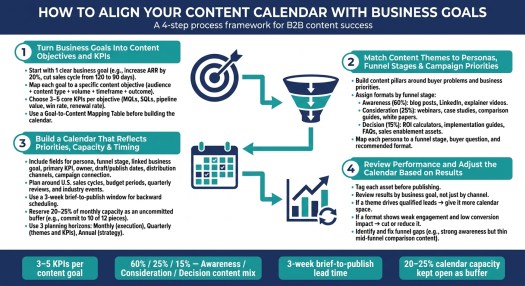
How to Align Your Content Calendar With Business Goals: A 4-Step Framework
The Complete Guide to Planning Your B2B Content Calendar for the Year
sbb-itb-0bbf42a
Step 1: Turn Business Goals Into Content Objectives and KPIs
Start with one clear business goal before you build the calendar. Maybe that means increasing new ARR by 20%. Maybe it means cutting the average sales cycle from 120 days to 90 days. Either way, start there. Everything else comes after that.
Map Each Business Goal to a Content Objective
A business goal tells you where the company needs to go. A content objective spells out how content helps get it there. This is where many teams move too fast.
Say the goal is revenue growth. That can turn into a content objective like using B2B lead generation strategies to increase MQL volume from manufacturing decision-makers by 25% in Q4 through four SEO blog series and one gated industry report, tracked by form fills and lead scoring. If the goal is retention, the content objective might be publishing two customer education pieces per month – FAQs, onboarding guides, and training videos – to support product adoption and upsell, measured by usage rates and expansion revenue.
The best objectives are specific. They spell out:
- Audience
- Content type
- Volume
- Time frame
- Outcome
That level of detail keeps content from turning into random acts of publishing.
Choose KPIs That Reflect Business Impact
Page views can tell you that people showed up. They do not tell you whether content moved pipeline.
For B2B content, focus on KPIs tied to pipeline and revenue, like MQLs and SQLs generated, MQL-to-SQL conversion rate, content-influenced opportunities, pipeline contribution value, closed-won revenue, and sales cycle length. If the content is meant to help retention, shift the focus to renewal rate, expansion revenue, and product adoption metrics.
A good rule of thumb: stick to 3–5 core KPIs per content objective. Go past that, and reporting gets noisy fast. For pipeline growth, a tight set often works best: marketing-sourced pipeline value, opportunity creation rate, and win rate.
Secondary metrics like organic traffic or social impressions still have a place. They can help explain why something worked or didn’t. But they shouldn’t be the thing that decides whether it worked.
Use a Goal-to-Content Mapping Table Before Building the Calendar
Use the table to lock in the objective before assigning dates or channels. It pushes the team into the right conversation: business goal first, content second.
| Business Goal | Content Objective | Primary KPIs | Example Content Types |
|---|---|---|---|
| Increase Q1 pipeline by $500,000 from tech SMBs | Generate 150 MQLs from CTOs and COOs via thought leadership and gated content | MQL count, opportunity creation, pipeline value | Industry trend blog series, gated whitepaper, LinkedIn posts, case study |
| Reduce churn by 10% in existing accounts | Improve product adoption with monthly training content for admins | Feature usage rate, renewal rate, expansion revenue | How-to videos, onboarding email series, admin FAQs, customer webinars |
| Shorten the average sales cycle from 120 to 90 days | Deploy detailed case studies, implementation guides, and an FAQ library to reduce decision-stage friction | Opportunity age, close rate, opportunity-to-close conversion rate | Detailed case studies, implementation guides, FAQ library |
Once the table is approved, use it to schedule and run the calendar. Every topic, format, and publish date should tie back to a row in that table. That way, each asset exists for a reason – not just to fill an empty spot on the schedule.
Next, match those objectives to personas, funnel stages, and campaign priorities.
Step 2: Match Content Themes to Personas, Funnel Stages, and Campaign Priorities
Now that the goal-to-content mapping table is in place, the next step is to decide what actually belongs on the calendar. Use that table as a filter. It should help you decide which buyer problems, personas, and funnel stages deserve space, based on business goals rather than guesswork.
Build Themes Around Buyer Problems and Company Priorities
A content pillar is a core theme linked to a buyer problem and a business priority. Each pillar should support one priority from the goal-to-content map and tie straight to a service line, product category, or target vertical. Common pillars for B2B teams include operational efficiency, risk reduction, cost control, and scalable growth.
Here’s the practical part: a pillar isn’t just a topic bucket. It gives your team a way to turn one business focus into multiple assets for different audiences. A cybersecurity firm, for instance, could take a risk-reduction pillar and turn it into blog posts on compliance risks, webinars on solution approaches, and one-page decision briefs for final approval discussions. That keeps the plan tight while still making each piece useful to a specific segment.
One planning rule is worth spelling out: prioritize pillars by revenue potential and audience urgency, not by what feels easiest to produce. If your highest-value service line doesn’t show up in your top themes, the calendar may look active, but it won’t be aligned with the business.
Once the pillar is clear, the next step is to choose formats that align with buyer intent at each stage.
Assign Formats by Stage of the Buyer Journey
Format choice should follow intent. Early-stage buyers need education, so awareness content usually works best in the form of blog posts, LinkedIn posts, explainer videos, and checklists. In the middle of the funnel, buyers are weighing options. That’s where webinars, case studies, comparison guides, white papers, and expert interviews tend to matter most. Webinars and case studies often do well here because they help answer tougher evaluation questions.
At the decision stage, the goal shifts. Now the job is to remove friction and help buyers make the case inside their company. That makes solution pages, ROI calculators, implementation guides, FAQs, and sales enablement assets strong choices.
A common mistake? Teams put too much weight on decision-stage content and leave awareness and consideration too thin. Strategic guidance often recommends putting about 60% of content effort into awareness, 25% into consideration, and 15% into decision content because that’s where buyers spend most of their self-directed research time.
Before you assign dates, it helps to sanity-check the mix with a simple matrix.
Compare Formats and Funnel Fit With a Planning Table
Before locking content into calendar slots, map each persona to a funnel stage, a buyer question, and the best format. This makes gaps easy to spot. Maybe there’s no mid-funnel asset for technical evaluators. Maybe finance has nothing built for the final approval step. Those holes are easier to fix here than after production starts.
| Persona | Funnel Stage | Buyer Question | Recommended Format | Production Effort | Business Value |
|---|---|---|---|---|---|
| Executive buyer | Awareness | “What’s the business risk of not acting?” | LinkedIn thought leadership post, trend blog | Low | Brand authority |
| Technical evaluator | Consideration | “How does this integrate with our current stack?” | Webinar, technical comparison guide | Medium–High | Reduces sales friction |
| Operations stakeholder | Consideration | “How will this affect our team’s daily workflow?” | Implementation guide, how-to article | Medium | Supports adoption |
| CFO / Finance lead | Decision | “Can we justify this investment internally?” | ROI calculator, case study | High | Drives conversion |
| End user | Post-purchase | “How do I get the most out of this?” | Onboarding video, FAQ, training guide | Medium | Improves retention |
This table doesn’t replace the calendar. It shapes it. Every item you schedule should tie back to a persona, a stage, and a business purpose. From there, you can build the calendar around team capacity and timing.
Step 3: Build a Content Calendar That Reflects Priorities, Capacity, and Timing
With your themes, formats, and funnel stages mapped, the calendar turns into your execution plan. This is where earlier decisions start to show up in the work itself.
Use the goal, persona, and funnel-stage mappings from the earlier steps to decide what makes the cut. A calendar only helps if it matches what your team can actually produce, not what sounded good in a planning meeting.
Include the Fields That Show Business Alignment
A good calendar does more than show publish dates. It shows why each piece exists and which business goal it supports.
Each entry should include:
- Content title
- Format
- Target persona
- Funnel stage
- Linked business goal
- Primary KPI
- Owner
- Draft due date
- Publish date
- Distribution channels
- Campaign connection
Those fields make it much easier to see whether a piece supports awareness, lead generation, pipeline, or retention, instead of just filling an empty slot.
The campaign connection field also simplifies ownership and reporting. Label high-value assets, like launch materials, cornerstone thought leadership, and conversion-stage content, as Tier 1. Everything else can sit in a supporting or reactive tier.
Once those fields are in place, timing becomes the next lever. You want content to line up with buying windows and campaign launches, not drift around them.
Plan Around U.S. Sales Cycles, Budgets, and Industry Events
Schedule content around budget cycles, buying windows, and industry events. For U.S.-based B2B companies, that usually means planning around fiscal-year periods, quarterly business reviews, trade shows, seasonal slowdowns, and post-event follow-up windows.
If buyers lock budgets in Q4, publish comparison content and ROI-focused case studies before that period. That timing matters. Great content published too late can miss the moment.
Industry events need their own layer on the calendar. One conference can easily support three separate assets:
- A pre-conference thought leadership piece
- In-event social coverage
- A post-event follow-up email sequence
That’s one moment, stretched across multiple touchpoints. Use a three-week brief-to-publish window as your baseline for backward scheduling.
It also helps to leave room for the unexpected. Reserve 20–25% of monthly capacity as an uncommitted buffer. So if your team produces 12 pieces per month, commit only to 10 in advance. That extra space gives you room for urgent requests or reactive content without throwing the whole plan off track.
Choose the Right Calendar Structure for Your Team
The right setup depends on team size and how many channels you’re running. For small to mid-sized B2B teams, a single master calendar usually works best. It gives everyone one source of truth and makes campaign coordination and priority management much easier.
A simple structure splits planning by time horizon:
| Planning Horizon | Focus | Typical Decisions |
|---|---|---|
| Monthly | Execution | Publish dates, promotions, campaign assets, owner assignments |
| Quarterly | Themes & KPIs | Core themes, campaign launches, funnel mix, KPI targets |
| Annual | Strategy | Business initiatives, major events, budget cycles, seasonal opportunities |
Larger teams with dedicated channel specialists may want separate channel calendars. That can work well, but those calendars should still roll up into a master view so leadership can track workload and priorities across the full content mix.
Once the calendar is live, review performance by goal and adjust the mix as priorities shift. With the calendar built, the next step is to measure which pieces actually moved the business goal.
Step 4: Review Performance and Adjust the Calendar Based on Results
A content calendar only works if you keep checking the results and feeding what you learn back into the plan. Once the calendar is live, measure performance against the goals it was built to support.
Review Content by Goal, Not Only by Channel
Don’t look at performance only by channel. Review it by business goal too.
Tag each asset before it goes live. Then group the results by goal so you can see which themes bring in qualified leads, help sales conversations, or affect pipeline.
This matters because channel metrics can hide the bigger picture. Goal-based reporting makes those gaps easier to spot.
Make Specific Calendar Changes From Performance Data
Use what you find to adjust the next publishing cycle. Data reviews only matter if they lead to clear calendar changes.
If a theme keeps driving qualified leads, give it more space on the calendar. If a format gets weak engagement and has little effect on conversions, cut back on it or stop using it.
Look for funnel gaps as well. For example, maybe awareness content is doing well, but mid-funnel comparison pieces are thin. That’s not just a content issue. It’s a calendar problem. Move budget and team time toward the topics and formats that have more impact on the pipeline.
Conclusion: Keep the Calendar Tied to Strategy as Goals Change
Start with business goals. Turn those goals into content objectives and KPIs. Match themes and formats to personas and funnel stages. Build a calendar your team can actually follow. Then review results on a set cadence.
Business goals change all the time. New products launch, target markets shift, and sales priorities move. When that happens, the calendar needs to move too. Regular content audits and strategy check-ins can help you stay on track before the plan starts drifting.
If your team needs help putting this into action, WSI Smart Web Marketing works with small to mid-sized B2B companies on strategy-first content planning, Fractional CMO services, and AI-informed marketing tied to measurable business results.
FAQs
How do I choose the right business goal first?
Start by auditing your existing content to spot recurring themes. Then talk with your sales and customer success teams to hear the problems prospects deal with day-to-day.
Once you have those insights, turn them into SMART goals: specific, measurable, achievable, relevant, and time-bound. The key is to tie those goals to business results, such as pipeline growth or larger deal sizes, rather than vanity metrics like traffic.
What if my team has limited content capacity?
Focus on high-relevance, value-driven content instead of chasing volume. The goal isn’t to publish nonstop. It’s about publishing content that aligns with your business goals and gives people a clear reason to pay attention.
A smart way to do that is with a pillar-cluster model built around three to five core themes. That keeps your content focused instead of scattered all over the place.
It also helps to audit what you already have. In many cases, your next strong piece doesn’t need to start from scratch. You may be able to repurpose an older article, webinar, case study, or sales asset into something new and useful.
And when you measure results, skip vanity numbers. Look at metrics that show business impact, such as lead quality and pipeline growth.
How often should I review and adjust the calendar?
Review your content calendar quarterly to keep it aligned with business goals.
Between those reviews, watch data trends and customer insights so you can make small course corrections as needed. It also helps to hold weekly marketing and sales check-ins to review performance and ensure your content still speaks to what buyers need.
The post How To Align Content Calendars With Business Goals appeared first on Smart Web Marketing.