

I was on a Zoom call a few weeks ago where we were talking about sales and one of the hosts of the meeting said, “I don’t know about you guys, but I don’t have people coming to me saying, ‘Here, take my money’.” But as I thought about it, I realize I kind of do have prospects coming to me ready to buy.
Don’t get me wrong. I have still had to learn how to have a good sales conversation and overcome objections. It’s something I’m constantly working on, but there’s no denying that having great content makes those conversations so much easier.
For example, one of the easiest sales conversations I ever had was with someone who had been following my newsletter for a few months. Because she had been reading my blogs and emails, she already understood what I do and the value I provide. She also knew the benefits of blogging more frequently because she had read about it in one of my blog posts. She upsold herself. All I had to do was tell her the pricing and we were able to get straight to talking about contracts.
So I get confused when I hear salespeople trashing marketing people and vice versa. It’s not an either/or situation. When marketing is at its best, it should be supporting sales.
To understand the animosity, let’s start by defining the differences between sales and marketing.
Table of Contents
- What Is Sales?
- What Is Marketing?
- Relationship Building
- Marketing Funnel vs Sales Funnel
- Using Marketing Content in the Sales Process
- The KLT Factor
What Is Sales?

Sales is the process of getting a prospect to buy your product and/or service. It usually involves at least a phone call. Sometimes multiple phone calls, and maybe an in-person meeting or a meeting over Zoom.
It involves building a much more personal connection with the prospect. A good salesperson doesn’t harass their prospects into buying from them. They ask them questions that reveal the prospect’s pain points, as well as how they think about those pain points.
All this allows the salesperson to present a solution in a way that directly addresses those pain points and uses language the prospect themselves use. That ensures, not only that they’ll understand the offer, but that it will resonate with them, even if they can’t put their finger on what it is about the offer that makes it so appealing.
As catchy as the ABC slogan from Glengarry Glen Ross is, a good salesperson is not always closing. A lot of their time is spent identifying and qualifying leads.
In some cases, a lot of their time is also spent educating leads. Someone who might be a good prospect might not understand the value of what is being offered, in which case they need to be educated before they’re ready to buy. That process can take hours.
That said, a lot of salespeople get paid on commission, meaning they only get paid (or they get a significant bonus) when they sell something for their employer. If you’re like me and you own your own business, you don’t get paid at all until you make a sale.
What Is Marketing?

At networking events, I always start my 30-second intro by saying, “I help high-quality leads find you so you don’t have to go out and hunt them down.” When marketing is done right, that’s exactly what happens, and who doesn’t want that?
While sales can often be traced back to a good marketing campaign, it’s rarely as simple as “Someone read my blog post on this topic and then they became a client,” although that does happen on occasion.
Usually it’s more like someone finds your website and reads 5-7 blog posts, maybe your About page and/or a page about a specific product/service, then they either click “buy” or reach out to have a conversation.
Or they could be like my client in the example I provided at the beginning of this article. Maybe they saw you speak at an event, went to your website to learn more about you, subscribed to your newsletter, and kept reading your updates until they were ready to become a client. Then they reached out for a conversation.
Then the salesperson gets all the credit for making that sale after the marketing department did all the heavy lifting.
This is why it’s so important to track the traffic on your website. While Google Analytics can tell you how many people visited your website or certain pages, other tools, such as Hubspot, can help you track each, individual user.
That means you can see if someone read your blog post about what to do with your kids’ college fund if you’re getting divorced, then read your article on what to do with your retirement fund if you’re getting divorced, then read 3-5 other blog posts before reaching out to you. You’ll be able to see each and every page and blog post they visited before scheduling their consultation, which allows you to see which pieces of content are doing the most work to help you grow your business. It also gives you a good idea of what their pain point is, which allows you to skip a big part of the sales conversation.
Relationship Building
While salespeople need to be good at building relationships in person, and often one-on-one, marketing is all about building brand recognition, which is a form of relationship building on a broader scale. They have to build an audience, then get that audience to know, like, and trust them, then encourage them to reach out to become a client.
The reason marketing isn’t considered as sexy as sales is it can be harder to define success. Someone read your blog post! Great! How much did they invest in your products/services as a result? Nothing? What are you good for?
As I said, if you’re tracking all the traffic to your website, you can usually place a value on each piece of content, but for the most part, we marketers tend to measure success in terms of things like “impressions” and “clicks.” A lot of people don’t even know what that means, much less how it can help their bottom line. (By the way, if you want a full list of marketing metrics and what they all mean, you might want to check out this article.)
Marketing Funnel vs Sales Funnel
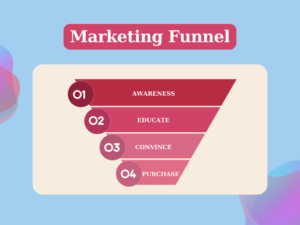
A lot of people talk about the marketing funnel and the sales funnel, but what does that really mean?
The marketing funnel starts with people becoming aware of your brand, it generates interest, builds on that interest, and generates enough demand that the prospect reaches out for a consultation.
That’s where the sales funnel begins. Now, for someone without a solid marketing strategy, the sales funnel starts with a cold call. They have to explain who they are and why they’re calling, and they leave a lot of voicemails and they get hung up on a lot.
But when the marketing funnel leads into the sales funnel, your salespeople get to skip a few steps. They’re already aware of who you are and what you do, and they’re already interested enough to initiate a conversation with you. All the salesperson has to do at that point is ask a few questions about what prompted them to reach out, then they can make their offer.
Using Marketing Content in the Sales Process
Sometimes you talk to a prospect and they’re just not ready to buy yet. Sometimes they’ll never be ready to buy and they just tell you they’re not ready at this time because they’re trying to let you down easy. Other times they really don’t have a need (or the budget) for your products/services now, but they will in the future.
Firstly, this is where a newsletter is invaluable. Ask if they’d be interested in subscribing to your newsletter, and if they say yes, you can send them relevant content on a regular basis. Not only does that help keep you top of mind, it also continues to educate them about the value you provide and why they should buy from you rather than one of your competitors.
Secondly, we’ve all had to send follow-up emails that end up sounding something like, “Hey, we talked a few weeks/months ago about the benefits of XYZ. Just wanted to check in and see if you’re any closer to making a decision. Please don’t hesitate to let me know if you have any questions.”
Boring, right? You’re trying not to sound like you’re harassing them, but because you’re not providing value or doing anything to further the relationship, you still end up sounding like you’re harassing them.
What if, instead, you could say something more like, “Hey, we talked a few weeks/months ago about your challenges with putting money aside for your kids’ college fund. Here’s an article we wrote about the different options, including the pros and cons that come with each one. If you have any questions, I’m always happy to hop on a phone call to answer them for you.” You include a link to the article in the email and now you don’t sound like you’re desperate to make a sale. You sound like you’re interested in the problem they’re trying to solve and you’re committed to helping them solve the problem, with or without you.
I also love providing links to my blog posts when I get a question I’ve been asked a million times. Rather than writing out a whole email about what I think of AI writing tools for the hundredth time, I could just say, “I’m glad you asked. I covered that topic in this blog post.” Done.
The KLT Factor

Whether you’re in marketing or sales, you’ve probably heard that people prefer to work with those they know, like, and trust — what I like to call the KLT factor.
There are a lot of ways you can earn the KLT factor from your prospects. In sales, you tend to earn it with each lead individually as you have a conversation with them, and in that conversation, not only learn about their pain points, but explain to them the value you provide and why they should want to work with you over someone else.
Marketing’s goal is also to build the KLT factor, but on a much larger scale. We are trying to build an audience and then get every member of that audience to know, like, and trust us. Then we send them over to the sales team, who had better be ready to take down their payment information because we worked hard to warm up those leads for you. All you have to do is convince them to take that final step in the buyer journey.
If you want to learn more about how content can support sales, sign up for our upcoming webinar, which is diving deep into that very topic.
If you found this content useful and would like to have more like it sent straight to your inbox, you can sign up for our newsletter in the space below. You can also see what we’re up to by following us on LinkedIn, and YouTube.
(function() {
window.mc4wp = window.mc4wp || {
listeners: [],
forms: {
on: function(evt, cb) {
window.mc4wp.listeners.push(
{
event : evt,
callback: cb
}
);
}
}
}
})();
The post Marketing vs Sales: Why They Work Better Together first appeared on AV Writing Services.