
Some people watch the Super Bowl for the game. Others for the half-time show. And some for the commercials. We started our team meeting with “tell us your favorite commercial.”
In my marketing circles, they are reviewing all the commercials. In my privacy and security circles, people were talking about Ring’s 30-second spot for its new “Search Party” feature.
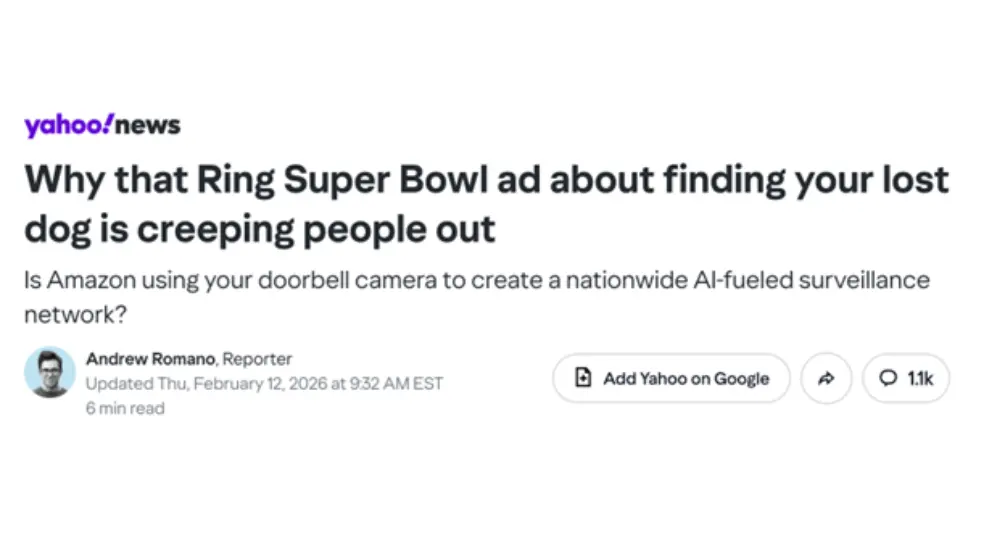
The Ring Ad That Turned Heartwarming Into Alarming
A sad child. A missing dog named Milo. A neighborhood of Ring cameras working together to bring him home. Ring founder Jamie Siminoff appearing on screen to say, “The way we look for them hasn’t changed in years until now.”
The ad was designed to be feel-good. For many people, it was the opposite, and now this ad is all the talk post Super Bowl.
Here’s how Search Party actually works.
When someone reports a lost dog in the Ring app, every nearby outdoor Ring camera that has the feature enabled uses AI to scan its saved footage for a visual match. If a camera thinks it’s found something, the camera’s owner gets a notification and can choose whether to share the clip. Ring says the search is temporary, expiring after a few hours unless renewed, and that nothing is shared automatically.
So far, so reasonable. Ring also reports that the feature has helped reunite more than one dog a day with their family since launch, and the company is donating $1 million to more than 4,000 U.S. animal shelters to expand the program.
The intent is genuinely good – use new technology to improve reuniting pets with their families. As a dog owner, I would want to find my lost dog and help others find theirs too. As a privacy pro, I also want to ensure that the people that show up in the ring camera feeds are protected.
The first issue is that it was turned on by default.
Search Party is automatically enabled on compatible outdoor Ring cameras enrolled in a subscription plan. Ring owners who don’t want to participate have to actively find the setting and turn it off. That opt-out default means millions of cameras joined this AI-powered neighborhood surveillance network without their owners making a conscious choice.
The second issue is that it raised a question nobody at Ring seemed prepared for.
As one social media user put it plainly: “If they can do this to find a dog, they can do this to find anyone.” Why are people concerned? In 2022, as stated in this Electronic Frontier Foundation (EFF) article, Ring reported that police departments had obtained emergency access to Ring footage without owner permission or a warrant. Ring later ended that practice.
But last October, Ring announced new partnerships with Flock Safety, which makes automated license plate readers and sells access to law enforcement, and Axon Enterprises, whose product line includes tasers and body cameras.
Privacy and civil liberties advocates, including the Electronic Frontier Foundation, called on Ring to drop the Flock partnership amid concerns that local law enforcement agencies had shared Flock network access with ICE.
Ring has since cancelled its Flock partnership, announcing the decision just after the Super Bowl backlash.

The company has also maintained that Search Party “is not capable of processing human biometrics” and that it has “no partnerships with ICE or any other federal agency.”
Its “Familiar Faces” facial recognition feature, Ring says, is separate from Search Party and requires users to opt in.
Why didn’t they choose to make Search Party also opt-in?
This is where IoT devices are confusing and complicated to consumers. Consumers who might use Familiar Faces would have expected that Search Party would have been opt-in as well; not default opt-out.
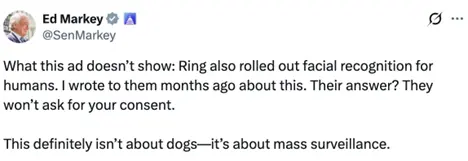
U.S. Senator Ed Markey (D-Mass.), long known for advocating for children’s privacy protections and sponsor of several privacy bills, weighed in on social media:

This Is a Listening Problem
I write constantly about listening to customers. Here’s what I believe:
Customers buy the products (they are the revenue).
Customers don’t like to be surprised and alarmed.
Customers shouldn’t have to hunt for opt-outs.
Customer perspective should be the center of every decision.
Ring built something technically impressive that genuinely helps people find lost pets. But by defaulting Search Party to “on” and advertising it during the most-watched television event of the year, they handed critics the perfect stage.
The backlash didn’t come from people who oppose technology or who wouldn’t want to find their lost dog. It came from customers who reasonably asked: who decided I was part of this, when did I agree, and why is it default opt-in?

People don’t generally like default opt-in (and next week I’m going to dive deeper into this pattern of big tech companies continuously doing just this (and angering customers)..
The Takeaway
Perform privacy risk assessments (and trying to avoid situations like this is why they are required under various laws like CCPA). Now is a really great time to remind the business just how important these really are. It’s not a paper exercise. Its entire purpose is to review the privacy risks and how to mitigate them.
Consider customer feedback.
Make privacy the default.
Make control easy to find and manage.
Some of you reading this are trying hard to advocate for privacy, and sometimes the business pressure to innovate, release a new product, or revenue wins without the privacy controls you’re pushing for.
I encourage you to use this example in your next presentation or meeting to explain what happens when privacy isn’t considered. It doesn’t make for a winning new release. It makes for negative PR and unhappy customers (and maybe even regulatory investigations, which only those behind closed doors would know about).
The companies that build lasting customer relationships in the AI era won’t be the ones who harvest the most data. They’ll be the ones who make customers feel like partners in how that data is used and not raw material for the next product launch.
What opt-in by default technology have you seen that has you frustrated? Reply and let me know, and I’ll feature it next week (and of course, your name is optional to be included!)
Wishing you a great week!
Jodi
 When you’re ready, here’s how we can help:
 Privacy Advisory & Implementation: We help companies navigate privacy requirements with confidence. Our advisory support covers strategy, operations, and real-world implementation.
 Fractional Privacy Services: We provide fractional privacy leadership tailored to your needs and pace. From program development to day-to-day support, we help you build and sustain a strong privacy program.
The post What Ring’s Super Bowl Ad Taught Us About Privacy appeared first on Red Clover Advisors.