
For what seems like eternity, leadership teams have spent enormous energy optimizing their sales pipelines.
But a new benchmark suggests we may be optimizing the wrong part of the buyer’s journey.
According to the 2026 LinkedIn Ads Benchmark Report, 81% of the B2B customer journey now happens outside the sales pipeline.
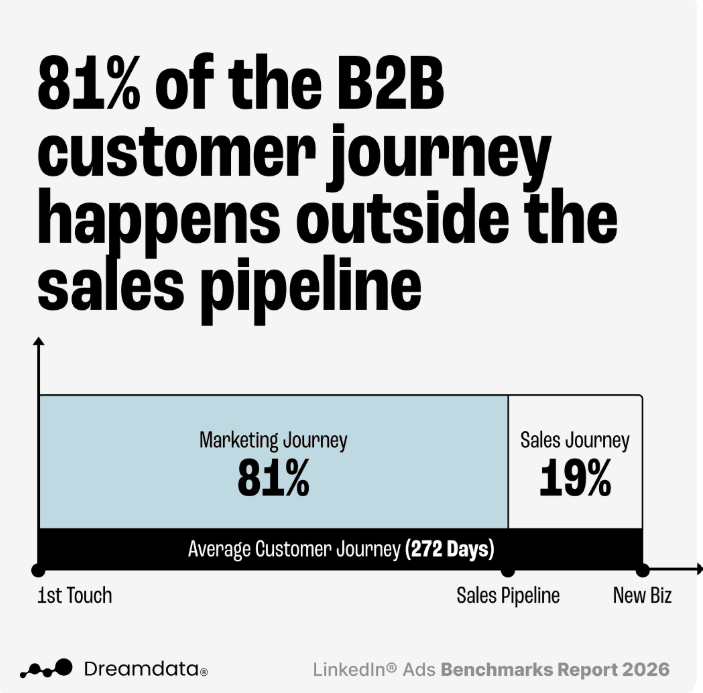
That means the majority of the purchase decision is already being shaped before a buyer ever speaks with sales.
Not during the demo.
Not during pricing conversations.
Not during procurement.
Long before buyers engage with the sales team or any formal sales process begins, they are spending months researching, validating, and forming opinions about companies that can solve their problem. The average B2B buying journey now spans 272 days. LET ME SAY THAT AGAIN – 272 DAYS!
During that time buyers are:
• researching vendors through AI and search
• reading reviews and analyst commentary
• consuming thought leadership
• watching product walkthroughs
• validating credibility with peers
By the time they enter your pipeline, many buyers already believe they understand the problem, the solution, and which companies are worth considering.
Sales still matters enormously.
BUT, the context for the conversation has already been set.
And that context is largely shaped by marketing.
The Leadership Challenge this Creates
Many organizations still operate with a fragmented go-to-market structure.
Marketing runs campaigns.
Sales runs pipeline.
Customer success runs retention.
But buyers experience companies as one continuous journey.
When those functions are not aligned, friction shows up quickly:
• messaging that doesn’t match the sales conversation
• expectations that don’t match the product experience
• brand promises frontline teams cannot consistently deliver
In fact, research across thousands of companies shows that misalignment across go-to-market teams can create 15–25% growth drag.
The issue is rarely effort.
The issue is that the growth system itself is misaligned.
What High-Growth Companies are Doing Differently
The companies adapting fastest to this shift have stopped thinking about marketing as a department.
They treat growth as a system that must be designed and aligned across:
• brand strategy
• customer insight
• go-to-market execution
• sales enablement
• customer experience
• employee behaviors
When those elements align, growth becomes far more predictable.
When they do not, companies spend more to acquire customers (higher CAC) and struggle to retain them (higher churn).
Bottom Line
If 81% of your customers’ buying journey happens before sales, the real question is this:
Is your organization designed for how buyers actually buy today?
Because many companies are still optimizing the last 19% of the journey while ignoring the first 81%.
Need help optimizing your marketing investment to deliver a capital-efficient revenue engine that drives growth?
That is the work we focus on at Britton Parris Marketing & Communications, helping growth-stage B2B companies align brand strategy, go-to-market execution, and customer experience so growth becomes more predictable.
If you’d like to continue the conversation, you can reach me directly at
hello@brittonparris.com or Calendar.