
Before you can forecast, budget, or scale, your financial systems need to be clean, consistent, and trustworthy. Here’s where to start.
Ask yourself one question: can you analyze the gross margin of each of your revenue line items in under five minutes? If the answer is no, your financial foundation needs work. And that’s where everything else begins.
A lot of business owners jump straight to the exciting parts of strategic finance: forecasting growth, tracking KPIs, making bold investment decisions. But those things only work when the underlying financial infrastructure is solid. Without it, even the best analysis is built on shaky ground.
Step One of the strategic finance framework is about getting the basics right. That means three things: a clean chart of accounts, accrual-based accounting, and a disciplined monthly close process. None of these are glamorous. But all of them are non-negotiable.
Your chart of accounts is your financial backbone
A chart of accounts (COA) is simply a structured list of every financial account your business uses to track transactions. Think of it as the filing system for your entire financial operation. When it’s well-organized, pulling any report or doing any analysis is fast and reliable. When it’s a mess, everything downstream suffers.
The most common chart of accounts problems we see in growing businesses are over-complexity and inconsistency. Too many line items. Duplicate categories with slightly different names. Expenses coded in the wrong buckets. These issues compound over time and make it nearly impossible to get a clean read on the business.
Every chart of accounts should be organized into five core categories: assets, liabilities, equity, revenue, and expenses. Within those, assign a standard numbering system for scalability — assets running from 1000 to 1999, liabilities from 2000 to 2999, and so on. The goal is consistency, not complexity.
Two questions to audit your COA right now
- How many line items do you have for salary and wages? If it’s more than one, you need consolidation.
- Are you tracking different types of office supplies across separate categories? That’s unnecessary complexity that quietly distorts your reporting.
Beyond initial setup, your chart of accounts needs regular maintenance. At minimum, conduct an annual review to merge duplicates, eliminate unused accounts, and ensure naming conventions are standardized throughout. A COA that made sense two years ago may not reflect how your business operates today.
One often-overlooked step is making sure your COA structure aligns with how you budget and forecast. If your expense categories don’t match your budget line items, you’ll never be able to do a clean comparison of planned versus actual performance. That alignment matters more than most business owners realize.
Why accrual accounting changes everything
Here’s a telling symptom: if your gross margin fluctuates significantly from month to month even though you’re selling the same product or service at the same price, there’s a good chance you’re not using accrual-based accounting. And that inconsistency makes it almost impossible to understand what’s actually happening in your business.
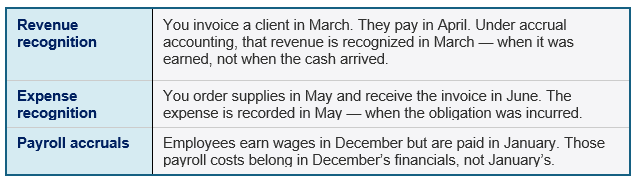
Accrual accounting records revenue and expenses when they are earned or incurred, not when cash changes hands. That distinction is critical. It means your financial statements reflect economic reality rather than the timing of your bank transactions.
.tatsu-By_YU-NaWg .tatsu-single-image-inner{border-style: solid;max-width: 100%;}.tatsu-By_YU-NaWg.tatsu-single-image{transform: translate3d(0px,15px, 0);}
When revenue and expenses are matched to the same period, your margins become meaningful. You can actually compare one month to another. You can spot trends. You can identify where costs are creeping up relative to revenue. Without accrual accounting, none of that analysis is reliable.
The monthly close: A discipline that pays dividends
Even with a clean chart of accounts and proper accrual accounting, none of it matters if your books aren’t closed in a timely, consistent way each month. Delays in the close process mean delays in visibility. And delayed visibility means decisions get made on stale data.
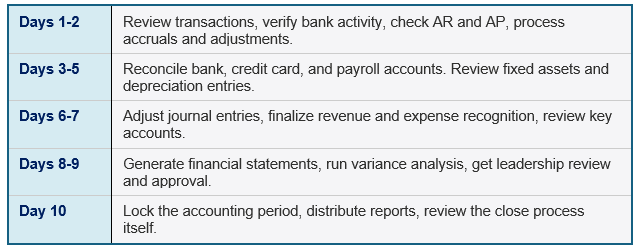
A well-run month-end close should take no more than 5 to 10 days, depending on the size and complexity of the organization. The process follows a clear sequence:
.tatsu-Hkhv9fK6Zx .tatsu-single-image-inner{border-style: solid;max-width: 100%;}.tatsu-Hkhv9fK6Zx.tatsu-single-image{transform: translate3d(0px,18px, 0);}
That last step matters more than most teams give it credit for. Reviewing the close process itself, not just the financials it produces, is how you continuously improve the speed and accuracy of your reporting over time.
Your financial foundation makes everything else possible
It might be tempting to skip ahead to the more dynamic parts of strategic finance. But every subsequent step in the framework depends on what gets built here. Your KPIs are only meaningful if the underlying data is clean. Your budget is only credible if your historical financials are accurate. Your forecast is only trustworthy if your accounting method properly matches costs to revenue.
This foundation work is also what separates companies that can raise capital or sell at a premium from those that can’t. When an acquirer or investor looks at your books, the first thing they’re evaluating is whether they can trust the numbers. Clean, consistent, well-organized financials signal a well-run business. Messy financials signal risk.
Getting this right isn’t complicated. It’s disciplined. And discipline, applied consistently over time, is what separates companies that plateau from those that grow.
Want the full framework?
Download the Embarc Advisors Strategic Finance Playbook for the complete 7-step process, including templates, best practices, and real-world examples to help you build a finance function that drives growth.
Ready to pursue breakthrough growth?
.tatsu-row > .tatsu-i4xrrohw9w3kdzbg.tatsu-column{width: 100%;}.tatsu-i4xrrohw9w3kdzbg.tatsu-column > .tatsu-column-inner > .tatsu-column-overlay{mix-blend-mode: normal;}.tatsu-i4xrrohw9w3kdzbg > .tatsu-column-inner > .tatsu-top-divider{z-index: 9999;}.tatsu-i4xrrohw9w3kdzbg > .tatsu-column-inner > .tatsu-bottom-divider{z-index: 9999;}.tatsu-i4xrrohw9w3kdzbg > .tatsu-column-inner > .tatsu-left-divider{z-index: 9999;}.tatsu-i4xrrohw9w3kdzbg > .tatsu-column-inner > .tatsu-right-divider{z-index: 9999;}
.tatsu-i4xrrohw4v86lfrm .tatsu-section-pad{padding: 15px 0px 15px 0px;}.tatsu-i4xrrohw4v86lfrm > .tatsu-bottom-divider{z-index: 9999;}.tatsu-i4xrrohw4v86lfrm > .tatsu-top-divider{z-index: 9999;}.tatsu-i4xrrohw4v86lfrm .tatsu-section-overlay{mix-blend-mode: normal;}
The post How To Build a Financial Foundation That Actually Supports Growth appeared first on Embarc Advisors.