

Happy Mother’s Day to every mom, auntie, grandmother, and woman holding it down for their families, communities, and loved ones. This one’s for you. And yes, there’s a leadership lesson here too.
I’m grateful to still have my mom, and honestly, I think about her often when I think about leadership. Not because she had a title or sat in a corner office, but because she somehow managed to keep our household moving with intention and care, balancing schedules, emotions, logistics, personalities, and priorities for me, my brother, and my dad, often without recognition and definitely without a playbook.
She knew when to push and when to let things breathe. She knew which fires required immediate attention and which ones would burn themselves out if given time. She didn’t lead through chaos or constant reaction. She orchestrated.
And every time I speak to a founder of a growing company, I notice that there’s plenty of well-intended activity, but very little orchestration.
So today is dedicated to all the women who have been orchestrating all along, and to the companies realizing that sustainable growth requires orchestration too – aligning people and strategy, across the complex span of marketing capabilities to reach the next level.
What Marketing Actually Looks Like (It’s WAY More Than You Think)
Here’s something I’ve noticed after 25+ years across all functions of marketing. Most non-marketing executives carry a version of marketing “in their head” that looks something like: logo, website, social posts, and maybe some ads. Perhaps a content person or a marketing coordinator if things are going well.
And they’re not wrong that those things are components of marketing. However, they’re just missing about 90% of the picture.
Here is a more robust picture of what marketing actually entails.
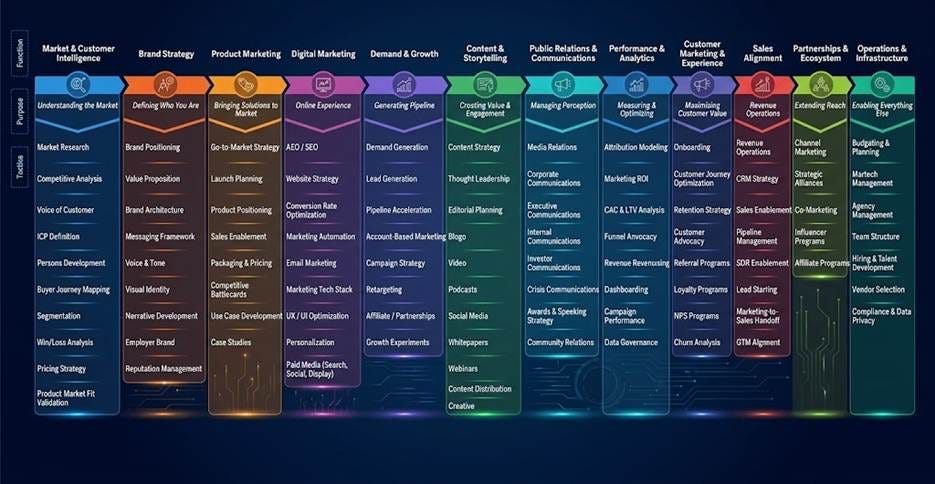
What you are looking at here isn’t a wish list. It’s the actual terrain of marketing. Twelve functions. At least ten tactics that sit under each one. And in every single one has its own timings, its own dependencies, and its own connection to the next thing in line.
Market research shapes brand positioning. Brand positioning drives go-to-market strategy. Go-to-market strategy fuels demand generation. Demand gen informs content. Content enables sales. Sales outcomes feed back into customer experience, which either validates or quietly erodes everything your brand promised to begin with.
Pull one thread wrong and the whole thing loses tension.
Here’s what I see at many mid-market companies. These functions get spread across different people, different agencies, different tools, and each one doing so in isolation with nobody at the front of the room saying, “this goes first, that waits, here’s where we’re headed.”
The result isn’t silence. It’s noise. Expensive, off-key noise that sounds vaguely like progress until you look at the numbers.
You do look at the numbers, RIGHT?
Let’s Be Real for A Second
You’ve put money into marketing. A website refresh. A campaign or two. Maybe a PR push. You’ve got people in seats, tools running in the background, reports coming in every week.
And still, growth feels harder than it should. Leads come in waves with no real pattern. The sales team is frustrated. You’re getting clicks that don’t convert. Customers show up with expectations your team can’t deliver on. Your cost to acquire is creeping up while the ROI stays flat.
If any of that sounds familiar, allow me to offer you something other than more tactics.
This is NOT a budget problem, and it’s not a team problem. It’s a sequencing problem, a leadership problem, and a strategy problem.
Here’s what’s actually happening:
-
Messaging is saying one thing, customer experience is delivering another
-
Paid ads are scaling before the positioning is sharp enough to convert
-
Content is being produced in volume with no connective narrative
-
Brand and sales motion are operating like they work for different companies
-
The whole team is measuring activity when what actually matters is outcomes
No single campaign fixes this. Because the problem isn’t the instrument or the tactic. It’s that no one (OR the wrong person) is conducting the orchestra.
It’s Hard in the Middle (Mid-Market That Is)
Here’s what makes this especially tough in the mid-market. You’re not a startup scrapping your first million, and you’re not an enterprise with a full marketing org and an eight-figure budget.
You’re in the growth zone, somewhere between $10M and $300M, with real customers, a real team, and real pressure to keep the trajectory moving. The decisions you make right now about positioning, acquisition, and growth are either going to compound into something durable or quietly plateau.
And having been a full-time CMO, I can tell you that a seasoned CMO who knows how to lead at this stage will cost you at least $350K a year plus equity, benefits, and a host of other things executives look for in comp packages.
So, what (or who) fills the gap? Usually, the CEO absorbs the strategy function on top of everything else. Or the best tactician on the marketing team gets promoted into a role that requires a different skill set entirely. Or you bring in a good agency, but agencies execute; they don’t lead.
And the orchestra keeps playing. Loudly. Without a conductor.
What is a Fractional CMO?
“Fractional CMO” has become one of those terms that means ten different things depending on who’s saying it. So let me clarify.
Fractional doesn’t mean part-time attention. It doesn’t mean junior support dressed up with a fancy title. It means full executive-level thinking and experience, the kind built from actually having sat in the CMO chair, led teams through real growth, navigated repositioning, survived market shifts applied to your specific business, at your specific stage, without the full-time overhead.
It means someone who leads. Not someone who just does.
In practice, this looks like:
-
Diagnosing before prescribing. Before a single tactic gets greenlit, the question is: where is growth actually leaking? What’s happening to CAC year-over-year? Where in the funnel are people disappearing? What does your positioning actually communicate, and is that what your buyer is hearing? Getting clear on those answers is often worth more than six months of campaigns.
-
Sequencing the right moves in the right order. This is the part that’s hard to explain until you’ve seen it done well. Should you shore up messaging before you scale paid ads? (ABSOLUTELY, yes.) Should you launch a new product line before your retention on the existing one is solid? (ABSOLUTELY, not.) The sequence matters enormously, and getting it right comes from having made those calls before and occasionally having gotten them wrong.
-
Bridging brand and operations. This is the gap that frequently kills growth at mid-market companies. Your brand makes a promise. Your team delivers the experience. When there’s daylight between those two things, customers feel it, they churn, they leave reviews that confuse your prospects, and they don’t refer. Closing that gap isn’t a brand project or an ops project. It’s both, led by someone who understands both.
-
Building systems that outlast the engagement. Campaigns are finite. Playbooks aren’t. A Fractional CMO who’s doing the job right isn’t creating dependency, they’re building repeatable systems, documenting strategy, and upskilling the internal team so the work compounds after they’ve scaled back.
-
Giving the CEO their focus back. This one doesn’t get said enough. When the CEO is also the de facto CMO, both roles suffer. Marketing decisions get reactive. Leadership attention gets scattered. A Fractional CMO who doesn’t need to be managed is one of the cleanest leverage moves a growth-stage founder can make.
The Part Founders Don’t Think About Until It’s Almost Too Late
If you’re thinking about an exit, or a raise, or PE interest at any point in the next few years, this section is for you.
Marketing isn’t just a revenue function. It’s a valuation function. And most founders don’t realize that until they’re deep into a transaction and someone’s asking questions they don’t have clean answers to.
From someone whose sat on the inside of the acquirer at a PE firm, here is what sophisticated buyers and investors look for:
-
Is your revenue predictable and repeatable? Pipeline that lives in the founder’s relationships or a single acquisition channel is a risk factor. It gets discounted. A fractional CMO builds the diversified demand infrastructure that makes revenue transferable and more valuable.
-
Is your brand positioned in a way that commands a premium? Vague, undifferentiated brands get valued like commodities. Sharp positioning in a defined market with a clear narrative and a distinct point of view carries a multiple premium. That work starts long before a transaction.
-
What does your unit economics look like? CAC, CAC payback period, LTV:CAC ratio these numbers tell the story of your business’s efficiency. A Fractional CMO optimizes them not just because it’s good marketing, but because it makes the financial profile of your company more attractive to capital.
-
What is your Net Retention Rate? High retention rates signal a healthy brand-to-experience alignment. Churn signals a gap. Acquirers model LTV deeply. A Fractional CMO who reduces churn is directly improving the revenue quality that drives your multiple.
-
Do you have documented marketing infrastructure? Buyers don’t just acquire your revenue they acquire your systems. Undocumented, founder-dependent marketing is a discount. A documented GTM playbook, measurement framework, ICP definition, and channel strategy? That’s a premium because it signals the business can run without you.
-
Do you have real brand authority in your market? Owned audiences, media presence, speaking platforms, and industry recognition carry intangible value that shows up in deal negotiations. It’s harder to build on a timeline. A Fractional CMO who thinks about brand authority alongside demand gen is building equity in both.
-
Is your team acquirable? Key-person risk cuts deal value. A Fractional CMO who builds team capability and documents repeatable processes reduces that risk which reduces acquirer risk, which improves your position at the table.
-
How does your pipeline look going into the process? The best exits happen when the seller controls the timing. A disciplined growth system, at least built 24 months before a transaction begins, lets you go to market with momentum, not just a story about what could be.
The Math, in Black & White
Let’s say your company is generating $20M in annual revenue.
A strong Fractional CMO might cost anywhere from $8,000 to $15,000 per month. Over the course of a year, that’s roughly a $96K to $180K investment.
Now imagine that engagement helps reduce customer acquisition costs by 20%, improves retention by even a few percentage points, strengthens positioning, and generates an additional $3M to $5M in attributable pipeline.
Then factor in enterprise value.
If your company exits at a 5X multiple, the downstream impact of stronger growth, better retention, improved operational alignment, and a more scalable go-to-market engine becomes exponentially more valuable than the original investment.
So the real question isn’t whether you can afford a Fractional CMO.
It’s how much longer you can afford to run the orchestra without one.
Bottom Line
The moms I know who are successfully raising families, leading professionally, and still protecting their own well-being understand something important:
they delegate.
They know when to bring in the right support.
They play the long game, even when the short game gets loud.
And they build systems that continue working, even when they are not in the room.
The best CEOs and founders I know operate the same way.
They understand that sustainable growth is rarely about doing more.
It’s about creating alignment, clarity, accountability, and momentum across the business.
So what would change if your marketing finally operated as one coordinated system instead of twelve disconnected efforts?
If revenue is not moving the way it should, there is usually a reason.