
Most businesses either track too little or drown in dashboards. Here’s a smarter approach, one that matches your metrics to where you actually are.
To improve, you need to know where you are now and where you want to be. That’s not a philosophy. It’s a measurement problem. And the tool for solving it is a set of key performance indicators that actually match the stage your business is in.
With a clean financial foundation and upgraded processes in place, Step Three of the strategic finance framework turns attention to measurement. This is where many businesses either undershoot, tracking only revenue and calling it done, or overshoot, building elaborate dashboards that nobody actually uses.
The smarter approach is to think about KPIs as a ladder. You don’t start at the top. You climb, adding layers of measurement as your business matures and your financial infrastructure can support them. Each level builds on the one before it, giving you a progressively sharper picture of what’s driving performance.
Level 1: The topline view
Every business starts here. Revenue is the first KPI: how much are we bringing in, and how fast is it growing? It’s the simplest possible read on the business, and for early-stage companies, it’s often the only one that matters.
But revenue alone is a limited lens. It tells you what’s coming in. It tells you nothing about what it cost to generate it, what’s left over, or whether the business is actually sustainable at its current trajectory. That’s where the next level comes in.
Level 2: Bottom line visibility
As the business grows and takes on more payroll, overhead, and operating complexity, the bottom line becomes impossible to ignore. Level 2 adds EBITDA and Seller’s Discretionary Earnings to the picture, giving owners visibility into profitability and the actual cash the business is generating for its shareholders.
This is the point where many owner-operated businesses stall. They know their revenue. They have a rough sense of profitability. But they don’t have the precision to understand why margins look the way they do, or what to do about it. That requires climbing to Level 3.
Level 3: Understanding unit economics
Gross margin is the defining metric at this level. It answers a question that sounds simple but has enormous implications: for every dollar of revenue, how much does it actually cost to deliver?
If a business is generating $1M in revenue, tracking gross margin tells you whether that revenue is being built on a sustainable foundation or whether the cost of delivery is quietly eroding profitability. Fluctuating gross margins, even when pricing hasn’t changed, often point to an accounting issue, a pricing problem, or an operational inefficiency that’s otherwise invisible at the topline.
Getting gross margin right is also what makes the next two levels meaningful. Without clean unit economics, the more granular metrics that follow are built on an unreliable base.
Level 4: Digging into the key financial metrics
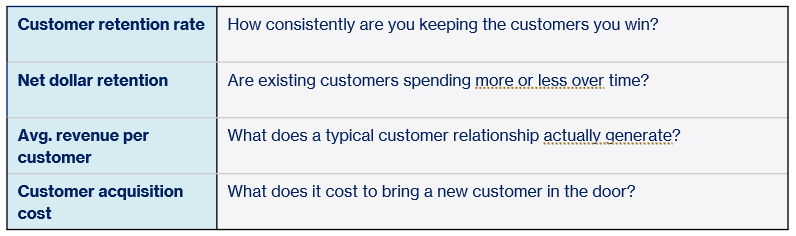
Level 4 is where the picture starts to get granular. Here, KPIs expand to include the customer-level metrics that reveal how effectively the business is acquiring, retaining, and monetizing its client base:
Key Level 4 metrics
.tatsu-By_YU-NaWg .tatsu-single-image-inner{border-style: solid;max-width: 100%;}.tatsu-By_YU-NaWg.tatsu-single-image{transform: translate3d(0px,30px, 0);}
These metrics don’t just describe performance. They diagnose it. A business with strong revenue but high customer acquisition costs and low retention has a fundamentally different problem set than one with stable retention but flat revenue per customer. Level 4 makes those distinctions visible.
Level 5: Understanding what drives the business
The most operationally mature businesses track a fifth layer: the leading indicators that explain why the Level 4 metrics look the way they do. If customer acquisition cost is too high, Level 5 tells you where in the funnel the problem lives. If revenue growth is stalling, Level 5 helps you pinpoint whether it’s a lead volume issue, a close rate issue, or a sales execution issue.
These operational and growth metrics typically include:

.tatsu-Hkhv9fK6Zx .tatsu-single-image-inner{border-style: solid;max-width: 100%;}.tatsu-Hkhv9fK6Zx.tatsu-single-image{transform: translate3d(0px,25px, 0);}
The discipline at this level isn’t just tracking these numbers. It’s connecting them to the financial outcomes above. When a business can draw a straight line from the number of proposals sent to revenue growth, or from utilization rate to gross margin, it has the kind of financial visibility that most companies only achieve after years of trial and error.
Start where you are, not where you want to be
The most important thing about the KPI ladder is that it’s a ladder, not a checklist to complete all at once. Jumping straight to Level 5 without clean Level 1 and 2 data is a recipe for noise, not insight. The metrics only become meaningful as the financial foundation beneath them matures.
The right starting point is wherever you are right now. If you’re only tracking revenue, that’s fine. Add EBITDA next. If you have solid topline and bottom line visibility, start digging into gross margin. Each step up the ladder gives you a sharper picture of your business and a clearer basis for the decisions ahead.
Ready to pursue breakthrough growth?
.tatsu-row > .tatsu-i4xrrohw9w3kdzbg.tatsu-column{width: 100%;}.tatsu-i4xrrohw9w3kdzbg.tatsu-column > .tatsu-column-inner > .tatsu-column-overlay{mix-blend-mode: normal;}.tatsu-i4xrrohw9w3kdzbg > .tatsu-column-inner > .tatsu-top-divider{z-index: 9999;}.tatsu-i4xrrohw9w3kdzbg > .tatsu-column-inner > .tatsu-bottom-divider{z-index: 9999;}.tatsu-i4xrrohw9w3kdzbg > .tatsu-column-inner > .tatsu-left-divider{z-index: 9999;}.tatsu-i4xrrohw9w3kdzbg > .tatsu-column-inner > .tatsu-right-divider{z-index: 9999;}
.tatsu-i4xrrohw4v86lfrm .tatsu-section-pad{padding: 15px 0px 15px 0px;}.tatsu-i4xrrohw4v86lfrm > .tatsu-bottom-divider{z-index: 9999;}.tatsu-i4xrrohw4v86lfrm > .tatsu-top-divider{z-index: 9999;}.tatsu-i4xrrohw4v86lfrm .tatsu-section-overlay{mix-blend-mode: normal;}
The post The KPI Ladder: How to Know What to Measure at Every Stage of Growth appeared first on Embarc Advisors.