
Gradius IT Solutions

IT Risk Assessment Services: The 2026 Executive Guide to Continuous Compliance
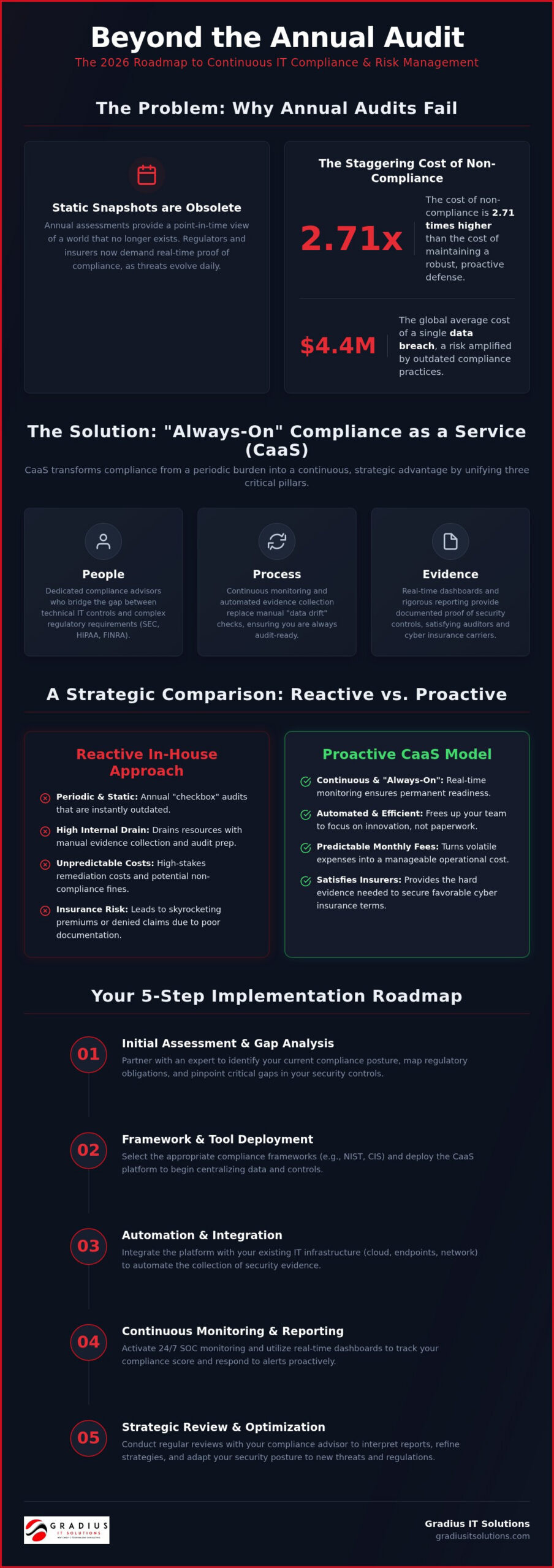
Your annual IT risk assessment isn’t a safety net: it’s a snapshot of a world that no longer exists. In 2026, relying on a once-a-year checklist to satisfy SEC or HIPAA requirements is like checking your mirrors once and driving the rest of the way blind. The stakes are clear. The cost of non-compliance is now 2.71 times higher than the cost of maintaining a robust defense. You feel the weight of manual evidence collection draining your best people, yet the fear of an audit failure or a $4.4 million data breach remains. It’s a relentless cycle that slows your operations and keeps you on the defensive.
We’re here to break that cycle. You deserve a framework where compliance isn’t a burden but a strategic engine for growth. This guide reveals how modern it risk assessment services transform your regulatory obligations into a high-performance advantage. We’ll show you how to move to an “always-on” audit posture, reduce business risk without hitting the brakes, and find a single accountable partner who treats IT and compliance as two sides of the same coin. Let’s stop reacting to threats and start outrunning them.
Key Takeaways
- Learn why traditional annual audits are obsolete in the 2026 threat landscape and how continuous assurance prevents insurance denials.
- Discover how modern it risk assessment services leverage the Compliance as a Service (CaaS) model to unify tools, experts, and evidence collection.
- Evaluate the financial advantage of predictable monthly fees over the volatile, high-stakes costs of manual audit remediation and internal resource drain.
- Get a clear 5-step implementation roadmap to move your organization from reactive panic to a state of “always-on” audit readiness.
- Understand the strategic value of a single accountable partner who integrates 24/7 SOC monitoring with real-time regulatory reporting.
The Evolution of IT Risk Assessment: From Checkbox to Continuous Assurance
The annual audit is a relic. It’s a snapshot of a moment that has already passed. In 2026, regulators like the SEC and FINRA don’t care what your security looked like six months ago. They care what it looks like right now. Reactive compliance is a gamble that costs 2.71 times more than a proactive strategy. If you’re still treating compliance as a once-a-year hurdle, you aren’t just risking a fine. You’re risking your reputation and your ability to stay insured. Modern it risk assessment services have evolved to meet this “always-on” demand. They provide the visibility needed to satisfy strict HIPAA updates and FINRA Rule 4370 requirements without slowing down your business operations.
To better understand how risk scores factor into your security posture, watch this helpful tutorial:
Why Static Assessments are Obsolete
Static reviews fail because the threat landscape moves at the speed of AI. Between audit cycles, your environment experiences “data drift.” New users are added. Cloud configurations change. Without continuous oversight, these small shifts create massive security gaps. Continuous assurance is the new gold standard. It replaces the “checkbox” with real-time monitoring and automated evidence collection. This shift ensures you’re always ready for an unannounced audit. It moves your firm from a state of periodic panic to one of permanent readiness. High-performance firms use it risk assessment services as a growth engine. When your compliance is automated, your team stops chasing paperwork and starts focusing on innovation.
The Hidden Impact of Non-Compliance on Cyber Insurance
Insurers have become the unofficial regulators of the IT world. They no longer accept simple “yes” or “no” answers on a renewal form. They want documented proof of your IT risk management protocols. If your risk documentation is inaccurate or outdated, you face two major threats: skyrocketing premiums or a denied claim after a breach. In 2026, the global average cost of a data breach has hit $4.4 million. You can’t afford to have your insurance carrier walk away because of a documentation error. Preparing for the current “Questionnaire Era” requires more than just a list of tools. It requires a Compliance as a Service approach that generates hard evidence of your security controls every single day. This proactive guardian approach positions your business as a premium, reliable force that stands firmly in the corner of your clients and partners.
What are IT Risk Assessment Services? Defining the CaaS Model
Modern it risk assessment services are more than just a vulnerability scan or a digital questionnaire. They represent a managed partnership that unifies automated tools, human expertise, and rigorous reporting into a single, accountable framework. This is the Compliance as a Service (CaaS) model. It’s built for executives who need to move beyond the “checkbox” mentality and secure their operations against real-world threats. While many vendors sell software-only (SaaS) solutions, these often fall short. Software can flag a problem, but it can’t explain the business impact or defend your choices to an auditor. A true CaaS model provides the “why” behind the “what.”
The foundation rests on three pillars: People, Process, and Evidence. Without all three, your compliance posture is a house of cards. A compliance-aware MSP doesn’t just manage your servers. They manage your risk profile. They ensure your technical stack aligns with your legal obligations, creating a seamless bridge between your IT budget and your regulatory requirements. This partnership model removes the burden of complexity from your shoulders, allowing you to focus on high-level strategy while your partner handles the technical heavy lifting.
People: The Role of the Dedicated Compliance Advisor
Technical IT teams focus on uptime. Regulatory auditors focus on rules. A dedicated advisor bridges this gap. Having a named expert who understands your specific environment is non-negotiable in 2026. They translate complex technical data into the language of risk that your board understands. This level of IT Consulting & Strategy Services ensures you aren’t just buying tools, but securing a proactive guardian for your firm’s future. They act as your advocate during audits, providing the professional confidence needed to satisfy even the most rigorous inquiries.
Process: Framework-Specific Expertise (HIPAA, SEC, FINRA)
Your risk assessment must be as unique as your industry. A generic approach leads to wasted effort and overlooked vulnerabilities. High-performance it risk assessment services tailor their methodology to specific frameworks. Whether you’re managing SEC disclosure timelines or HIPAA patient data protections, the process must follow established standards like the NIST Guide for Conducting Risk Assessments. This structured approach allows you to manage multiple frameworks simultaneously without duplicating your internal team’s workload. For firms in the financial sector, specialized Compliance for Financial Services provides the exact evidence trails needed to satisfy FINRA Rule 4370.
If you’re ready to stop managing paperwork and start managing growth, exploring a Compliance as a Service partnership is the logical next step for your executive team.
In-House vs. Managed IT Risk Assessment: A Strategic Comparison
Deciding between building an internal compliance team or partnering with it risk assessment services is a fundamental business choice. It’s the difference between owning a problem and owning a solution. Internal teams often get bogged down in the minutiae of evidence collection. They lose sight of the strategic goals that drive your business forward. Managed services provide a single accountable partner. This removes the “expertise gap” that occurs when generalist IT staff try to interpret nuanced SEC or HIPAA requirements.
Generalist IT staff are excellent at maintaining uptime and fixing hardware. However, they rarely have the specialized training required to navigate the 2026 regulatory landscape. Compliance requires a different mindset: one focused on risk scores, documentation trails, and defensive posturing. A managed partner brings this specific expertise to the table from day one. They ensure that your security controls are not just active, but also auditable. This turns a potential vulnerability into a documented strength.
Scalability is another critical factor. As your business grows into new markets or industry verticals, your compliance needs will shift. Managing this internally requires constant re-training and recruitment. A managed service model scales with you. Whether you’re expanding your healthcare practice or taking on new financial clients, your partner already has the framework-specific expertise to keep you protected. This allows you to enter new markets with confidence, knowing your compliance engine is already running.
The ROI of Outsourcing Compliance
Outsourcing compliance isn’t just about saving money: it’s about gaining time. Research suggests that firms using specialized it risk assessment services can reduce time spent on audit preparation by up to 80%. This allows your core team to focus on revenue-generating projects rather than chasing down log files. You also avoid the high cost of internal vacancies. Finding and keeping a qualified compliance officer is difficult and expensive. A managed partnership ensures you always have access to a team of experts without the overhead of full-time salaries. Compliance as a Service (CaaS) turns a cost center into a risk-mitigation asset.
The Strategic Advantage of a vCIO
A vCIO provides the executive-level oversight your board demands. They align your technology roadmap with long-term regulatory goals. This ensures every hardware upgrade and software implementation is compliant from day one. You get the strategic vision of a C-suite executive without the full-time salary. This level of VCIO Consulting Services keeps your business agile and ready for whatever the 2026 landscape throws your way. They act as your proactive guardian, anticipating regulatory shifts before they impact your bottom line. This partnership ensures that your technology serves your business goals while maintaining an ironclad compliance posture.
Building Your 2026 Roadmap: A 5-Step Implementation Guide
Execution is where strategy meets reality. You can’t achieve continuous compliance with a vague set of goals. You need a structured roadmap that addresses the specific technical and regulatory hurdles of the 2026 landscape. High-performance it risk assessment services provide this map. They move your firm from a state of reactive anxiety to a posture of controlled, proactive defense. This isn’t a one-time project. It’s a repeatable, five-phase cycle designed to keep your business resilient and audit-ready at all times.
- Phase 1: Comprehensive Gap Assessment and Risk Analysis. We begin by identifying the delta between your current security posture and the requirements of frameworks like SEC or HIPAA. This phase establishes your baseline risk scores.
- Phase 2: Policy Documentation and WISP Development. A Written Information Security Program (WISP) is your legal shield. We formalize your internal rules to ensure they meet the latest 2026 regulatory standards.
- Phase 3: Automated Control Implementation. We deploy the technical guardrails: Multi-Factor Authentication (MFA), Endpoint Detection and Response (EDR), and ironclad encryption. These aren’t optional; they’re the foundation of modern security.
- Phase 4: Continuous Monitoring and Real-Time Evidence Collection. We move beyond the annual audit. This phase implements the tools that track your compliance status every second of every day.
- Phase 5: Ongoing Security Awareness Training and Reporting. Your people are your first line of defense. Regular training and executive reporting ensure compliance remains a core part of your company culture.
Automated Evidence Collection: The Heart of Modern Compliance
Manual evidence collection is a resource drain that your business can’t afford. Modern compliance requires moving away from manual screenshots and toward real-time, API-driven reporting. This shift ensures your documentation is “Audit-Ready” 365 days a year. When an auditor asks for proof of your security controls, you don’t spend weeks digging through emails. You provide a live dashboard. This level of transparency builds trust and drastically reduces the stress of regulatory inquiries. For a deep dive into what you need to track, review our IT Compliance Audit Readiness Checklist.
The AI Advantage: Predictive Risk Management
AI is changing the way we handle risk. In 2026, leading it risk assessment services use AI to identify potential compliance drifts before they become violations. Predictive algorithms can spot a misconfigured cloud bucket or a suspicious login pattern that a human might miss. AI also automates the categorization of sensitive data, ensuring your firm stays on the right side of privacy regulations without manual intervention. Leveraging Secure AI & Automation Services allows your executive team to focus on high-level growth while the technology acts as a proactive guardian.
Transform your compliance roadmap into a strategic advantage today.
Why Compliance-Aware Managed IT is the Ultimate Safety Net
Your journey toward total business resilience ends here. Choosing it risk assessment services is a critical first step, but the real power comes from how those assessments live within your daily IT operations. A compliance-aware managed partner acts as your ultimate safety net. They catch the subtle configuration drifts and security gaps that a standard IT firm would miss. This isn’t just about passing an audit. It’s about building a fortress around your data and your reputation. By merging enterprise-grade security with SMB accessibility, we ensure that firms in the legal, healthcare, and financial sectors have the protection they deserve without the enterprise-level price tag.
The Gradius approach is simple: we act as your single accountable partner. You no longer have to manage the friction between your security tools and your regulatory reporting. We handle both. This “Prevent-Instead-React” philosophy ensures that your technology supports your growth instead of creating a liability. You move from a state of vulnerability to a state of total resilience. You stop worrying about the “what-ifs” and start focusing on your next big move.
Integrating Security Operations (SOC) with Compliance
There is a powerful synergy between 24/7 monitoring and regulatory readiness. Regulators like the SEC and FINRA now demand more than just policies. They demand proof. Integrating your Cybersecurity & SOC Services ensures you have the logs and audit trails needed to satisfy any inquiry. Our U.S.-based 24/7 SOC watches your network while you sleep, identifying threats before they trigger a breach notification requirement. This continuous oversight is the only way to meet the aggressive disclosure timelines set for 2026. Your incident response plan stops being a document in a drawer and becomes a living, breathing defense mechanism. You gain the peace of mind that comes from knowing a team of experts is always three steps ahead of the threat.
Positioning Your Business for Future Growth
A strong compliance posture is your most effective sales tool. It allows you to bid on larger enterprise contracts with confidence. It proves to your partners that you take their data security as seriously as your own. This proactive guardian approach also simplifies the increasingly complex world of cyber insurance. Carriers are looking for firms that can provide documented evidence of risk mitigation. Our assessments include a free Cyber-Insurance Readiness Review to ensure you secure the best possible premiums and coverage. You aren’t just checking boxes. You are positioning your business as a premium, reliable force in your industry. This is the foundation of trust upon which all future growth is built.
Compliance is no longer an option; it is the foundation of trust.
Secure Your Future with Continuous Compliance
Compliance is no longer a hurdle to clear once a year. It’s the pulse of a healthy, resilient business. We’ve explored how the 2026 landscape demands a shift from static checklists to continuous assurance. By integrating it risk assessment services into your daily operations, you eliminate the expertise gap and stop the drain on your internal resources. You move from a state of reactive anxiety to one of permanent, documented readiness.
Gradius stands in your corner as a single accountable partner for IT, security, and compliance. Our U.S. based 24/7 SOC and specific expertise in RIA and Healthcare frameworks provide the protective shield your firm needs. We don’t just find gaps. We close them. Every assessment includes a free Cyber-Insurance Readiness Review to ensure your coverage is as ironclad as your defense.
The burden of complexity has been lifted. It’s time to transform your regulatory obligations into a competitive advantage that fuels your growth. Let’s build a foundation of trust that carries your business forward.
Frequently Asked Questions
What is the difference between an IT risk assessment and a standard IT audit?
An IT risk assessment identifies potential vulnerabilities before they are exploited; a standard audit verifies if specific controls are already in place. Think of the assessment as a strategic roadmap and the audit as a final exam. Assessments focus on risk mitigation and business resilience. Audits focus on historical compliance and checking the boxes for past performance. One prepares you for the future, while the other verifies the past.
How often should my business conduct a professional IT risk assessment?
You should conduct a formal deep dive at least once a year, but the 2026 landscape demands continuous monitoring. Major infrastructure changes, new regulatory updates, or entering new markets should trigger an immediate review. Waiting 12 months in a fast-moving threat environment is a gamble. High-performance firms use it risk assessment services to maintain real-time visibility rather than relying on a static annual report.
Does an IT risk assessment help my business get cyber insurance more easily?
Yes, a professional assessment is often the only way to satisfy modern insurance questionnaires. Insurers now require documented proof of MFA, encryption, and incident response plans. Our assessments include a specific Cyber-Insurance Readiness Review. This proactive documentation helps you secure better premiums and prevents claim denials by proving you’ve met the due care standards required by your policy.
Can Compliance as a Service (CaaS) guarantee that we will pass every audit?
No service can legally guarantee a 100% pass rate, but CaaS makes failure highly unlikely. It shifts your posture from reactive panic to always-on readiness. By automating evidence collection and maintaining continuous oversight, you eliminate the human errors that lead to audit findings. You aren’t just hoping to pass. You are providing a transparent, auditable trail that satisfies even the most rigorous examiners.
How much time will my internal team need to spend on compliance once CaaS is implemented?
Your internal team will see their compliance workload drop by up to 80% once the framework is active. CaaS automates the tedious manual evidence collection and log management that typically drains your best resources. Your team stays focused on high-level growth and innovation. We handle the technical heavy lifting, policy updates, and reporting. We act as a single accountable partner for your compliance engine.
Is an IT risk assessment suitable for small businesses with under 20 employees?
Absolutely. Small businesses are often primary targets for cyberattacks because they lack enterprise-grade defenses. If you handle patient data or financial records, you face the same SEC and HIPAA regulations as larger firms. A scaled version of it risk assessment services provides the protection you need without the overhead of a full-time compliance officer. It’s an investment in your firm’s survival and brand reputation.
What are the most common risks identified during an IT risk assessment?
We frequently identify misconfigured cloud storage, incomplete MFA implementation, and shadow IT where employees use unapproved apps. Lack of formal policy documentation is another major risk that leads to insurance denials. These vulnerabilities are often invisible to internal teams but stand out during a professional analysis. Identifying these gaps early allows us to close them before they become expensive violations or data breaches.
How does CaaS handle data privacy regulations like GDPR or CCPA?
CaaS manages data privacy by mapping your technical controls to specific regulatory requirements like GDPR or CCPA. We use AI-driven tools to categorize sensitive data and ensure it’s stored according to legal standards. This unified approach handles multiple frameworks simultaneously. You get a single source of truth for your privacy obligations. This reduces vendor friction and ensures your data handling practices are always defensible.

Article by
Robert Joyce
**Robert Joyce** is the Founder, CEO, and Chief Technology Officer of Gradius IT Solutions, a security first provider of Managed IT Services, Cybersecurity, Cloud, Compliance, and Secure AI solutions serving businesses throughout New Jersey, New York, Connecticut, and across the United States.
With more than 28 years of IT experience, including 23 years supporting hedge funds, global banks, and wealth management firms, Robert has built a career designing and managing secure, resilient, and highly available technology environments where uptime, cybersecurity, and business continuity are essential.
His expertise includes Microsoft 365, cloud computing, cybersecurity, networking, infrastructure, disaster recovery, compliance, virtualization, and strategic IT leadership. Following the events of September 11, Robert helped rebuild critical technology infrastructure for Merrill Lynch, an experience that reinforced the importance of resilience, planning, and operational excellence.
Robert founded Gradius IT Solutions to bring enterprise level technology and security services to small and midsized businesses at a predictable monthly cost. Today, the company delivers fully managed and co managed IT services, cybersecurity, Microsoft 365, cloud solutions, compliance consulting, Secure AI consulting, technology projects, and vCIO services. Through a U.S. based 24/7 Help Desk and a nationwide network of trusted technology partners, Gradius supports organizations across the country with responsive, security focused technology solutions.
Robert partners with business owners and executive leaders to align technology with business goals, reduce risk, strengthen cybersecurity, improve productivity, and create long term IT strategies that support growth. His mission is simple: provide every client with enterprise class technology, exceptional service, and a trusted advisor they can rely on as their business evolves.
Disclaimer
## Disclaimer
The information provided in this article is for general informational and educational purposes only and should not be considered professional IT, cybersecurity, legal, regulatory, or compliance advice. While Gradius IT Solutions strives to provide accurate and up to date information, technology, security threats, and regulatory requirements change frequently, and we cannot guarantee that all information will remain current or applicable to your specific situation.
Every organization has unique technology, security, compliance, and business requirements. Before implementing any recommendations discussed in this article, you should evaluate their suitability for your environment or consult with a qualified technology professional.
Gradius IT Solutions makes no warranties, express or implied, regarding the completeness, accuracy, reliability, or results obtained from the use of this information. Any actions you take based on this content are at your own risk. Gradius IT Solutions shall not be liable for any direct, indirect, incidental, or consequential damages arising from the use of, or reliance upon, the information contained in this article.
References to third party products, services, or vendors are provided for informational purposes only and do not constitute an endorsement unless explicitly stated.
If you would like guidance tailored to your organization, contact Gradius IT Solutions to schedule a consultation with one of our technology experts.
This post IT Risk Assessment Services: The 2026 Executive Guide to Continuous Compliance first appeared on Gradius IT Solutions and is written by rjoyce@gradiusitsolutions.com