
Gradius IT Solutions

Cloud Migration for Businesses: The 2026 Strategic Roadmap to Resilience
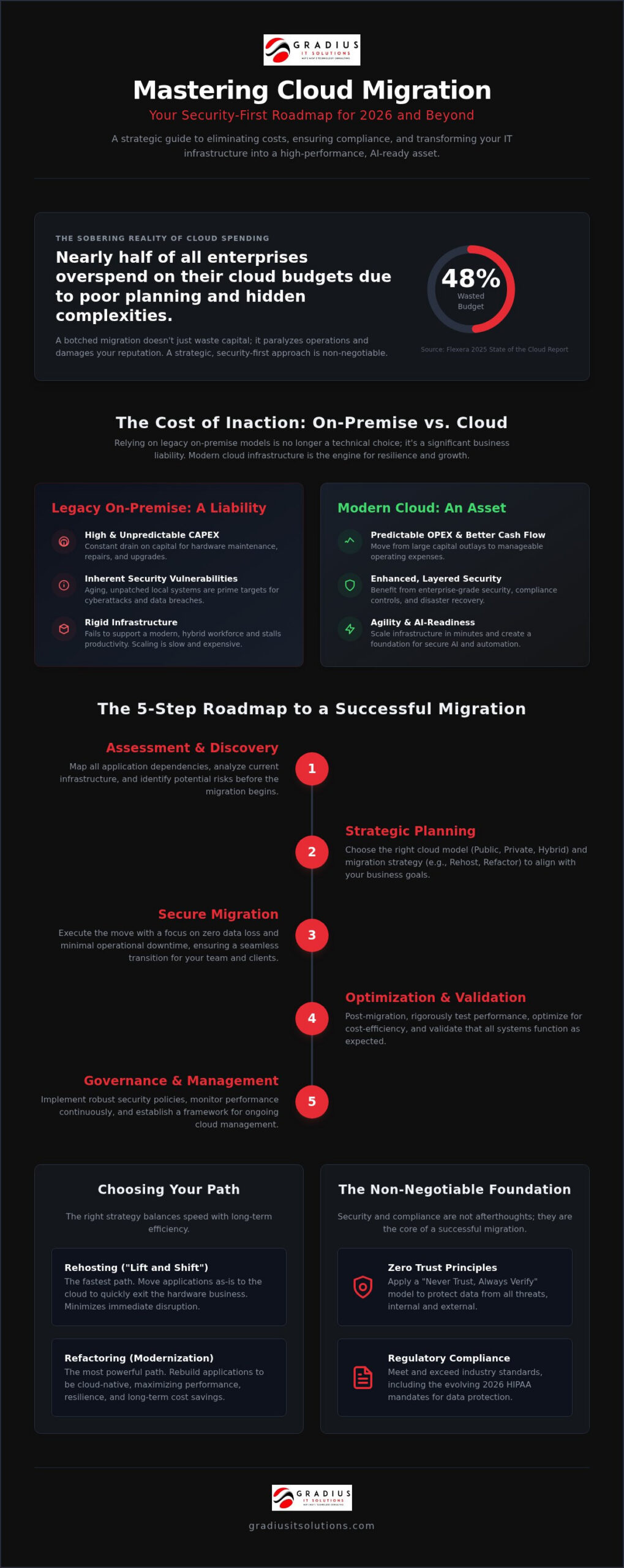
Nearly half of all enterprises are currently overspending on their cloud budgets. According to the Flexera 2025 State of the Cloud report, 48% of companies waste capital during cloud migration for businesses due to poor planning. It’s a sobering reality. You want the agility of the cloud, but the fear of transition downtime and the complexity of new 2026 HIPAA mandates feel like a massive wall. You’re right to be cautious. A botched move doesn’t just cost money; it risks your reputation.
We understand the pressure. You need a transition that’s invisible to your clients but transformative for your team. This guide delivers a security-first roadmap designed to help you master technical complexities, eliminate hidden costs, and ensure your infrastructure is ready for the AI-driven demands of 2026. We’ve built this framework to protect your data while empowering your growth. We’re moving beyond support to a partnership that secures your bottom line.
We’ll walk through the specific steps to achieve a seamless migration with zero data loss. You’ll discover how to turn your IT environment from a liability into a high-performance asset that’s fully compliant and ready to scale. Let’s build a resilient future together.
Key Takeaways
- Eliminate the technical debt of on-premise models by transitioning to a modernized, resilient infrastructure.
- Navigate the complexities of cloud migration for businesses using a strategic framework that balances cost, performance, and industry-specific needs.
- Build a non-negotiable foundation of security by applying Zero Trust principles and meeting the latest regulatory compliance standards.
- Follow a proven 5-step roadmap to ensure your transition is predictable, scalable, and free from operational downtime.
- Future-proof your operations by integrating secure AI and automation to drive long-term productivity and cost efficiency.
Why Cloud Migration for Businesses is a 2026 Necessity
Cloud migration for businesses is no longer a technical choice; it’s a strategic imperative for survival. In 2026, the definition of migration has evolved. It’s no longer just about moving files to a remote server. It’s a full-scale infrastructure modernization that positions your company to be predictive rather than reactive. Relying on “on-premise only” models has become a significant liability. Localized disasters, power outages, or even simple hardware failures can paralyze a business that lacks a distributed cloud presence. Modern cloud computing environments ensure 24/7 availability, providing the operational resilience your clients now expect as a baseline.
The landscape has shifted toward AI-readiness. You can’t effectively implement Secure AI & Automation Services if your data is trapped in silos or legacy systems. The cloud provides the necessary compute power and data accessibility to fuel these tools. It’s the essential foundation for any firm looking to automate repetitive tasks and gain a competitive edge in a fast-moving market. Successful cloud migration for businesses requires a proactive partner who can anticipate these needs before they become bottlenecks.
The High Cost of Inaction
Maintaining legacy hardware is a constant drain on your capital and team productivity. As servers age, they become more expensive to repair and more difficult to secure. Security vulnerabilities are inherent in aging, unpatched local systems. These “black boxes” often sit in closets, forgotten until a breach occurs. Beyond the budget, these rigid systems fail to support a modern, hybrid workforce. If your team can’t access critical data securely from anywhere, your productivity will stall while your competitors move forward.
Cloud Migration as a Competitive Advantage
Agility defines the winners in 2026. The cloud gives you incredible speed to market. You can deploy new software tools or scale your entire infrastructure in minutes instead of months. This shift also transforms your financial outlook. You move from massive, unpredictable CAPEX outlays to manageable, predictable OPEX. This transition allows for better cash flow management and more aggressive investment in growth. Cloud migration is a strategic business pivot that redefines IT as a high-performance engine rather than a technical burden. We stand in your corner to ensure this transition is seamless and secure.
Choosing Your Path: Common Cloud Migration Strategies
Every successful cloud migration for businesses starts with choosing the right framework. The industry standard “6 Rs” provide the essential blueprint: Rehosting, Replatforming, Refactoring, Retiring, Retaining, and Repurchasing. For many firms, the choice often boils down to balancing immediate speed with long-term operational efficiency. You must also decide between Public, Private, or Hybrid Cloud models. Regulated industries like legal or finance often favor Hybrid or Private models. These allow you to maintain strict control over sensitive data while still benefiting from massive cloud scalability. We help you cut through the technical noise to find the path that actually fits your growth goals.
Don’t ignore application dependencies. Your critical software must survive the move without breaking. A single overlooked connection between a local database and a legacy app can cause total failure post-migration. Mapping these intricate links is a non-negotiable step in a successful cloud migration. We act as your proactive guardian, identifying these hidden risks before they impact your uptime. If you’re unsure which strategy fits your current stack, our vCIO consulting can help map out your ideal path.
The “Lift and Shift” vs. Modernization
Rehosting, or “Lift and Shift,” is the fastest path available. You move your existing applications to the cloud exactly as they are. It minimizes immediate disruption and gets you out of the hardware business quickly. Refactoring is more intensive. You rebuild applications to be cloud-native from the ground up. While it costs more upfront, it maximizes performance and long-term savings. The right choice depends on your specific budget and whether your legacy apps are robust enough to function in a modern, high-speed environment.
The Role of Managed Microsoft 365 Services
For regulated businesses, Microsoft 365 and Azure are the preferred choice. This ecosystem consolidates email, file sharing, and security into a single, unified environment. It’s easier to manage and far more secure than a fragmented stack of third-party tools. By utilizing Microsoft 365 management services, you can ensure your productivity tools are always optimized and compliant. This framework also allows you to integrate secure AI agents directly into your existing workflow. It turns your standard office suite into a high-performance engine that’s ready for the demands of 2026. We handle the complexity so your team can stay focused on the bottom line.
Security and Compliance: The Non-Negotiable Foundation
Security isn’t a feature you add later. It’s the bedrock of a resilient infrastructure. Cloud migration for businesses fails when security is treated as an afterthought. We implement Zero Trust principles from the start. This means we never trust and always verify every single access request, regardless of where it originates. You need to know exactly where your data lives and who has the keys to it. Data sovereignty and integrity are paramount. We layer controls like Multi-Factor Authentication (MFA) and Endpoint Detection and Response (EDR) to create a perimeter that moves with your data. It’s about building a proactive guardian around your most valuable assets.
The regulatory environment in 2026 is unforgiving. Sweeping HIPAA Security Rule updates finalized in May 2026 have eliminated “addressable” flexibility. Every safeguard is now mandatory. If you handle Protected Health Information (PHI), NIST-aligned encryption for data at rest and in transit is no longer optional. Financial firms face similar pressure from the SEC and FINRA. We align your migration with the current ISO/IEC 27001:2022 standards and SOC 2 Trust Services Criteria. This isn’t just about checking boxes. It’s about ensuring your business survives an audit and a cyberattack simultaneously.
Protecting Regulated Data
Audit readiness can be a massive burden on your internal team. Our Compliance as a Service simplifies this process by providing continuous oversight. We ensure your environment meets the strict requirements of the SEC Cybersecurity Rule, which is critical for financial advisors. We use advanced encryption to prevent unauthorized interception. This protective layer ensures that even if data is accessed, it remains unreadable to bad actors. We take the complexity of compliance off your shoulders so you can focus on your clients.
The Importance of a 24/7 SOC
Threats don’t follow a 9-to-5 schedule. Effective cloud security requires always-on monitoring through a Security Operations Center (SOC). Our U.S.-based team catches threats in real-time before they escalate into breaches. Incident response is about having a battle-tested plan ready to execute. We don’t wait for a crisis to decide how to react. Automated patch management reduces the attack surface by 80%. This proactive approach keeps your systems updated and resilient against known vulnerabilities. We stay three steps ahead so you don’t have to look back.
The 5-Step Roadmap to a Successful Migration
Execution is the graveyard of good intentions. While many firms jump straight into the technical move, a successful cloud migration for businesses requires a methodical, five-step approach. We start with a Strategic Assessment to audit your current stack and identify clear goals. Next, we move to Architecture Design, where we build a secure and scalable environment tailored to your industry. Step three is the Pilot Migration, where we test the process with non-critical data to ensure total stability. Only then do we move to Full Execution, focusing on zero downtime and data integrity. Finally, we enter the Optimization phase to tune performance and manage costs. This ensures you don’t fall into the 48% of firms that overspend their cloud budget due to poor planning. This isn’t a one-time event; it’s a lifecycle of continuous improvement.
Phase 1: Assessment and Planning
We begin by identifying “low-hanging fruit.” These are the applications or data sets that offer the highest impact with the lowest risk, providing early wins that build momentum for your team. A critical part of this phase is conducting a thorough IT risk assessment. We identify potential roadblocks like legacy software dependencies or security gaps before they become active threats. We also establish clear Key Performance Indicators (KPIs) for the project. We measure success through specific metrics like 99.9% uptime during transition, rapid user adoption rates, and tangible infrastructure cost savings. This strategic alignment ensures your IT goals match your business objectives perfectly.
Phase 2: Execution and Validation
During execution, we often utilize a “Parallel Run” strategy. This keeps your old systems active while we rigorously test the new cloud environment. It’s our safety net. It ensures that if any issue arises, your operations continue without a second of interruption. We also prioritize User Training. Your team needs to feel empowered to use these new tools, not frustrated by them. We provide the guidance necessary to leverage the full power of the cloud from day one. The final step is validation. We document every result and verify that all compliance controls are fully active and monitored. This strategic alignment is what makes cloud migration for businesses a growth driver rather than a technical hurdle. We don’t just move your data; we protect your future.
Schedule your strategic vCIO consultation today.
Beyond the Move: Maximizing Your Cloud Investment
The day your migration finishes is actually Day One of your new growth phase. Cloud migration for businesses is a strategic pivot, not a final destination. Now that your data resides in a secure, scalable environment, your focus must shift toward extracting maximum value. Many firms fall into the trap of “cloud sprawl,” where unmanaged resources lead to the 48% overspending rate identified in the Flexera 2025 State of the Cloud report. Continuous optimization is your solution. We implement governance strategies that identify and eliminate idle resources. This turns your cloud environment into a lean, high-performance engine that only costs what it produces. Efficiency is the new baseline.
Next, we leverage Secure AI & Automation to streamline your repetitive workflows. Your new infrastructure is the perfect foundation for these tools. You can now automate data entry, client support, or complex financial analysis with total confidence. This isn’t just about speed; it’s about freeing your team to focus on high-level strategy. To keep your technology aligned with these outcomes, we provide vCIO consulting as a core part of our partnership. We ensure every technical decision supports your long-term business goals. We’re moving beyond support to a role of strategic advocacy.
Predictive Maintenance and Support
We’ve moved beyond the outdated “Break-Fix” model. In the cloud, reactive IT is a liability. We use 24/7 monitoring to ensure your infrastructure remains high-performing at all times. Our team identifies potential bottlenecks or security anomalies before they impact your operations. We also conduct regular business reviews. These aren’t just status updates. They’re strategic sessions where we evaluate how your technology must evolve to meet your changing goals. We stay three steps ahead of the curve so you don’t have to look back.
The Future-Proof Business
Growth shouldn’t be painful. With a cloud-first foundation, you can scale your infrastructure instantly as your headcount or client base expands. There’s no more waiting for hardware shipments or complex server installs. You’re also ready for the next generation of security standards. As regulations evolve, your cloud environment can be updated globally with a few clicks. This resilience is the ultimate competitive advantage. You’re no longer fighting your tools; you’re using them to win. We stand in your corner to ensure your infrastructure is a high-performance asset, not a burden.
Secure Your Competitive Edge in the Cloud
The window for reactive IT is closing. In 2026, cloud migration for businesses has transformed from a simple storage upgrade into a high-performance strategic pivot. You’ve seen how a security-first framework protects your operations from evolving threats while ensuring total compliance with new mandates. By following a methodical roadmap, you eliminate the risks of downtime and unmanaged costs. This transition is about more than just moving data. It’s about building an infrastructure that’s ready for the AI-driven demands of tomorrow.
We stand in your corner as a proactive guardian. Our U.S. based 24/7 SOC and help desk provide the unwavering reliability you need to lead your industry. We specialize in compliance-aware managed IT for regulated firms, delivering results with predictable flat-fee pricing. You don’t have to carry the burden of complexity alone. We handle the technical heavy lifting so you can focus on scaling your business with absolute confidence.
The future of your infrastructure starts now. Let’s build a resilient, future-proof environment that drives your success for years to come.
Frequently Asked Questions
What are the main benefits of cloud migration for businesses?
Cloud migration for businesses delivers instant scalability and operational resilience. You gain the ability to deploy new tools in minutes rather than months. It also provides the essential foundation for secure AI and automation. By shifting from reactive local hardware to predictive cloud environments, your team can focus on high-level growth. This move eliminates the technical debt of aging servers and positions your firm to lead in a fast-moving market.
How long does a typical cloud migration take for a mid-sized company?
A typical migration for a mid-sized company takes between three to six months. The timeline depends heavily on your current data volume and application complexity. We start with a deep strategic assessment to map every software dependency. This prevents delays and ensures a predictable rollout. While the technical move might happen quickly, the planning and validation phases are what guarantee your long-term success and stability.
Will our business experience downtime during the migration process?
You won’t experience operational downtime if you use a “Parallel Run” strategy. We keep your existing systems active while we rigorously test the new cloud environment. This safety net ensures your team stays productive throughout the entire transition. We prioritize data integrity and seamless handovers. Our goal is an invisible transition for your clients and a transformative one for your internal team.
Is the cloud more secure than an on-premise server?
Yes, the cloud is significantly more secure than most on-premise servers. Leading providers invest billions in physical and digital security that a single firm cannot match. We layer these foundations with Zero Trust principles and 24/7 SOC monitoring. Local servers are often unpatched and vulnerable to physical theft or localized disasters. The cloud offers distributed protection and automated updates that keep your data safe from modern threats.
How does cloud migration impact regulatory compliance (HIPAA, SEC)?
Cloud migration for businesses simplifies regulatory compliance by centralizing your security controls. It makes audit readiness much easier through automated logging and NIST-aligned encryption. For industries facing strict HIPAA or SEC requirements, the cloud provides a transparent trail of data access. We ensure your environment is built to meet these evolving standards from day one. This proactive approach turns compliance from a burden into a reliable business asset.
What is the difference between a public cloud and a private cloud?
Public clouds like Microsoft Azure share infrastructure among many users while maintaining strict logical isolation. They offer the highest scalability and cost-efficiency. A private cloud is a dedicated environment exclusive to your business. It’s often used by firms with extreme data sovereignty requirements. Most modern businesses find their ideal balance in a hybrid model. This allows you to keep sensitive data in a private space while utilizing public cloud power for daily operations.
Do we need to replace our current IT staff after moving to the cloud?
You don’t need to replace your current IT staff. Instead, their role shifts from manual hardware maintenance to strategic technology management. Moving to the cloud frees your team from the cycle of fixing aging servers. They can then focus on leveraging new tools to drive productivity and innovation. We act as a partner to your internal team, providing the high-level expertise needed to manage complex cloud environments effectively.
How do we manage the costs of a cloud environment to avoid “bill shock”?
We prevent “bill shock” through continuous optimization and proactive governance. We identify and shut down idle resources that often cause costs to spiral. By utilizing predictable flat-fee pricing for our management services, you gain total visibility into your IT spend. We help you shift from unpredictable capital outlays to manageable operational expenses. Regular business reviews ensure your cloud investment stays aligned with your actual usage and growth goals.

Article by
Robert Joyce
**Robert Joyce** is the Founder, CEO, and Chief Technology Officer of Gradius IT Solutions, a security first provider of Managed IT Services, Cybersecurity, Cloud, Compliance, and Secure AI solutions serving businesses throughout New Jersey, New York, Connecticut, and across the United States.
With more than 28 years of IT experience, including 23 years supporting hedge funds, global banks, and wealth management firms, Robert has built a career designing and managing secure, resilient, and highly available technology environments where uptime, cybersecurity, and business continuity are essential.
His expertise includes Microsoft 365, cloud computing, cybersecurity, networking, infrastructure, disaster recovery, compliance, virtualization, and strategic IT leadership. Following the events of September 11, Robert helped rebuild critical technology infrastructure for Merrill Lynch, an experience that reinforced the importance of resilience, planning, and operational excellence.
Robert founded Gradius IT Solutions to bring enterprise level technology and security services to small and midsized businesses at a predictable monthly cost. Today, the company delivers fully managed and co managed IT services, cybersecurity, Microsoft 365, cloud solutions, compliance consulting, Secure AI consulting, technology projects, and vCIO services. Through a U.S. based 24/7 Help Desk and a nationwide network of trusted technology partners, Gradius supports organizations across the country with responsive, security focused technology solutions.
Robert partners with business owners and executive leaders to align technology with business goals, reduce risk, strengthen cybersecurity, improve productivity, and create long term IT strategies that support growth. His mission is simple: provide every client with enterprise class technology, exceptional service, and a trusted advisor they can rely on as their business evolves.
Disclaimer
## Disclaimer
The information provided in this article is for general informational and educational purposes only and should not be considered professional IT, cybersecurity, legal, regulatory, or compliance advice. While Gradius IT Solutions strives to provide accurate and up to date information, technology, security threats, and regulatory requirements change frequently, and we cannot guarantee that all information will remain current or applicable to your specific situation.
Every organization has unique technology, security, compliance, and business requirements. Before implementing any recommendations discussed in this article, you should evaluate their suitability for your environment or consult with a qualified technology professional.
Gradius IT Solutions makes no warranties, express or implied, regarding the completeness, accuracy, reliability, or results obtained from the use of this information. Any actions you take based on this content are at your own risk. Gradius IT Solutions shall not be liable for any direct, indirect, incidental, or consequential damages arising from the use of, or reliance upon, the information contained in this article.
References to third party products, services, or vendors are provided for informational purposes only and do not constitute an endorsement unless explicitly stated.
If you would like guidance tailored to your organization, contact Gradius IT Solutions to schedule a consultation with one of our technology experts.
This post Cloud Migration for Businesses: The 2026 Strategic Roadmap to Resilience first appeared on Gradius IT Solutions and is written by rjoyce@gradiusitsolutions.com