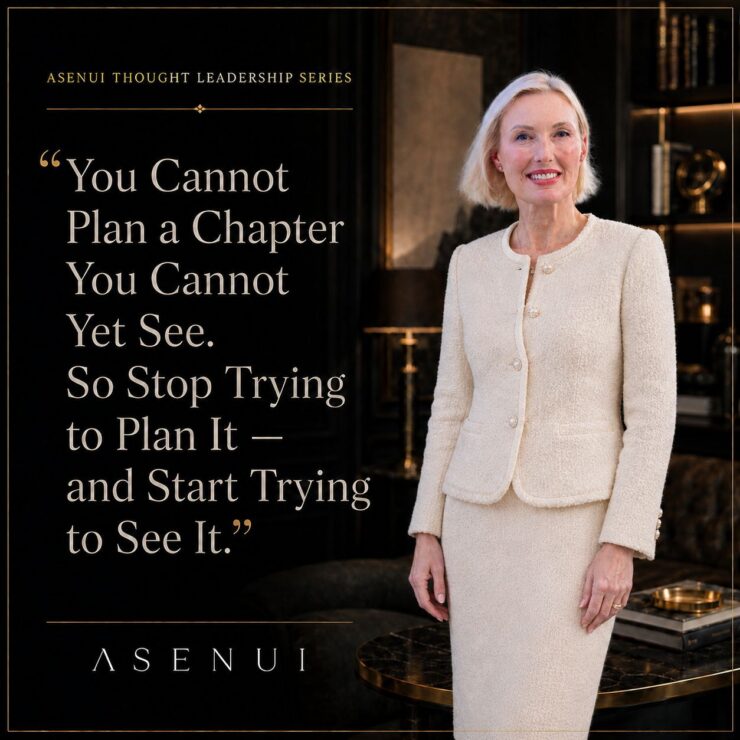
The instinct, when one chapter ends, is to plan the next.
It’s a reasonable instinct and, for the founder navigating a major transition, frequently the wrong one. Because the next chapter, in the cases that matter, is not yet visible. And you cannot plan your way toward a destination you can’t yet perceive.
The planning instinct assumes the question is how — how to get to the next thing. But for the founder who has just exited, or is approaching it, the real question is prior: what should the next thing even be? And that question is not answered by planning. It is answered by seeing — by encountering perspectives and possibilities that make a new direction visible for the first time.
This is why so many post-exit founders pour energy into elaborate plans for directions that turn out to be wrong. They are executing on the only options that were visible from inside their existing environment — and that environment, populated by people still building what they themselves just finished, could not show them anything genuinely new.
The work of the transition is not strategic. It’s perceptual. The task is not to choose between known options but to expand the field of what’s even in view — and that requires exposure to people and conditions outside the frame that produced your last chapter.
The next chapter does not arrive as a plan.
It arrives as a glimpse — usually in a conversation you didn’t see coming, with someone whose life is organised around a possibility you’d never considered.
Stop planning the thing you can’t see.
Go somewhere it might become visible.
Anna Lautenschlaeger is a founder, economist, and convener of rare rooms. She holds two PhDs (including Economics), an MBA, and spent years as a professor at the University of London. She is the bestselling author of Hiring & Managing Virtual Assistants and founder of ASENUI — a by-invitation-only society for accomplished entrepreneurs seeking depth over display, and LAULAU – an offshore and nearshore staff recruitment agency.