
Ever since we’ve started leading organizations through change, one question has kept coming up: “How do you build an effective team?” This inevitably leads to further concerns, like:
- How many people should be on the team?
- What kind of expertise do we need?
- What outcomes must we accomplish?
- How will we prioritize?
- What processes will we follow?
- How will we work with other teams?
- How will we share information?
- How will we connect and create a sense of belonging?
- How will we know we’re successful?
Whether you’re a well-established organization rethinking how teams must work in a hybrid or remote environment, or a startup officially launching a team for the first time, how you answer these questions will ultimately define how your team is structured, and how they do they work. We’ve put together a simple framework to help leaders think through the core elements of a team so you can set yours up for success.
The Anatomy of an Effective Team
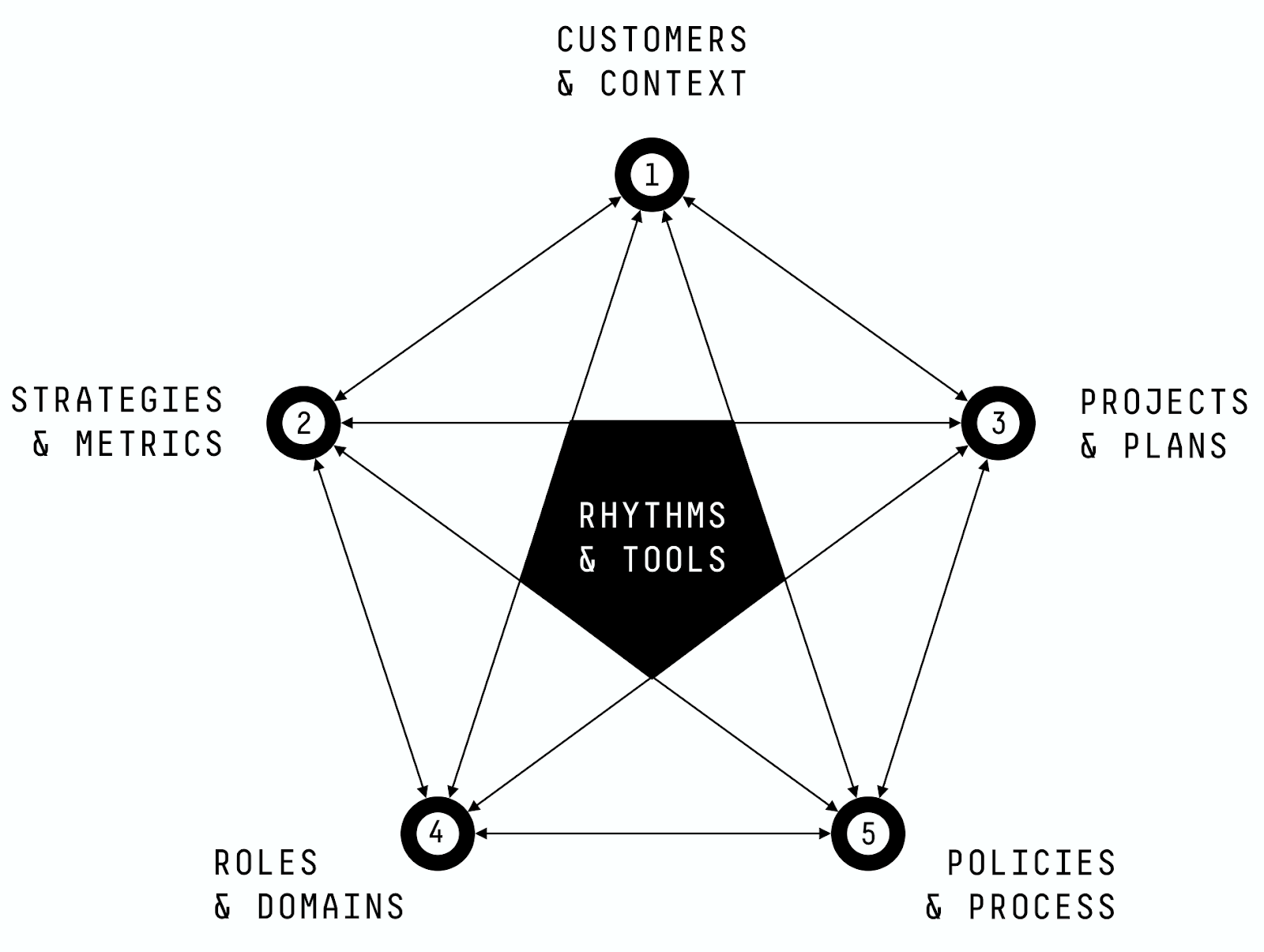
A team is a group of people who will work together to reach a common goal. Of course, while it’s easy enough to define, putting it into practice is significantly more challenging! How do you get individuals to truly work “together,” so that the team is more than the sum of its parts? How do you align teams around a common goal, especially when so many cross-functional teams have competing priorities? We start by breaking down a team into five core elements:
- Customers and Context: Whom we’ll serve
- Strategies and Metrics: How we’ll serve them
- Projects and Plans: What we’ll do
- Roles and Domains: Who will do what
- Policies and Process: How we’ll get along
Each of these elements are mediated through Rhythms and Tools: the meetings you attend and the tools you use to get work done as a team. Let’s look at each of these core elements in more detail.
Part I: Customers and Context
Teams are dealing with more demands from more stakeholders than ever before, making it hard to prioritize goals and align around a clear strategy. So before we start any client engagement, the very first question that we ask the team is also the one that raises the most consternation: “Who is your customer?”
It’s our belief, reinforced by years of practice, that no team can exist without a customer—and by “customer,” we simply mean an explicit group who consumes the output of the team. This customer is often external (e.g., “people who buy our widgets”) but, for shared services teams like Finance and HR, it could be internal (e.g., “The Finance Department serves the internal teams who need to make smart financial decisions”). Note that calling another team a “customer” doesn’t necessarily define how you work with them: for instance, you might work in partnership with another team to achieve the organization’s goals.
The better the understanding of who the team’s customer is and what they need, the greater the sense of clarity and purpose each team member feels. When you know whom you’re trying to help, it serves as a guiding principle, regardless of what else is going on in the market. It’s also especially relevant for a rapidly scaling team, as being customer-led is the most effective way to knit teams together in an expanding organization.
Unfortunately, we’ve found that many teams never come to a consensus about who the customer is — or if they have more than one — and what they need to deliver. If you find your team is unclear about this core element, hold a brainstorm and ask:
- Who consumes the output of our daily work? Often, teams are quick to label their customer as an external audience, when in fact they are creating raw material that another team uses to interact with outside customers. This is especially true for companies with retail outlets or franchises; the main office rarely serves the final customer.
- What do they need from us most, and why? After the customer has been identified, use Clayton Christensen’s Jobs to Be Done Framework to focus on their desired outcomes. For example, if you’re a data science team, don’t assume other teams want more data — they might just want to make better, faster decisions. That insight might change everything you do. If you’re not sure what they need, go on a listening tour of your most important customers to find out firsthand.
- When do we come together to assess our customers? Customers aren’t static—new needs will emerge over time, as well as completely new customers. That’s why we recommend reviewing their needs on a regular basis, such at the beginning of any new project, at a quarterly sensing session to determine what’s changing, or during a Project Retrospective, which allows the team to discuss how a project impacted the customer.
Next week, we’ll discuss how to go from Strategies and Metrics to Project and Plans—that is, what teams actually do for their customers. Sign up for our newsletter to get it first.
The post How to Build a High Performing Team appeared first on NOBL Academy.