
Beware the Ides of March…
For those of you who are not history or Shakespeare nerds, March 15th is sometimes referred to as the Ides of March, a.k.a. the day Julius Caesar was assassinated. The famous line, “beware the Ides of March” is from Shakespeare’s play about Caesar.
While it would be a stretch to refer to Google’s March 2025 core algorithm update as an “assassination,” it certainly kept us on our toes.
Google’s core algorithm update launched on March 13 and finished rolling out on March 27th. As usual, Google claimed the update did not roll out before the 13th, but also as usual, websites started seeing weird things going on with their website traffic prior to the 13th, so let’s get into it.
Table of Contents
Volatility
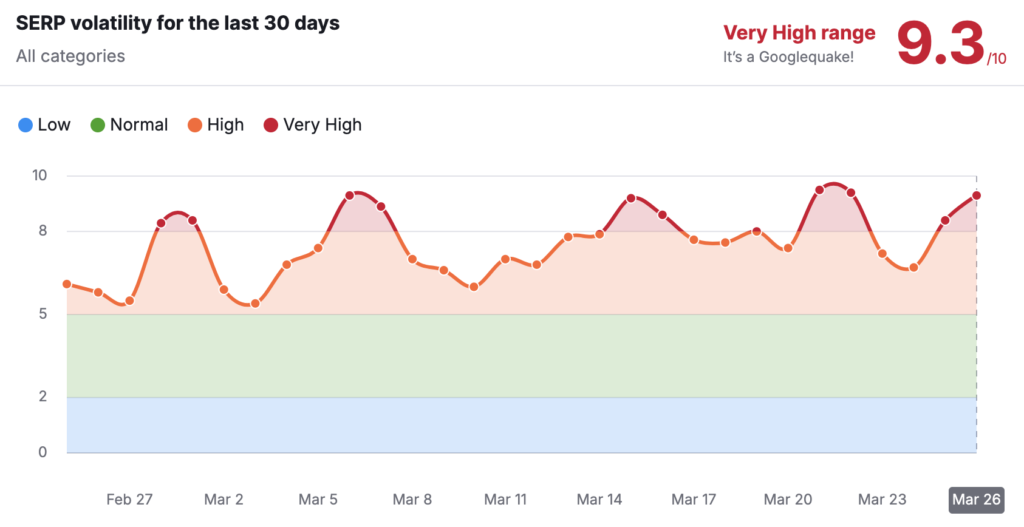
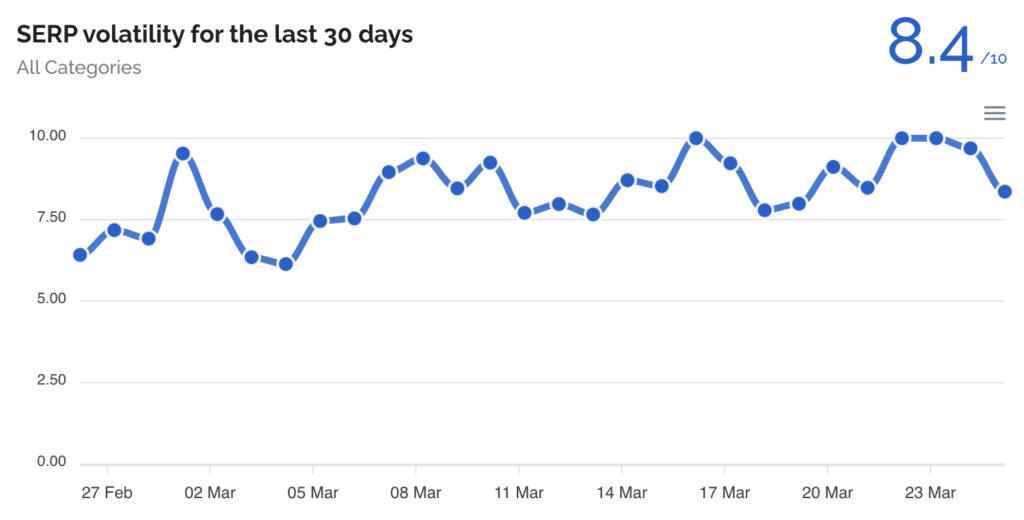
What made this core update unique was the amount of volatility the SEO tools reported.
In this case, “volatility” refers to your search rankings rising and falling dramatically in a short time frame. As this update started to roll out the volatility reported was almost literally off the charts, as you can see from these images:
Multiple people reported:
- Volatility in their search rankings
- URLs disappearing from Google, only to reappear, then disappear again
- Extremely low traffic from organic search
- Low-quality traffic from organic search that is, at best, not buying, and at worst, bouncing back to Google right away
One person even reported most of their traffic was coming from the US even though the website is only designed for German-speaking areas!
Volatility was so high that some people began theorizing that something was happening to create a problem with third-party SEO tools.
Turns out they were right. Google later admitted they had made changes to the HTML of their website, which interfered with the ability of third-party SEO tools to properly measure the search rankings of the websites they were trying to track, which resulted in the record-high volatility reports.
Improvements to Google’s AI
One of the main goals of the March 2025 core update was to improve Google’s AI features, including updating their AI Overviews to include links to Google’s own search results.
This makes sense given that SearchGPT also has a function that provides links to resources for people to visit if they want to check where the AI got its content from.
Google also made improvements to its health AI Overviews, including expanding health knowledge panels and launching a new What People Suggest for health topics.
This makes sense given
- Google tends to be extra careful when it comes to the information about health that it ranks at the top of its searches. It doesn’t want to be responsible for pointing anyone in the direction of content that could harm their health when they’re looking for help.
- AI is hilariously wrong way too often for us to rely on the information it gives us without checking where it’s getting that information.
Google is testing whether AI Overviews might be more effective if placed in the middle of the page instead of the top, which I find interesting, given the fact that the “Featured Snippet” has always been placed at the top of Google’s search results, which is a huge part of what made achieving Featured Snippet status so desirable.
Google Assistant will be completely replaced by Gemini, Google’s AI chatbot
Google dropped review counts for non-shopping search results, which makes sense. I know I look carefully at the reviews if I’m thinking of buying something or hiring someone, but if I just need some information on a topic, I’m not going to bother with the reviews.
If your website ranks highly for certain searches, but people don’t use your website when they search those terms, Google might remove your website from those searches. This demonstrates the importance of understanding improving search rankings as just the first step. You also need to convince people to click through to your website, not only to improve your chances of converting them into a warm lead (hopefully a client) but also to maintain those search rankings.
What Can You Do to Make Google Your Friend?

Since I often refer to SEO as the process of “making Google your friend,” let’s see what Google says it’s looking for in a friend.
John Mueller, who works for Google, says SEO professionals need to stop over-prioritizing minor SEO metrics, such as URL structure, links, or any one tactic over creating a stable website with high-quality content that answers people’s questions.
Google’s Danny Sullivan said Google’s goal continues to be to improve search rankings for high-quality websites with thoughtful content. Hopefully, that means creators of those types of sites will recover by the end of 2025 if they lost search ranking status after previous core algorithm updates, but of course, there are never any guarantees, in SEO as in life.
Sullivan admitted that some content creators creating great content, still aren’t seeing improvements in their search results if they don’t have a great page experience. Nevertheless, he also admitted that Google has some work of its own to do to try to make sure high-quality content gets raised above websites that might have a better page experience, but lower quality content.
Along those same lines, if your website took a hit from the “helpful content” update of September 2023, you should not necessarily expect to see a benefit from this update if you have not improved the content on your website.
That said, Google’s tips are pretty much the same advice they give with every core update to their algorithm. It said there are no specific actions you can take to recover, and even that a hit after a core update is not necessarily a sign that anything is wrong with your pages, which begs the question: what’s the purpose of the updates if they’re causing high-quality sites to lose rankings?
If you found this content useful and would like to have more like it sent straight to your inbox, you can sign up for our newsletter in the space below. You can also see what we’re up to by following us on LinkedIn and YouTube.
(function() {
window.mc4wp = window.mc4wp || {
listeners: [],
forms: {
on: function(evt, cb) {
window.mc4wp.listeners.push(
{
event : evt,
callback: cb
}
);
}
}
}
})();
The post Google’s March 2025 Core Algorithm Update Was a Wild Ride first appeared on AV Writing Services.