
A strategic blueprint crafted after meeting with CEOs, franchise owners, and business leaders facing unprecedented turbulence, by Hema Dey, CEO and Founder of Iffel International Inc.
Over the past year, I have sat with CEOs, franchise owners, founders, and operators across multiple industries, and the conversations have all pointed to the same reality:
The cost of doing business is rising, AI is reshaping digital marketing, and revenue generation has become harder, more volatile, and more unpredictable than ever before.
Across boardrooms, advisory calls, and leadership roundtables, the same pain points repeat themselves:
- Marketing performance is inconsistent without explanation
- Customer acquisition costs are increasing because it is harder to get the “good” lead
- Talent requirements are shifting faster than companies can hire, and recruiters aren’t really sure how to hire
- Websites are becoming outdated almost overnight; the technology required is what makes it outdated
- Confusion around how AI, LLMs, and new search behaviors affect visibility
- Fragmentation across technology stacks and marketing channels
- Brand trust is becoming more important than keywords, but branding using old methods are not working
- Each platform (Google, ChatGPT, Perplexity, Meta) requires different protocols, and there isnt a huge budget or enough hours in a day!
These leaders are not struggling because they lack effort. They are struggling because the rules changed without warning.
AI has transformed how customers discover, evaluate, and choose businesses. Search moved from keyword-based queries to entity trust, structured data, and AI-curated recommendations.
Marketing roles that once relied on content production and keyword strategy now demand:
- AI literacy
- Data comprehension
- Strategic alignment
- Technical SEO fluency
- Schema implementation
- Brand consistency across platforms
- Understanding how LLMs “read” and evaluate business information
Technology stacks that worked just two years ago are now insufficient. Websites require:
- Schema markup
- Structured content architecture
- Entity reinforcement
- Technical hygiene
- Clear, authoritative messaging
Meanwhile, customers expect:
- Instant answers
- Proof of expertise
- Transparent value
- Seamless digital interactions
This guide is the culmination of those conversations — a carefully constructed roadmap for leaders who need clarity, direction, and a modern strategy to protect and grow revenue in the AI era.
It will show you:
- Why your costs are rising and why your marketing returns are not
- How AI and LLMs have fundamentally changed discovery and conversion
- Why traditional SEO is collapsing and what AI SEO really requires
- How branding and trust now outperform keywords
- What skillsets, technology, and website upgrades are needed in 2024–2025
- How to stabilize and grow revenue in this new environment
This is not just a guide. It is a strategic survival plan for business owners who refuse to be left behind. and who are ready to evolve ahead of the market.
Section 1:
Introduction: The New Reality of Marketing & Revenue Growth
Marketing has never changed as fast as it has in the past 18 months or if we look at our charts since the release of ChatGPT in 2022. It was never a threat till 31 October 2024 when ChatGPT launched its own search engine and things just started to really shift from that point on. Search engines are no longer the only place customers look for solutions.
AI assistants, zero-click search, and conversational discovery have rewritten the buyer journey.
Customers now ask ChatGPT instead of Google. Although a large percentage still use Google, there is a rapid migration to ChatGPT as a trusted platform. They compare vendors through AI summaries instead of reading websites. They trust entities, expertise, and veracity over keywords and ads. The answers are so succinct and backed by validated sources that the trust consumers have in AI is very high.
And because of this shift, the traditional marketing playbook specifically related to search engine optimization and digital advertising has collapsed, not traditional and foundational marketing theory and planning: some key symptoms include and growing each day include executive and business owner seeing:
- Organic traffic is dropping even for well-optimized sites
- Ads are more expensive and less predictable
- Zero-click search steals visibility from businesses
- AI models “choose” which brands to surface
- Buyers rely on proof, not noise
Businesses feel this as: fewer leads, lower conversion rates, and unclear attribution. The difficulty in forecasting new business and revenue pipelines is causing confusion, job losses, and the scramble for answers, knee-jerk reactions, and frustrated employees. Worse, jobs are on the line, and without the understanding and root cause of the problem, some have only one option to write a dismissal letter or be told they have lost their jobs as head of sales and marketing.
The truth is simple: Marketing no longer drives revenue unless it is strategically aligned with AI-driven discovery and real customer intent.
This is why Revenue Optimization matters now more than ever. It connects strategy, brand, technical SEO, content, conversion, and KPIs into one unified growth system.
In this guide, you’ll learn:
- How AI changed search and customer behavior
- Why most marketing efforts fail in the AI era
- What revenue optimization really means
- How to align your brand, website, SEO, content, and sales
- The full SEO2Sales
 methodology for scalable growth
 - What KPIs to track in a zero-click, AI-assisted world
This is the new roadmap for growth, which is rooted in clarity, structure and verifable authority. For additional reading find out who AI awards proof in this additional article HERE
SECTION 2
What Is Revenue Optimization?
Most businesses think revenue is the result of marketing, sales, or advertising and some still believe that door-knocking is the answer to prayer. WRONG! But in the AI era, revenue is the result of alignment between your strategy, brand, website, technical SEO, content, and conversion systems. If each element isn’t cohesively stitched together for the dots to connect, revenue optimization becomes bleak.
Revenue Optimization is the discipline of engineering that alignment.
It’s the process of systematically identifying and removing the gaps that cause a business to leak revenue, whether those gaps come from messaging, search performance, user experience, sales processes, or measurement blind spots.
Put simply:
Revenue Optimization is the art and science of making sure every part of your marketing ecosystem works together to produce measurable, predictable growth.
Why This Matters Now (More Than Ever)
AI has changed how customers discover, evaluate, and choose brands. Traditional marketing funnels built for the pre-AI era don’t reflect how people buy anymore.
Today:
- Customers ask AI assistants before they visit websites.
- Zero-click search gives answers without sending traffic anywhere.
- Google prioritizes entities, expertise, brand clarity, and accuracy.
- Buyers want proof, not promises.
- Marketing and sales data are fragmented across dozens of tools.
- Most websites aren’t structured for AI or human decision behavior.
This fragmentation means businesses lose revenue not because they don’t market…but because their systems aren’t built for how people find and trust information today.
The 5 Components of Revenue Optimization
True Revenue Optimization brings together five disciplines:
1. Brand & Message Clarity
Customers choose brands that clearly answer:
“What do you do, who is it for, and why you?”
Here are some good supplemental how to guides on how to set your brand up for success in this AI era. Branding Strategy, Building an AI Strategy and Change Management Guide for Marketing Leaders.
Weak messaging = weak conversions = lost revenue.
2. AI-Aligned Strategy
Strategy must be built for today’s discovery landscape: AI assistants, semantic search, topic authority, and entity-based optimization. It’s not about “more content.” It’s about the right content, written and structured the right way.
3. Technical Foundations (SEO Infrastructure)
Your website must be:
- Structured
- Fast (critical task for web technicians)
- Schema-enabled
- Crawlable
- Authoritative
- Entity-rich
This is where most agencies fail but where Iffel excels with CEO and Fractional CMO for her clients: Hema Dey’s marketing and technology skillset, making her a MarTech Specialist.
4. Conversion Optimization (CRO)
You can’t grow revenue if your website can’t convert. CRO ensures:
- Clear calls to action
- User intent alignment
- Value propositions that resonate
- Forms, funnels, and micro-conversions that work
5. Measurement & KPIs That Actually Matter
Old KPIs: impressions, clicks, reach. New KPIs:
- Qualified demand
- Conversion pathways
- Revenue per visitor
- Assisted conversions
- Content-driven revenue impact
- Companies can’t optimize what they can’t measure.
Revenue Optimization Is a System — Not a Service
Most marketing efforts fail because they are treated as isolated tasks: SEO one year. Ads the next. A random website redesign. Then the content. Nothing connects. Nothing compounds. Revenue stagnates. Revenue Optimization transforms marketing from a set of activities into a unified, cross-functional system that compounds results month after month.
Why Iffel International Leads in This Space
We pioneered SEO2Sales long before AI changed the market. Now, our methodology aligns perfectly with what AI and Google reward:
- clarity
- consistency
- verifiable expertise
- technically sound websites
- brand alignment
- measurable revenue outcomes
Businesses don’t need more marketing. They need a revenue system and that’s exactly what Revenue Optimization delivers.
SECTION 3
The Iffel Revenue Optimization Framework
A Unified System for Predictable, Scalable Growth in the AI Era
The biggest reason businesses fail to grow consistently is fragmentation. Marketing does one thing. Sales does another. Your website says something different from your ads. Your SEO team chases keywords while your branding team chases visuals. Your KPIs don’t connect. Your content isn’t aligned to what buyers or AI models need. The dots don’t connect, and there are no patterns for AI to grab on to.
Think of it as a revenue leak from every gap. And just like water leaks can destroy your property, these symptoms can destroy your revenue generation for your business.
The Iffel Revenue Optimization Framework closes those gaps by turning your entire marketing ecosystem into a single, unified growth engine one that is aligned with how AI systems index information and how modern buyers make decisions. This framework is structured around six interconnected pillars, each essential for generating measurable, predictable revenue in today’s market.
The Six Pillars of the Iffel Revenue Optimization Framework
| Pillar | Purpose | What AI & Customers Expect | Key Deliverables |
|---|---|---|---|
|
1. Brand & Messaging Clarity |
Communicate value instantly with precision and trust, apply varacity in your candor on every micro asset representing your brand. | Build a revenue blueprint that aligns with the AI-era discovery | Brand messaging guide, value proposition, positioning statements |
| 2. AI-Aligned Strategy | Build a revenue blueprint that aligns with AI-era discovery | Intent-driven journeys, topic authority, entity recognition | Strategic roadmap, topic clusters, content plan, competitive analysis |
| 3. Technical Architecture (AI-Ready SEO) |
Ensure your website is structured for AI interpretation, fast performance, and credibility | Schema, clean structure, fast load, crawlability, entity reinforcement | Technical SEO audit, schema setup, URL structure, site architecture |
| 4. Authority Content & Thought Leadership | Revenue pathways, assisted conversions, entity growth, and AI visibility | Evidence, expertise, topical depth, reliable explanations | Pillar pages, cluster content, case studies, topical authority hubs |
| 5. Conversion Rate Optimization (CRO) | Turn traffic into revenue with intentional user paths and trust signals | Clear CTAs, frictionless UX, mobile-first design, proof, intuitive layouts | Landing page redesigns, CTA flows, funnel optimization, trust integration |
| 6. Measurement & Revenue KPIs | Track what actually drives revenue, not vanity metrics | Revenue pathways, assisted conversions, entity growth, AI visibility | KPI dashboard, attribution modeling, analytics integration, reporting cadence |
Without crystal-clear brand messaging, no amount of marketing can produce consistent revenue.
The Framework Works Because It Eliminates Fragmentation
Most companies try to grow with isolated tactics:
- A new website
- A new ad campaign
- A new SEO team
- A new email system
But tactics don’t produce revenue. Systems do.
The Iffel Revenue Optimization Framework we call AI SEO2SalesTM turns marketing from a set of disconnected activities into a tightly engineered, AI-aligned revenue engine.
Once the six pillars are aligned:
- Your brand becomes clearer
- Your authority increases
- AI assistants surface for you more often
- Your website converts better
- Your pipeline stabilizes
- Your revenue becomes predictable
This is the transformation modern businesses are searching for, and this is why our framework stands out in the marketplace.
SECTION 4
How AI Has Changed Marketing & Discovery
Why your customers no longer “search” the way they used to — and what this means for your business.
The customer journey has been rewritten. Not adjusted. Not shifted. Completely rewritten.
AI systems ChatGPT, Perplexity, Gemini, Claude, and even Google’s AI Overviews now act as decision gateways. They interpret information, summarize brands, and influence buyer choices before someone ever reaches your website.
1. AI Assistants Have Replaced Traditional Search Behavior
Instead of typing keywords like “best logistics firm” or “how to improve my marketing,” today’s buyer asks:
- “Who is the best company to help me increase revenue using AI?”
- “What are the top marketing frameworks for small businesses?”
- “How do I fix my website so it ranks in zero-click search?”
AI doesn’t return 10 blue links. It returns one synthesized answer, based on:
- Expertise
- Brand clarity
- Authority content
- Consistency
- Verifiable proof
- Structured data
- Entity strength
This means marketing is no longer just about “ranking.” It’s about being chosen by AI systems as the best, clearest, most trustworthy answer.
2. Zero-Click Search Has Reduced Website Traffic — But Increased Competition
Google’s AI Overviews, Featured Snippets, People Also Ask, and Knowledge Graph results now give users answers without sending them to a website. Is this good or bad?
As a business owner, you might feel this as:
- Lower organic traffic
- Lower click-through rates
- Higher competition for visibility
- More expensive paid search
- Fewer conversions from organic
But traffic loss does not mean opportunity loss. It means your content must be structured for AI interpretation, not just human reading.
Read this for more depth to Bye Traditional SEO / Zero-Click Search — it outlines this shift perfectly.
3. AI Uses Entities, Not Keywords, to Evaluate Brands
The old SEO model ranked pages. The new model ranks entities — brands, experts, authors, and companies.
AI systems want to know:
- Who are you?
- What do you stand for?
- What have you published?
- What problems do you solve most often?
- Are you consistent across all channels?
- Do you demonstrate real-world expertise?
This is why your emphasis on:

fits the new world perfectly. Iffel was already doing what Google and AI engines reward now.
4. AI Gives Preferential Visibility to Brands With Structured, Trustworthy Content
AI models prefer content that:
- Is structurally organized
- Uses pillar–cluster architecture
- Demonstrates E-E-A-T (Experience, Expertise, Authority, Trust)
- Has schema markup: get the details on what website schema is HERE
- Uses consistent messaging
- Includes case studies, frameworks, and examples
- Reflects a real methodology (your SEO2Sales
 )
)
This is why businesses with “pretty websites but no structure” are disappearing online.
Your blog Why Vibe-Coding Hurts SEO speaks directly to this problem:
If the architecture is wrong, AI won’t surface you.
5. AI Has Collapsed the Funnel — Buyers Validate Before They Visit You
Previously, the funnel looked like:
Awareness → Research → Consideration → Website → Decision
Now it’s:
AI Query → AI Summary → Decision → Website (optional)
Your website is no longer the first touch — it’s the final validation step.
That means you need:
- Strong brand positioning
- Clear and consistent messaging
- Demonstrated authority
- Technical accuracy
- Structured content
- A conversion-focused website
This is why your Revenue Optimization Framework is essential. It aligns the parts of the business buyers actually evaluate.
6. Buyers Trust Proof, Not Promotion
AI systems also amplify social proof, verifiable expertise, and clear frameworks.
They reward:
- Case studies
- Evidence-based insights
- Repeatable methodologies
- Expertise that can be validated
This is why your blogs on Veracity, Values, and Leadership matter — they feed the credibility layer that AI models are trained to detect.
7. This Shift Creates a Major Opportunity — If You Adapt Early
Most businesses still rely on:
- Outdated SEO tactics
- Guesswork content
- Shallow websites
- Generic messaging
- Disconnected strategies
These brands disappear in zero-click environments and AI-generated results.
But for companies that realign their strategy with AI-era discovery, the upside is huge:
- Higher-quality leads
- Greater brand visibility
- Stronger authority signals
- More consistent conversions
- Lower acquisition costs
- Faster organic growth
AI changed the rules and SEO2SalesTM is an ideal Revenue Optimization Framework, built for this new game.
SECTION 5
AI + SEO2Sales : Our Signature Method
The new definition of SEO: Search Everywhere Optimization that drives measurable revenue.
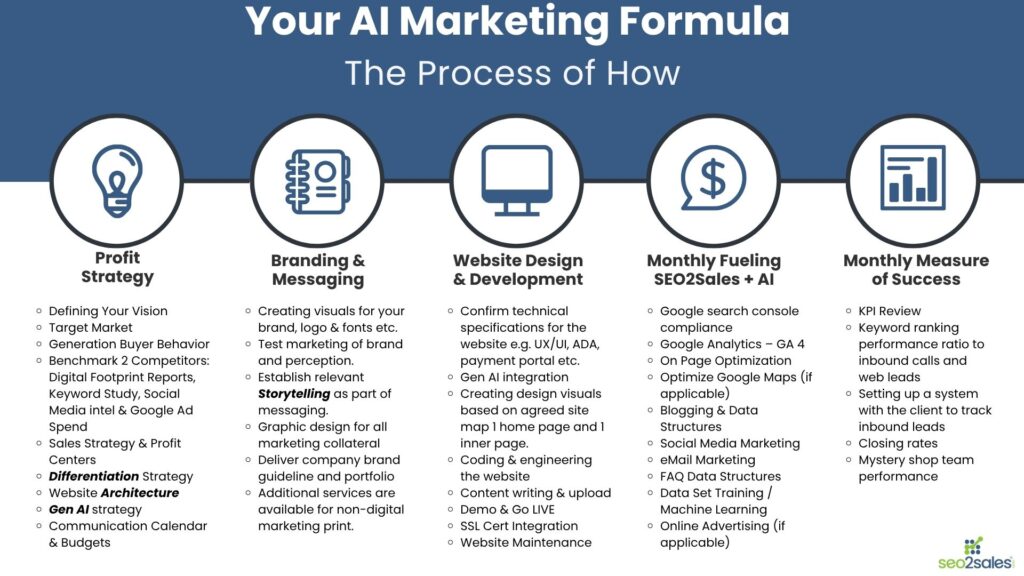
For most companies, SEO is still treated as a technical service — keywords, metadata, backlinks, and blog posts. But this approach stopped working a while ago. AI accelerated the decline even further.
Customers no longer follow a linear search path. AI assistants filter brands before buyers ever see a website. Google answers questions directly in zero-click formats. Semantic search prioritizes authority, not keyword density. Entity-based ranking rewards brands, not blog posts.
SEO is no longer about ranking on Google — it’s about being chosen across all discovery channels.
This is why Hema Dey created AI + SEO2Sales , a modern, AI-aligned framework that connects search performance directly to revenue outcomes.
1. Search Everywhere Optimization (The New SEO)
Buyers use dozens of discovery channels, often without realizing it: and they have favorites which are forming another conundrum for marketers – how do you fit brands into walled gardens?
- ChatGPT
- Perplexity
- YouTube
- AI Overviews
- Local search
- Social proof engines
- Industry directories
- Review platforms
- Voice assistants
SEO2Sales ensures your brand is discoverable, credible, and clear everywhere, not just on one platform. This removes the dependency on Google alone and expands your influence across the entire AI-driven discovery ecosystem. It is the era where search has now become democratized.
2. AI-Ready Content That Feeds LLMs
SEO2Sales formats content not just for humans, but for AI models that summarize your brand.
AI chooses answers based on:
- Clarity
- Authority
- Evidence
- Consistency
- Entity strength
- Topic coverage
- Structural integrity
SEO2Sales ensures every page contains the signals AI systems need to confidently surface your brand:
- Proper schema
- Structured content
- Defined topic clusters
- Clear author expertise
- High-quality internal linking
- Real-world examples and case studies
This is why Hema Dey wrote a guide on How to Rank on ChatGPT. It aligns seamlessly with this method.
3. Technical Architecture Designed for AI, Not Aesthetics
Most websites fail not because their content is bad…but because their architecture is wrong. It isn’t about a string of beautiful pages put together. When will people wake up! “Vibe-coded” websites the kind built on pretty visuals with no technical standards — do not survive in AI search environments.
SEO2Sales fixes this with:
- Clean HTML structure
- Crawl-friendly layouts
- Optimal schema markup
- Intent-based page hierarchy
- Fast-loading templates
- AI-friendly formatting
- Error-free technical SEO
4. Messaging That Converts Search Into Sales
Search visibility means nothing without conversion.
SEO2Sales connects search intent to buyer intent by aligning:
- Brand message
- Value proposition
- Differentiators
- Content framing
- Trust signals
- Calls to action
- Landing page UX
- CRO pathways
Our methodology ensures the customer sees the right message at the right time — building confidence, reducing friction, and driving action. This moves SEO from a “traffic service” to a revenue engine.
5. KPI System That Measures What Actually Matters
Traditional SEO metrics:
- Clicks
- Impressions
- Ranking position
These no longer tell the full story.
SEO2Sales tracks:
 Conversion pathways
 Assisted conversions
 Content-led revenue
 Sales-qualified discovery
 Authority growth
 AI visibility (emerging KPI)
 Search-to-sale attribution
 Revenue recovery from CRO
This is a major differentiator; no other agency reports SEO this way.
6. The Outcome: SEO That Produces Real Pipeline Growth
When all components of SEO2Sales are aligned, businesses experience:
- Higher-quality traffic
- More qualified leads
- Increased conversions
- Stronger brand authority
- Improved AI visibility
- Consistent revenue growth
- Lower acquisition costs
- Clearer strategic direction
SEO2Sales transforms SEO from a cost center into one of the most powerful revenue drivers inside a business.
Why This Method Works (And Why Others Don’t)
Most SEO agencies still:
- Chase keywords
- Produce surface-level blogs
- Ignore brands
- Ignore CRO
- Ignore AI
- Ignore architecture
- Ignore KPIs that matter
SEO2Sales does the opposite — it integrates all of the modern drivers of visibility, authority, and conversion into a single, unified system.
This is why your clients see results even when others fail:
You are not optimizing for rankings. You are optimizing for revenue.
SECTION 6
Conversion Rate Optimization (CRO) & Website Performance
Traffic means nothing if your website can’t convert.
Most businesses think they have a “traffic problem.” But what they actually have is a conversion problem. In the AI era, where discoverability is scattered across multiple channels and attention spans are shorter than ever, a website must do more than look good. It must:
- Communicate value within seconds
- Answer the buyer’s unspoken questions
- Establish trust rapidly
- Guide the visitor toward action without friction
- Align with the intent that brought the visitor there
This is the heart of Conversion Rate Optimization (CRO) — a central pillar in your Revenue Optimization Framework and a critical part of SEO2Sales .
.
1. Why Websites Don’t Convert (The Hidden Revenue Leaks)
Most websites fail for one of these reasons:
 Messaging is unclear
Buyers can’t tell what you do or why they should choose you.
 Value proposition is weak
The website sounds like everyone else.
 No defined conversion pathways
Buttons, forms, and next steps are buried or confusing.
 Slow load times & technical friction
Users leave within 2–3 seconds of delay.
 Poor mobile experience
60–70% of users bounce if the mobile layout is clunky.
 Lack of trust signals
No reviews, case studies, expertise indicators, or credibility markers.
 Too much “pretty,” not enough “purpose”
Design becomes decoration instead of communication.
And the biggest problem of all: The website is built without considering how buyers actually make decisions.
CRO fixes these issues by aligning user behavior with business goals.
2. CRO + SEO = The New Revenue Engine
CRO and SEO cannot be separated anymore. AI-driven discovery changes who lands on your site —
and CRO determines what happens after they arrive.
Think of it this way:
SEO brings the right people.
CRO turns those people into revenue.
This is why Iffel’s SEO2Sales approach integrates CRO into every SEO plan:
- Every keyword is mapped to buyer intent
- Every page is structured for clarity
- Every content piece includes trust-building elements
- Every call-to-action matches the visitor’s readiness
The result? Higher qualified leads, higher conversions, and measurable ROI.
3. What CRO Looks Like in the AI Era
Your CRO system doesn’t just optimize pages — it optimizes the decision journey.
 Intent-Driven Page Layouts
The page layout mirrors how real people think and decide.
 Above-the-Fold Clarity
Within or under 3 seconds, the user understands:
- What you do
- Who you help
- Why are you different
- What to do next
 Trust Amplification
AI-era buyers want:
- Proof
- Real expertise
- Case studies
- Certifications
- Testimonials
- Data
These must be strategically placed, not buried.
 Micro-Conversions
Not every visitor is ready to buy.
CRO creates multiple pathways:
- Book a call
- Download a resource
- Sign up for an audit
- View a case study
This turns early-stage visitors into revenue later.
 Friction Removal
Fewer steps.
Fewer clicks.
Simpler forms.
Cleaner messaging.
Stronger guidance.
 Mobile-First Experience
CRO isn’t mobile-friendly — it’s mobile-first, because that’s how buyers behave.
4. CRO as Part of Revenue Optimization
CRO isn’t a “website project.” It’s a revenue system.
In your framework, CRO:
 Bridges SEO & sales
It connects search intent with conversion intent.
 Repairs the leaks in the pipeline
Even great traffic leaks revenue without CRO.
 Improves every metric that matters
- Lead quality
- Conversion rate
- Revenue per visitor
- Cost per acquisition
- Sales cycle time
 Reduces dependency on ads
Better CRO = more revenue from organic channels.
 Increases AI trust signals
AI favors websites with:
- Clarity
- Strong engagement
- Lower bounce rates
- Higher dwell time
- Clear entity consistency
CRO makes your brand “AI-evidence ready.
5. The CRO Questions Every Business Must Answer
Your CRO process helps clients answer the critical questions buyers ask silently:
- “Why you?”
- “Why now?”
- “Can I trust you?”
- “Do you understand my problem?”
- “Will this work for my situation?”
- “What should I do next?”
When a website answers these questions clearly, conversion rates rise — sometimes dramatically.
6. The Outcome: A Website That Sells
When CRO is fully implemented:
- Visitors convert faster
- Buyers feel more confident
- AI recognizes the brand as authoritative
- Organic traffic becomes more profitable
- Advertising becomes more efficient
- Leads become more qualified
- Sales close faster
A website built with CRO is not just a digital brochure — it is a revenue engine.
And in the AI era, this is no longer optional. It is the competitive advantage most businesses are missing.
SECTION 7
Measurement: KPIs for the AI Era
You can’t optimize what you can’t measure, especially now that AI controls so much of the buyer journey.
Marketing used to be measured by simple metrics:
- Impressions
- Clicks
- Traffic
- Followers
- Keyword positions
But these numbers no longer reflect how customers find, evaluate, or choose brands.
In an AI-driven world where buyers rely on ChatGPT, zero-click search, AI summaries, and cross-channel discovery traditional KPIs are blind spots. To drive real revenue, businesses must measure what actually influences decisions in the new landscape. This is where your AI-aligned measurement model stands out.
1. Why Traditional KPIs No Longer Work
 Impressions don’t reflect relevance
AI often gives answers without generating impressions.
 Traffic is no longer a reliable indicator of demand
Zero-click search solves the user’s question before they click.
 Keyword rankings are fragmented and personalized
AI rewrites rankings based on entities, not keywords.
 CTR has collapsed across most industries
Users consume information without ever visiting a website.
 Attribution is broken across devices, platforms, and AI assistants
Most buyer journeys are invisible to analytics tools.
Because of this, companies are making decisions based on metrics that no longer matter — or worse, metrics that mislead them.
You fix this by measuring what’s real, not what’s easy.
2. The New KPIs That Actually Predict Revenue
Your Revenue Optimization Framework replaces vanity KPIs with revenue-centered KPIs, such as:
 Revenue Pathways
Which content, search terms, or pages influence customers before they convert?
 Assisted Conversions
What “non-last-click” signals helped the buyer choose you?
 Content-Led Revenue
Which pieces of content generate pipeline and shorten sales cycles?
 Entity Growth & Topic Authority
Are AI and search engines recognizing your brand as an expert?
 AI Visibility (Emerging KPI)
How often does your brand appear in:
- ChatGPT answers
- Perplexity citations
- Gemini AI Overviews
- Zero-click summaries
This is the “new SERP.”
 Conversion Quality
Not all leads are equal — which entry points bring the best revenue?
 Search-to-Sale Attribution
Which search behaviors reliably translate into real revenue?
 Technical Health & Crawlability Scores
Because technical decay = lost rankings = lost revenue.
 Revenue per Visitor
A powerful north-star metric that combines traffic + conversion + value.
These KPIs give CEOs and CMOs clarity they’ve never had before.
3. Alignment Between Marketing & Sales Data
Most companies have two sets of numbers:
- Marketing numbers
- Sales numbers
And they rarely match.
Your Measurement System integrates:
- Google Analytics
- Search Console
- CRM
- Call tracking
- Pipeline data
- AI discovery data
- CRO behavior signals
- Technical SEO audits
This creates a unified revenue dashboard that connects activity → intent → conversion → revenue.
No more guessing.
No more misalignment.
No more finger-pointing between departments.
4. Why Measurement Is a Core Part of Revenue Optimization
Measurement is not a reporting function it is a strategic weapon.
Your model ensures clients measure:
 What drives discovery
 What influences decisions
 What builds credibility
 What produces predictable revenue
 What bottlenecks must be fixed
 What opportunities are emerging
This gives businesses clarity, confidence, and direction.
Without this level of visibility, companies end up:
- Overspending on ads
- Under-investing in technical SEO
- Creating content that doesn’t convert
- Investing in tactics instead of strategy
- Losing revenue without knowing why
Measurement is how you end the guessing game.
5. The Outcome: Decisions Made With Certainty
When companies adopt our AI-era measurement system, they gain:
- Clear benchmarks
- Accurate forecasting
- Better ROI visibility
- Faster pipeline growth
- Higher lead quality
- Shorter sales cycles
- Stronger executive alignment
- Better allocation of marketing spend
- Greater insight into AI discoverability
This transforms marketing from a “cost center” into an intelligent, predictable revenue driver.
You might like to read this article: “How to Measure Marketing in the AI Era” it reinforces this exact measurement approach.
SECTION 8
Case Studies & Proof
In an era where anyone can make marketing claims, evidence has become the most powerful trust signal you can provide. AI systems just like human buyers, are trained to identify:
- Real results
- Real expertise
- Real client success
- Real transformations
- Real methodologies
- Real-world applications
Case studies are no longer optional “nice-to-have” website elements. They are essential components of entity authority, AI visibility, and buyer decision-making. Below are examples of how the Revenue Optimization Framework and SEO2Sales have driven measurable outcomes for clients across different industries.
Case Study 1 — AI-Driven Shopping Experience Boosted Revenue (Retail / eCommerce)
A California-based brand of natural medicine implemented AI-powered recommendation engines, supported by SEO2Sales architecture and structured product data.
Results:
- Increased product and service visibility in AI-generated shopping results
- Higher conversion rates from AI-assisted queries
- Stronger alignment between product data, search intent, and buyer needs
- Improved revenue per visitor
- Reduced dependency on paid ads
See press release HERE
Case Study 2 — Professional Services Practice Wins in Local AI SEO
We have many professional services clients, but one came to us with urgency. They struggled with declining Google traffic and increasing competition despite strong reviews and a quality service offering. By implementing our Local AI SEO2Sales Framework, the business achieved:
Results:
- Significant increase in visibility across Google AI Overviews
- Improved ranking in local semantic queries
- Higher call volume from qualified prospects (we trained humans but also used our AI Call Center to assist)
- Reduction in no-show rates due to clearer value messaging
- Enhanced authority in ChatGPT-generated local recommendations
Case Study 3 — B2B Manufacturer Grows Pipeline Through SEO2Sales Strategy
A mid-sized manufacturer experienced stagnant growth despite steady traffic. The issue wasn’t awareness; it was conversion and making it easy for their customers to buy. It was also a family business with a mix of old-school thinking around door-knocking and digital marketing.
After applying our AI + SEO2SalesTM Revenue Optimization Framework:
Results:
- Clarified value proposition that resonated with decision-makers
- Rebuilt site architecture to support AI discovery
- Added CRO layers to fix leaks in the sales funnel
- Elevated technical SEO through structured data and entity building
- Enabled marketing + sales alignment around real KPIs
Outcome:
A measurable increase in sales-qualified leads, fewer low-quality inquiries, and a stronger presence in AI-powered search environments. More profit and sales.
Case Study 4 — Strategic Brand Realignment Increases Conversions (SMB / Services)
A service-based SMB came to Iffel with a website built by a design agency visually attractive, structurally weak. Through the SEO2Sales brand alignment and CRO overhaul:
Results:
- Website conversion rate increased
- Time on page increased
- Bounce rate decreased
- Clearer differentiation in a crowded market
- Higher trust in both human and AI-driven evaluations
- Consistent lead flow after years of unpredictability
Pretty websites don’t make money — strategic websites do.
What These Case Studies Prove
1. Revenue Optimization works across industries.
We have our process for professional services, manufacturing, eCommerce, and global organizations.
2. SEO2Sales is a repeatable system — not a tactic.
Each success story follows the same framework:
- Clarity
- Strategy
- Structure
- SEO
- CRO
- Measurement
3. AI-driven marketing rewards your model.
Focus and emphasis on:
- entity authority
- structured content
- technical integrity
- conversion pathways
- veracity is exactly what AI systems surface.
4. You deliver measurable, real-world outcomes.
Not just clicks, but:
- revenue
- leads
- qualified demand
- authority
- long-term growth
This is what CEOs and CMOs really care about.
SECTION 9
FAQs
1. What is Revenue Optimization, and how is it different from traditional marketing?
2. How has AI changed the way customers search for and evaluate businesses?
3. Why is SEO alone not enough anymore?
4. Does Revenue Optimization work for small and mid-sized businesses?
5. How does AI decide which businesses to recommend?
6. Do I need a Fractional CMO to execute this?
SECTION 10
Your Next Steps
Revenue Optimization begins with clarity. Let’s get you there.
By now, you understand the shift: AI has changed how customers search, compare, and decide. Businesses that adapt early will dominate their markets. The Iffel Revenue Optimization Framework and SEO2Sales methodology give you a proven, structured, AI-aligned path to:
- Increase visibility across AI search, Google, and zero-click platforms
- Strengthen your brand’s authority and trust
- Improve website performance and conversions
- Align marketing and sales into a unified revenue system
- Eliminate wasted effort and fragmented tactics
- Generate predictable, measurable growth
Your next step is simple. You can start with us a few different ways.
1. Book Your Revenue Optimization Audit
A 360° assessment of your:
- Brand clarity
- Technical SEO
- Content authority
- Site architecture
- CRO readiness
- AI visibility
- KPIs
You’ll receive:
- A prioritized action plan
- Clear revenue opportunities
- A roadmap built specifically for your business
 Schedule your audit today
(Insert link or calendar embed)
2. Talk With a Fractional CMO Who Understands the AI Era
If you’re feeling the effects of:
- Lower traffic
- Rising ad costs
- Weak conversions
- Content that isn’t ranking
- Declining visibility
- Fragmented marketing efforts
…then you don’t have a marketing problem. You have an alignment problem.
Let’s fix that together.

3. Download the AI Revenue Optimization Checklist (Free)
A step-by-step guide to evaluate your:
- Website
- Content
- Technical SEO
- CRO gaps
- Brand clarity
- AI readiness
- KPI structure
Perfect for businesses that want to understand exactly where they stand.
 Get the Checklist, email us at admin@iffelinternational.com
No matter where you are today, your business can grow — predictably, sustainably, and intelligently — when every part of your marketing ecosystem is aligned.
Revenue Optimization is the future.
Iffel International is the partner to get you there with our proven SEO2SalesTM process.
The post A Complete Guide for Business Leaders Navigating Rising Costs, AI Shifts, and the New Realities of Revenue Generation appeared first on AI Digital Marketing Agency | Fractional CMO | AI SEO.