
By Rhonda Overby, Board Director and Founder & CEO of Camera Ready
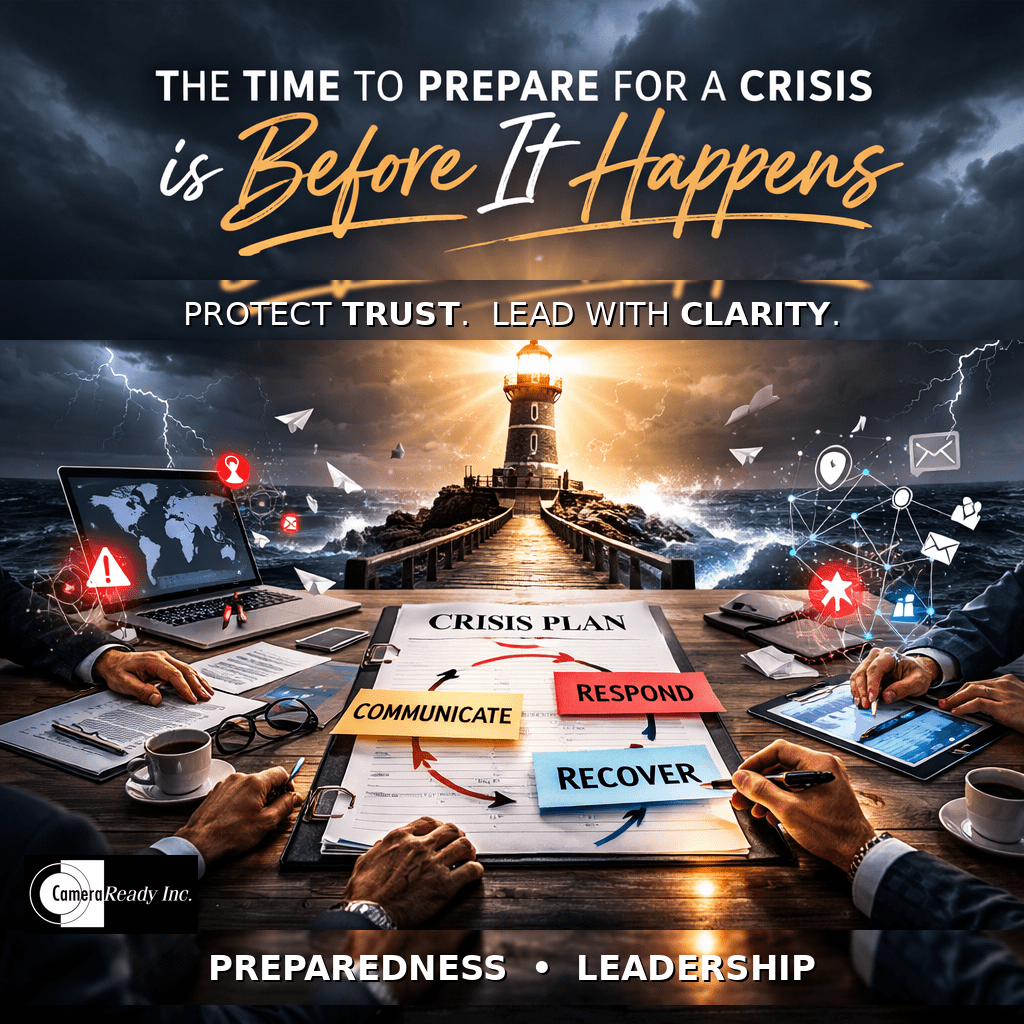
Organizations rarely believe a crisis will happen to them.
Not because leaders are unaware of risk, but because crises often feel abstract until they are immediate. Strategic plans, operational controls, and governance frameworks can create a sense of preparedness that can unintentionally obscure the lack of communication readiness.
When disruption occurs — whether reputational, operational, regulatory, cyber, leadership, or cultural, stakeholders also experience the organization’s response.
Silence, hesitation, contradiction, or visible uncertainty can expand the perceived severity of an incident regardless of the underlying facts. Conversely, clarity and composure can meaningfully contain reputational damage even while operational recovery is still underway.
Crisis communication planning is therefore a leadership discipline.
Why Organizations Delay Preparation
Many organizations assume crisis plans can be assembled when needed. This assumption is understandable. Crisis scenarios feel hypothetical, and dedicating time to them can appear pessimistic or unnecessarily resource intensive.
Yet the characteristics of crisis environments make improvisation particularly risky:
- information is incomplete and evolving
- stakeholder anxiety accelerates speculation
- internal teams seek direction simultaneously
- regulators, media, and customers expect rapid acknowledgment
- leadership credibility is evaluated in real time
In these conditions, the absence of a communication framework does not create neutrality. It creates narrative vacuum and risk.
The Expanding Nature of Organizational Crisis
While cybersecurity incidents receive significant attention, crisis exposure is broader.
Organizations today face potential disruption from:
- cyber and data privacy events
- leadership conduct or transition challenges
- operational failures or safety incidents
- regulatory actions and investigations
- cultural or workplace trust breakdowns
- social amplification and misinformation
- third-party or ecosystem risk
Each of these scenarios introduces uncertainty that stakeholders must interpret quickly, often with incomplete context.
The organization’s messaging becomes the lens through which trust is either stabilized or weakened.
What Prepared Organizations Do Differently
Prepared organizations build communication infrastructure capable of supporting multiple scenarios.
This typically includes:
Defined decision authority
Clarity regarding who can approve messaging
Message architecture
Frameworks that establish priorities and sequencing
Leadership visibility
Stakeholders interpret presence as accountability
Empathy alongside information
Facts alone rarely stabilize stakeholders. Recognition of impact communicates awareness and responsibility.
The Cost of Communicative Hesitation
Research into data breach response and organizational disruption consistently demonstrates that delayed acknowledgment increases reputational and financial consequences. The IBM Cost of a Data Breach Report has repeatedly shown that prolonged detection and containment timelines correlate with higher total breach costs, underscoring how time amplifies impact.
Similarly, Verizon’s Data Breach Investigations Report highlights the continued role of human behavior in incident origination, reinforcing that crisis risk is not purely technical.
While these studies focus on cybersecurity, the broader lesson applies across crisis types: uncertainty magnifies perceived risk, and communication is the primary mechanism through which uncertainty can be reduced.
Board Oversight and Communication Readiness
For boards, crisis communication readiness, directors are increasingly asking:
- Does management have a communication activation protocol?
- Are internal communication pathways as clear as external ones?
- Has leadership rehearsed crisis visibility and tone?
- Does the organization understand the reputational implications of silence?
These questions reflect recognition that reputation recovery is often more complex than operational recovery and serve the board’s primary function: stewardship via risk mitigation.
Preparedness as a Signal of Stewardship
Crisis preparation is frequently misinterpreted as pessimism. In reality, it is evidence of respect for stakeholders and awareness of organizational responsibility.
Prepared communication does not eliminate crisis. It reduces confusion, preserves credibility, and supports faster alignment during periods when stakeholders most need reassurance.
The organizations that navigate disruption most effectively are the ones whose stakeholders experience leadership as steady while uncertainty unfolds.
The time to determine how an organization will communicate during disruption is not when disruption begins.
It is when clarity can still be designed rather than improvised.
Rhonda Overby advises boards and executive teams on enterprise reputation, stakeholder trust, and communication.