

Labor-management relations is the structured, bilateral process through which employers and employee representatives, typically unions, interact to negotiate and administer the terms and conditions of employment, covering collective bargaining, contract administration, and grievance procedures. In the United States, this field spans two distinct legal worlds: private-sector workplaces governed by the National Labor Relations Act (NLRA) and enforced by the National Labor Relations Board (NLRB), and federal-sector workplaces governed by the Federal Service Labor-Management Relations Statute and administered by the Federal Labor Relations Authority (FLRA). A third layer, the Labor-Management Reporting and Disclosure Act (LMRDA), adds transparency and democratic accountability requirements for unions themselves.
Here is what this guide covers:
- The core elements of labor-management relations and how the process flows day to day
- The U.S. legal framework: NLRA, NLRB, LMRDA, the Federal Service Statute, and the U.S. Department of Labor (DOL)
- Dispute-resolution processes, from grievances to strikes
- Roles and responsibilities across management, unions, and HR
- Practical principles for constructive outcomes
For enforcement questions or to file a charge, the NLRB (private sector) and the FLRA (federal sector) are the primary agencies. The DOL’s Office of Labor-Management Standards (OLMS) handles union reporting and compliance under the LMRDA.
Table of Contents
- What labor-management relations actually involves day to day
- The U.S. legal framework: statutes, agencies, and sector differences
- How disputes get resolved: grievances, mediation, arbitration, and strikes
- Who does what: roles and responsibilities across the table
- Why healthy labor-management relations matter for your organization
- Practical principles for constructive bargaining and dispute avoidance
- Where to find authoritative help and how to take your next steps
- Key Takeaways
- Why the balance of power at the bargaining table matters more than most people admit
- Free resources from Workplacefairness to help you act
- Useful sources and further reading
What labor-management relations actually involves day to day
Labor-management relations is a specialized sub-function within HR, focused on the formal, legally governed relationship between an employer and its unionized workforce. Five building blocks define the field.
- Collective bargaining: The negotiation process through which management and a union’s exclusive representative reach a collective bargaining agreement (CBA) covering wages, hours, benefits, and working conditions.
- Exclusive representation: Once a union is certified, it represents all employees in the bargaining unit, whether or not they are union members.
- The CBA: The written contract that governs the employment relationship for the duration of the agreement, typically two to four years.
- Contract administration: Day-to-day management of CBA obligations, including interpreting ambiguous language and tracking compliance.
- Grievance procedures: The formal, step-by-step process for resolving disputes about CBA interpretation or alleged violations.
How the process flows. Organizing and recognition come first: employees petition for a union, the NLRB conducts an election, and a certified union becomes the exclusive representative. Bargaining follows, producing a CBA. Once signed, the parties shift to contract administration. When a dispute arises, it enters the grievance procedure, escalating through defined steps until it is resolved or referred to arbitration.
Three quick examples:
- Wage dispute: A union files a grievance claiming management applied a wage scale incorrectly. The parties meet at Step 1, management reviews payroll records, and the issue is resolved without arbitration.
- Policy change: Management proposes a new attendance policy mid-contract. The union argues the change is a mandatory subject of bargaining and demands to negotiate before implementation.
- Discipline: An employee is suspended. The union representative challenges whether just cause existed under the CBA and escalates to arbitration when Step 2 talks fail.
The U.S. legal framework: statutes, agencies, and sector differences
Three federal statutes form the backbone of U.S. labor law, and understanding which one applies to a given workplace is the first step in any labor relations analysis.

| Statute | Sector covered | Primary enforcer | Key focus |
|---|---|---|---|
| National Labor Relations Act (NLRA) | Private sector | NLRB | Collective bargaining rights, unfair labor practices |
| Labor-Management Reporting and Disclosure Act (LMRDA) | Unions (all sectors) | DOL/OLMS | Union financial reporting, member bill of rights, fair elections |
| Federal Service Labor-Management Relations Statute | Federal executive branch | FLRA | Federal employee bargaining rights, grievance procedures |
The NLRA protects private-sector employees’ rights to organize, bargain collectively, and engage in concerted activity. The NLRB investigates and adjudicates unfair labor practice (ULP) charges and conducts representation elections.
The LMRDA, administered by the DOL’s OLMS, requires unions to file financial reports, hold fair elections, protect members’ rights to vote and speak, and safeguard union funds from misuse. It applies to most private-sector unions and some public-sector unions.
The Federal Service Labor-Management Relations Statute governs most federal executive-branch employees. The FLRA administers the statute through three components: the Authority (adjudicates ULP charges and representation disputes), the Office of the General Counsel (investigates and prosecutes ULP charges), and the Federal Service Impasses Panel (resolves bargaining impasses).
Private sector vs. federal sector: the key differences
- Scope of bargaining: Federal unions cannot bargain over wages or most benefits, which are set by Congress. Private-sector unions bargain over virtually all terms and conditions.
- Strike rights: Federal employees generally cannot strike. Private-sector employees retain the right to strike, subject to notice requirements and legal constraints.
- Remedies: NLRB remedies can include back pay and reinstatement. FLRA remedies are generally more limited.
- Grievance exclusivity: In federal workplaces, a negotiated grievance procedure embedded in a CBA is often the exclusive remedy for covered matters, which can bar standard HR grievance channels for those same issues.
The ILO frames labor relations broadly as covering legal, economic, sociological, and institutional interactions between workers, employers, and the state, a framing that helps explain why U.S. practitioners must be fluent in law, economics, and organizational behavior simultaneously.
How disputes get resolved: grievances, mediation, arbitration, and strikes
Most disputes in a unionized workplace follow a predictable path before reaching an outside agency or court.
- Informal resolution. The employee raises the issue with a supervisor. Many disputes end here.
- Step 1 grievance. The union files a written grievance. Management responds within a contractually defined window, often 5–15 days.
- Step 2 escalation. If unresolved, the grievance moves to a higher management level, sometimes HR or a labor relations specialist.
- Step 3 (if applicable). Some CBAs include a third internal step involving senior management or a joint labor-management committee.
- Arbitration. Either party may demand binding arbitration. A neutral arbitrator hears evidence and issues a decision that is enforceable in federal court.
Mediation vs. arbitration. Mediation is a voluntary, non-binding process in which a neutral third party helps the parties reach their own agreement. The Federal Mediation and Conciliation Service (FMCS) provides mediators to both private and federal-sector parties at no charge. Arbitration is typically binding and produces a final decision the losing party must follow.
Unfair labor practice charges. When a party believes the other has violated the NLRA (private sector) or the Federal Service Statute (federal sector), it files a ULP charge with the NLRB or FLRA respectively. The agency investigates, and if it finds merit, issues a complaint that proceeds to a hearing. Knowing how to file a labor board charge before a deadline passes is critical, since NLRB charges must generally be filed within six months of the alleged violation.
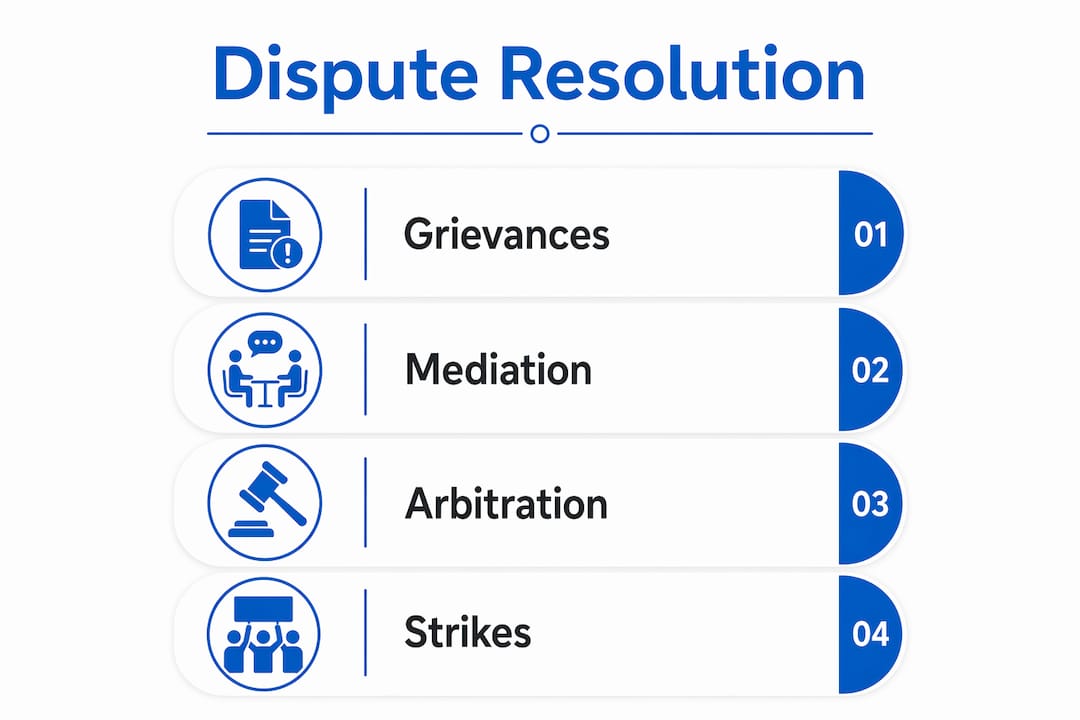
Strikes and lockouts. Private-sector employees have a protected right to strike over mandatory subjects of bargaining. Unions representing workers in healthcare facilities must give 10 days’ advance notice. Employers may respond with a lockout under certain conditions. Both actions carry significant legal and reputational consequences, and most disputes are resolved well before either occurs.
Pro Tip: Document every step of a grievance in writing, including dates, names, and the specific CBA provision at issue. Gaps in documentation are the most common reason grievances fail at arbitration.
Who does what: roles and responsibilities across the table
| Role | Primary responsibilities |
|---|---|
| Management negotiators | Develop bargaining proposals, cost out contract terms, present management’s position at the table |
| Union representatives | Advocate for bargaining-unit members, file and process grievances, communicate CBA rights |
| Labor relations specialists | Administer the CBA day to day, advise supervisors, coordinate grievance responses, prepare for bargaining |
| HR business partners | Handle non-union employee relations, support supervisors on policy, escalate potential ULP issues |
| Outside legal counsel | Advise on ULP exposure, represent parties in arbitration or NLRB proceedings |

Labor relations specialists carry a particularly broad load. According to HR Policy Association research, the top responsibilities for employee and labor relations teams include internal complaint handling (75% of teams), collective bargaining (65%), and coordination with outside counsel (63%).
Daily tasks for labor relations practitioners:
- Interpreting CBA language for supervisors and managers
- Tracking grievance deadlines and preparing management responses
- Monitoring compliance with wages, hours, and benefit provisions
- Preparing cost models and proposals ahead of contract reopeners
- Advising on discipline to reduce just-cause exposure
The adversarial nature of collective bargaining, the urgency of strike management, and the legal and reputational stakes of ULP disputes make labor relations one of the more demanding specialties in HR. Practitioners who thrive tend to combine strong negotiation skills with deep compliance literacy and the ability to stay composed under pressure.
Pro Tip: Build relationships with union stewards outside of formal grievance meetings. Informal trust reduces the volume of formal disputes and speeds resolution when they do arise.
Why healthy labor-management relations matter for your organization
The stakes of getting labor-management relations right are concrete and measurable. Well-managed relations reduce work stoppages, clarify workplace rules, and improve employee satisfaction. Poorly managed relations produce the opposite: disputes, strikes, legal liability, and reputational damage that can affect recruiting and retention for years.
SHRM’s guidance on labor and employee relations confirms that effective management of this function reduces workplace disruptions, strengthens compliance with labor laws, and improves employee satisfaction when supported by clear policies and consistent communication.
Benefits of constructive labor-management relations:
- Fewer work stoppages and lower operational disruption
- Predictable labor costs through multi-year CBAs
- Clearer rules for discipline, promotion, and scheduling
- Higher employee morale and reduced turnover in unionized units
- Stronger legal defensibility when disputes do arise
Risks of adversarial or neglected relations:
- Strikes, slowdowns, or work-to-rule campaigns
- Costly ULP litigation and potential back-pay awards
- Reputational harm that affects public perception and talent pipelines
- Loss of management flexibility when arbitrators rule against poorly documented decisions
Consider a straightforward example: a manufacturer that negotiates a productivity-linked wage increase during bargaining avoids a strike, retains its workforce, and gains a contractual framework for measuring output. A comparable manufacturer that refuses to bargain in good faith faces a ULP charge, a potential strike, and the cost of temporary replacements. The difference in outcome traces directly to how labor-management relations were managed at the table.
Practical principles for constructive bargaining and dispute avoidance
Preparation and transparency are the two factors that most consistently separate productive bargaining from protracted conflict. The following checklist applies whether you are sitting on the management side or the union side of the table.
- Gather your data early. Compile wage surveys, benefits cost analyses, grievance logs, and productivity metrics at least 90 days before bargaining opens.
- Define your priorities and your limits. Know which proposals are essential, which are tradeable, and which you will not move on. Undisciplined bargaining teams make costly concessions under pressure.
- Frame issues jointly where possible. Presenting a problem as shared (“our grievance rate on overtime scheduling is high for both of us”) opens more solutions than positional demands.
- Commit to realistic timelines. Set a target date for a tentative agreement and build in mediation as a fallback before the contract expires.
- Keep supervisors informed. Supervisors who misapply a new CBA provision generate grievances. Brief them before the ink dries.
- Document everything. Bargaining notes, proposals exchanged, and tentative agreements reached at the table all become evidence if a ULP charge is filed later.
- Involve counsel early on complex issues. Subcontracting, plant closings, and benefit-plan changes carry mandatory bargaining obligations that are easy to trigger inadvertently. Understanding common employer labor law violations before bargaining begins reduces exposure significantly.
Sample bargaining questions that produce movement:
- “What does the data show about our grievance rate on this issue over the last three years?”
- “Would a six-month pilot period on this scheduling change address your members’ concerns?”
- “If we agree on a grievance timeline, what flexibility does that give us on the discipline language?”
Pro Tip: Proactive transparency and consistent communication between management and union representatives tend to produce more durable agreements than reactive, conflict-driven approaches. Share relevant operational data with the union before bargaining, not during it.
Where to find authoritative help and how to take your next steps
The table below lists the primary resources for anyone navigating labor-management relations in the United States, whether you are an employee, a union representative, an HR professional, or an employer.
| Resource | What it provides | Where to go |
|---|---|---|
| NLRB | Guidance on NLRA rights, ULP charge filing, election procedures | nlrb.gov |
| DOL/OLMS | LMRDA compliance, union financial reports, member rights | dol.gov/labor-relations |
| FLRA | Federal-sector statute text, ULP procedures, impasse resolution | flra.gov |
| Federal Service Statute | Full statutory text for federal-sector practitioners | law.cornell.edu |
| Workplacefairness | Plain-language guides on employee rights, filing charges, and finding an attorney | workplacefairness.org |
Action steps:
- Filing a ULP charge (private sector): Submit Form NLRB-501 to your regional NLRB office within six months of the alleged violation. The NLRB’s website provides regional office contacts and filing instructions.
- Filing a ULP charge (federal sector): Contact the FLRA’s Office of the General Counsel. Charges must be filed within six months as well.
- Seeking a mediator: Contact the Federal Mediation and Conciliation Service (FMCS) directly. Mediation is free and available to both private and federal-sector parties.
- Gathering documentation: Before filing any charge or grievance, collect the relevant CBA language, written communications, pay records, and a timeline of events.
- When to consult an attorney: If a ULP charge has been filed against you, if arbitration is imminent, or if a strike authorization vote has passed, retain labor counsel immediately.
Workplacefairness complements these government resources with plain-language guides that translate statute and agency guidance into terms employees and employers can act on without a law degree.
Key Takeaways
Labor-management relations in the United States is governed by three federal statutes, administered by distinct agencies for private and federal sectors, and built around collective bargaining as its central mechanism.
| Point | Details |
|---|---|
| Core definition | Labor-management relations covers collective bargaining, contract administration, and grievance procedures between employers and employee representatives. |
| Legal anchors | The NLRA governs private-sector workplaces; the Federal Service Statute governs federal employees; the LMRDA regulates union transparency and member rights. |
| Dispute resolution | Grievances move from informal resolution through defined CBA steps to binding arbitration; ULP charges go to the NLRB or FLRA depending on sector. |
| Practical principle | Proactive transparency and early data preparation consistently produce more durable agreements than reactive, adversarial approaches. |
| Workplacefairness | Workplacefairness provides free, plain-language guides on employee rights, filing charges, and finding an employment attorney at workplacefairness.org. |
Why the balance of power at the bargaining table matters more than most people admit
Labor-management relations is often framed as a legal compliance exercise, a matter of following the NLRA, filing the right forms, and avoiding ULP charges. That framing misses the deeper dynamic. The quality of the relationship between management and a union representative shapes outcomes that no statute can mandate: whether a grievance gets resolved at Step 1 or drags through arbitration for two years, whether a contract negotiation produces a workable agreement or a strike, whether employees trust the process enough to raise concerns through formal channels rather than walking out the door.
What most guides understate is how much the informal relationship matters. Formal legal compliance sets a floor. What happens above that floor, the daily conversations, the willingness to share data, the consistency with which supervisors apply the CBA, determines whether labor-management relations actually works for anyone. Organizations that treat the union as an adversary to be managed rather than a representative to be engaged tend to accumulate grievances, lose arbitrations on procedural grounds, and face bargaining impasses that could have been avoided with earlier, more honest communication.
The statutes and agencies covered in this guide are real and consequential. But they are backstops, not substitutes for the kind of good-faith engagement that produces equitable workplaces. Employees and employers alike are better served by understanding both the legal framework and the relational principles that make it function.
Free resources from Workplacefairness to help you act
Workplacefairness has provided free, plain-language information on employee rights and workplace fairness since 1994, when it was founded as the National Employee Rights Institute. For anyone navigating labor-management relations, whether you are an employee trying to understand your CBA rights, an HR professional preparing for bargaining, or someone considering filing a charge, the site offers practical guides that translate complex law into clear next steps.
Start with the employee rights guide for a comprehensive overview of your legal protections under U.S. law. If you believe your employer has violated labor law, the common employer violations guide walks through the most frequent infractions and what you can do about them. For state-specific questions or to find an employment attorney in your area, the Workplacefairness attorney directory connects you with legal professionals who handle labor and employment matters.
Useful sources and further reading
The sources below provide statutory text, agency guidance, and practitioner context for anyone who wants to go deeper on U.S. labor-management relations.
| Source | What it adds |
|---|---|
| National Labor Relations Act (NLRB) | Full statutory text and NLRB enforcement guidance for private-sector practitioners |
| DOL/OLMS: Labor Relations | LMRDA provisions, union financial reports, member bill of rights, and OLMS enforcement |
| Federal Service Labor-Management Relations Statute (FLRA) | Complete text of the federal-sector statute with FLRA annotations |
| Federal Service Statute via Cornell LII | Annotated U.S. Code version of Chapter 71, useful for cross-referencing with case law |
| U.S. Department of Commerce: Labor-Management Relations | Practitioner guidance on bilateral resolution, negotiated grievance procedures, and federal-sector distinctions |
| ILO Industrial Relations Glossary | International framing of industrial relations covering legal, economic, and sociological dimensions |
- NLRA/NLRB: The primary source for private-sector rights, election procedures, and ULP charge filing. The NLRB’s regional offices handle most initial contacts.
- LMRDA/OLMS: Essential for union officers and members who need to understand reporting obligations, election standards, and member protections.
- Federal Service Statute: Required reading for federal HR practitioners and union representatives in the executive branch.
- Cornell LII: Provides a freely searchable, annotated version of the U.S. Code, including Chapter 71, that is easier to navigate than the raw statutory text.
- ILO Glossary: Useful for practitioners who work in multinational environments or want a conceptual framework that situates U.S. law within broader industrial relations theory.
This article provides general information about U.S. labor-management relations law and is not legal advice. Confirm current rules and your specific rights with the relevant agency or a qualified employment attorney.
Recommended
- Common Employer Labor Law Violations: Your 2026 Guide
- What Is Labor Standards Enforcement for Workers?
- What Is a Labor Board Charge? Your Rights Explained
- What Is Right to Work? A Guide for Workers
The post What Is Labor-Management Relations? A U.S. Guide appeared first on Workplace Fairness, Empower Workers.