

Labor trafficking is the use of force, fraud, or coercion to compel a person to provide labor or services against their will. If you or someone you know is in immediate danger, call 911 now. For non-emergency situations, the National Human Trafficking Hotline (Polaris) is available 24/7 at 1-888-373-7888 or by text at 233733.
If you suspect trafficking right now:
- Call 911 if there is an immediate physical threat.
- Contact the National Hotline (Polaris) for confidential referrals and guidance.
- Do not confront a suspected trafficker alone.
- Help the person reach a safe space before taking any other steps.
- Do not attempt a solo rescue — trained professionals should lead any intervention.
Table of Contents
- What is labor trafficking under U.S. federal law?
- How does trafficking differ from other workplace violations?
- What are the warning signs of labor trafficking?
- Where does labor trafficking commonly appear?
- What should you do if you suspect labor trafficking?
- What protections and remedies are available to victims?
- How can employers, coworkers, and advocates prevent labor trafficking?
- Key takeaways
- Workplacefairness’s perspective on labor trafficking
- Authoritative sources and next-step resources
What is labor trafficking under U.S. federal law?
The Trafficking Victims Protection Act (TVPA), enacted in 2000 and codified at 22 U.S.C. § 7102(9), defines labor trafficking as the recruitment, harboring, transportation, provision, or obtaining of a person for labor through force, fraud, or coercion, for the purpose of involuntary servitude, peonage, debt bondage, or slavery. Federal enforcement is shared among the Department of Labor (DOL), the Department of Justice (DOJ), and the Department of Homeland Security (DHS).
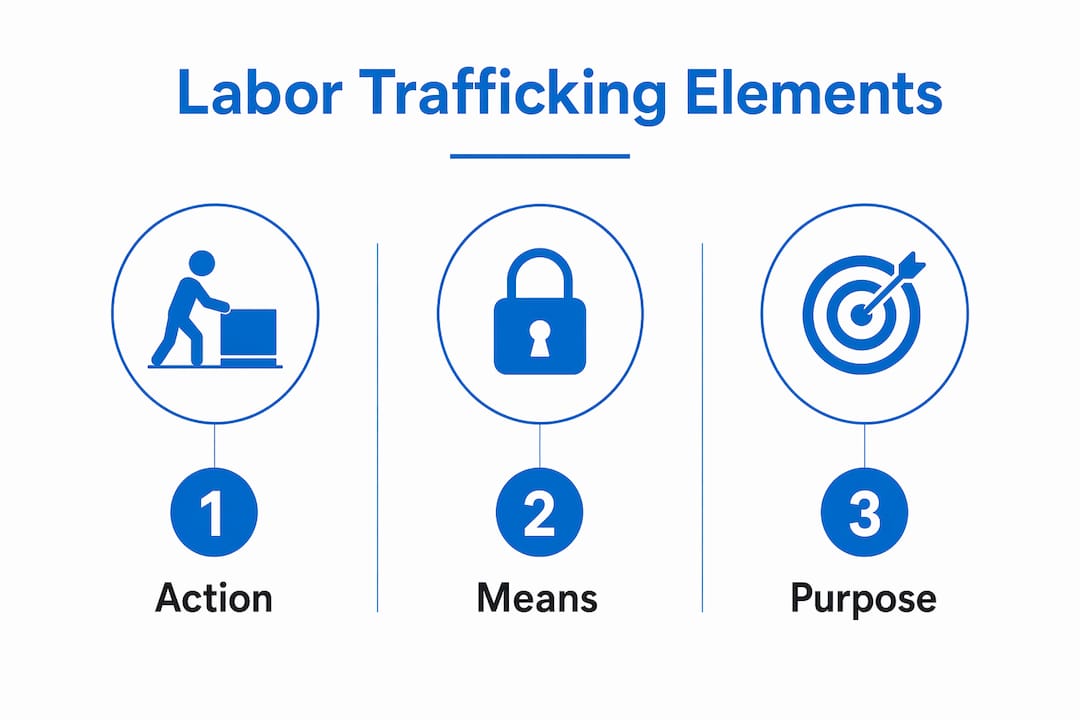
The legal test follows an Action + Means + Purpose model. All three elements must be present for a situation to meet the federal trafficking standard.
| Element | What it means | Examples |
|---|---|---|
| Action | How the trafficker obtains the victim | Recruiting, harboring, transporting, providing, or obtaining |
| Means | How control is maintained | Force (physical assault, confinement), fraud (false job offers, withheld wages), coercion (deportation threats, debt bondage) |
| Purpose | The goal of the exploitation | Involuntary servitude, peonage, debt bondage, slavery |
One point advocates must understand: prior consent is irrelevant once force, fraud, or coercion is applied. A worker who initially agreed to a job can still be a trafficking victim if conditions later become coercive.
How does trafficking differ from other workplace violations?
Labor trafficking sits at the most severe end of a spectrum of workplace misconduct. Wage theft, unsafe conditions, and immigration violations are serious — but they do not automatically constitute trafficking. The distinction matters because it determines which agency to contact first and what remedies are available.
| Situation | Likely classification | First contact |
|---|---|---|
| Employer fails to pay overtime | Wage theft | DOL Wage and Hour Division |
| Unsafe equipment, no protective gear | OSHA violation | OSHA / DOL |
| Employer threatens deportation to prevent a worker from leaving | Possible trafficking | National Hotline, then DOL or DOJ |
| Employer holds worker’s passport and controls housing | Likely trafficking | National Hotline / DHS Blue Campaign |
| Undocumented worker paid below minimum wage | Immigration + wage violation | DOL Wage and Hour Division |
Multiple violations often coexist. A domestic worker whose employer withholds her passport, charges inflated fees for housing, and threatens deportation if she complains faces wage theft, immigration violations, and trafficking. In overlapping cases, the National Hotline coordinates with DOL, DOJ, and DHS to determine who takes the lead. Workplacefairness offers a practical overview of common employer violations that can help you identify where a situation falls on this spectrum.
What are the warning signs of labor trafficking?
Traffickers exploit vulnerabilities — economic hardship, precarious immigration status, limited English, and social isolation — to create dependency and prevent victims from seeking help. Psychological coercion can be as effective as physical restraint, which means trafficking is often hidden in plain sight.
Core red flags include:
- Withheld identity documents: Employer holds a worker’s passport, visa, or ID and refuses to return them on demand.
- Debt bondage: Worker owes an ever-growing, undefined debt to the employer or recruiter for transportation, housing, or food.
- Threats of deportation: Employer uses immigration status as a weapon to prevent complaints or departure.
- Overcrowded or inhumane housing: Workers are housed in employer-controlled, substandard conditions with no freedom to leave.
- Withheld or manipulated wages: Pay is delayed, docked arbitrarily, or never delivered.
- Isolation and monitoring: Worker cannot speak freely, is accompanied by a supervisor during conversations, or lacks access to a phone.
- No control over schedule or movement: Worker cannot refuse shifts, take time off, or leave the worksite.
No single indicator proves trafficking. Look for overlapping patterns — the more signs present, the greater the concern.
Pro Tip: If you want to check on a worker you suspect may be trafficked, try to speak with them privately and without time pressure. Ask open-ended questions about their living situation and whether they feel free to leave their job. Never press for details in front of a supervisor or employer.

Where does labor trafficking commonly appear?
Labor trafficking appears across many U.S. industries, but certain sectors carry higher risk because of informal work arrangements, subcontracting chains, and isolated worksites.
- Agriculture: Workers recruited through labor brokers, housed on-site, and charged inflated fees that create debt bondage. Remote locations limit access to outside help.
- Domestic service: Domestic workers brought into private homes, often from abroad, with passports withheld and no contact with the outside world. Workplacefairness has documented labor trafficking risks in domestic work and the nonprofit strategies that address them.
- Construction: Day laborers hired through informal networks or deceptive job ads, then underpaid or not paid at all. Subcontracting layers obscure accountability. Day laborers can review their wage protections to understand their rights.
- Hospitality and food processing: Workers housed in employer-controlled facilities, charged for meals and lodging, and threatened with job loss or deportation if they complain.
Trafficking also hides in supply chains. A business may unknowingly source goods or services from a subcontractor using trafficked labor. Deceptive job ads, informal labor recruiters, and social networks are the most common recruitment channels traffickers use to reach vulnerable workers.
What should you do if you suspect labor trafficking?
Acting carefully protects both the potential victim and the integrity of any future investigation.
- Ensure immediate safety first. Call 911 if there is a physical threat. If the situation is not immediately dangerous, do not rush.
- Create a private, safe space. If possible, speak with the worker away from the employer or anyone who may be monitoring them.
- Document what you observe. Record dates, locations, names, and specific behaviors. Preserve pay stubs, text messages, or photos if the worker consents and it is safe to do so.
- Report to the right channel. Call the National Human Trafficking Hotline (1-888-373-7888) for guidance on next steps. For wage-related violations, contact the DOL Wage and Hour Division. For criminal investigation, contact local law enforcement or the DOJ tip line. For immigration-related coercion, contact DHS or the Blue Campaign.
- Connect the worker to services. Victim advocates, legal aid organizations, and shelter providers can offer support that law enforcement alone cannot.
- Keep the victim’s wishes central. Survivors have the right to make their own decisions. Advocates should provide information and options, not pressure.
Avoid confronting a suspected trafficker directly. If someone feels pressured to stay in a job or fears harm for leaving, contact trained professionals rather than attempting an intervention alone.
What protections and remedies are available to victims?
Survivors of labor trafficking have access to several overlapping forms of relief under U.S. law.
- Criminal prosecution: The DOJ prosecutes traffickers under the TVPA and related statutes. Convictions can result in significant federal prison sentences.
- DOL investigations: The DOL Wage and Hour Division can recover unpaid wages and pursue civil enforcement against employers. Understanding labor standards enforcement helps advocates know what to request.
- T visa (immigration relief): Trafficking victims who cooperate with law enforcement may be eligible for a T nonimmigrant visa, which provides temporary legal status and access to federal benefits. Prior consent to employment does not disqualify a victim.
- Civil remedies: Survivors can bring private civil lawsuits under the TVPA for damages. They may also file wage claims through the DOL or state labor agencies.
- Victim services: Shelter, counseling, legal representation, and case management are available through federally funded victim service providers. Many offer pro bono or low-cost legal help.
The DOL, DOJ, and DHS each play a distinct enforcement role, and cases often involve coordination across all three agencies.
How can employers, coworkers, and advocates prevent labor trafficking?
Prevention requires shared responsibility across workplaces, supply chains, and communities.
Employer best practices:
- Never confiscate or hold workers’ identity documents.
- Provide transparent, written pay agreements in workers’ primary languages.
- Allow workers free access to communications and the ability to leave the worksite.
- Vet labor recruiters and subcontractors for compliance with labor standards.
- Establish confidential internal reporting channels for workers to raise concerns.
Community and supply-chain measures:
- Conduct regular audits of subcontractors and labor brokers.
- Partner with local service providers and nonprofit organizations to build referral networks.
- Train supervisors and HR staff to recognize red flags and respond without retaliation.
- Distribute hotline information (National Human Trafficking Hotline: 1-888-373-7888) in multiple languages at worksites.
- Support workers’ access to legal information through organizations like Workplacefairness.
Nonprofit sector staff can also draw on sector-specific guidance for nonprofit workforce indicators to strengthen community-based detection and response programs.
Key takeaways
Labor trafficking is a federal crime requiring proof of an action, a coercive means, and an exploitative purpose — and prior consent to a job never bars a trafficking finding if coercion follows.
| Point | Details |
|---|---|
| The legal test | Action + Means + Purpose under the TVPA (22 U.S.C. § 7102(9)) must all be present. |
| Immediate action | Call 911 for danger; call the National Hotline (1-888-373-7888) for non-emergency reporting. |
| Prior consent is irrelevant | A worker who agreed to a job can still be a trafficking victim if coercion is later used. |
| Key red flags | Withheld documents, debt bondage, deportation threats, and isolation are the strongest indicators. |
| Who enforces | DOL, DOJ, and DHS share enforcement; Polaris coordinates national referrals. |
Workplacefairness’s perspective on labor trafficking
Labor trafficking is one of the gravest violations of workplace fairness we address. Since our founding in 1994, Workplacefairness has worked to connect employees with the legal knowledge they need to recognize exploitation and assert their rights. Our guides cover employee rights broadly, common employer violations, and labor standards enforcement — all of which intersect with trafficking prevention and response.
If you are an employee, coworker, or advocate trying to understand whether a situation crosses the line into trafficking, start with the resources below. Knowledge is the first protection.
Authoritative sources and next-step resources
- National Human Trafficking Hotline (Polaris): 1-888-373-7888 | Text: 233733 | Available 24/7, confidential, multilingual. Provides crisis support, referrals, and reporting intake.
- U.S. Department of Labor (DOL): Wage and Hour Division investigates labor violations and can recover unpaid wages; the DOL also publishes guidance on recognizing and reporting trafficking.
- U.S. Department of Justice (DOJ): Prosecutes trafficking crimes federally; operates a human trafficking tip line and funds victim service grants.
- DHS Blue Campaign: The Department of Homeland Security’s national public awareness effort; provides training materials, multilingual resources, and reporting guidance for employers and communities.
- Office for Victims of Crime (OVC): Funds victim services nationwide and publishes training materials on labor trafficking identification and response.
- Workplacefairness: Worker-facing guides on employee rights, employer violations, and labor standards enforcement — a practical starting point for employees and advocates navigating exploitation or trafficking concerns.
This article provides general information about labor trafficking and is not legal advice. For guidance specific to your situation, consult a qualified attorney or contact the relevant federal agency or hotline listed above.
Recommended
- Common Employer Labor Law Violations: Your 2026 Guide
- What Is Labor Standards Enforcement for Workers?
- Day Laborer Wage Protections: Your 2026 Rights Guide
The post What Is Labor Trafficking: A U.S. Guide for Employees appeared first on Workplace Fairness, Empower Workers.