

“Employment tribunal” is a U.K. term for an independent judicial body that decides workplace disputes between employers and workers. In the United States, no single forum carries that name. Instead, U.S. employees bring workplace claims through federal and state administrative agencies, private arbitration panels, or civil courts, depending on the type of dispute.
Your closest U.S. equivalents are:
- Equal Employment Opportunity Commission (EEOC) — discrimination, harassment, and retaliation claims under federal civil rights law
- National Labor Relations Board (NLRB) — union organizing, collective bargaining, and unfair labor practice charges
- U.S. Department of Labor (DOL) — wage and hour violations, FMLA, and federal contractor compliance
- State labor or fair employment practice agencies — parallel to federal agencies, often with broader protections and shorter deadlines
- Private arbitration panels — binding dispute resolution under mandatory arbitration clauses in many employment contracts
- Civil courts — federal or state litigation when administrative remedies are exhausted or a claim does not require agency filing first
If something happened at work that you believe was unlawful, your first move is to preserve every record you have, note the exact dates, and contact the appropriate agency or review the employee rights guides at Workplacefairness before a filing deadline passes.
Table of Contents
- How U.S. workplace disputes are resolved: agencies, courts, and arbitration
- Which U.S. forum handles your type of claim?
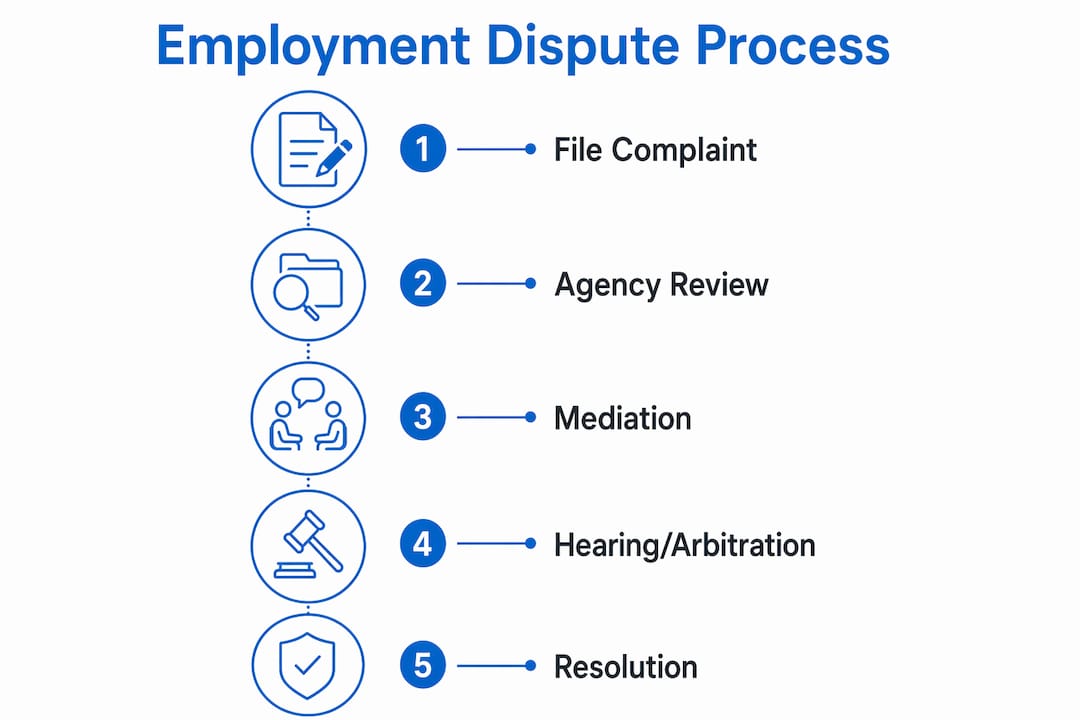
- Step-by-step: the typical U.S. employment dispute process
- What to expect at a U.S. administrative hearing or arbitration
- Possible outcomes, remedies, and costs
- Where to find trustworthy legal help
- Your immediate action checklist after a workplace incident
- Key Takeaways
- Why understanding this term matters for U.S. workers
- Workplacefairness has free guides and an attorney directory for you
- Useful sources and recommended reading
How U.S. workplace disputes are resolved: agencies, courts, and arbitration
Three main paths exist for resolving employment disputes in the United States. Each differs in formality, cost, and the remedies available.
| Forum | When used | Common claims | Key characteristics |
|---|---|---|---|
| Administrative agency (EEOC, NLRB, DOL, state agencies) | Before or instead of court; often required first | Discrimination, wage theft, unfair labor practices | Free to file; agency investigates; mediation/conciliation offered; can issue binding decisions |
| Arbitration | When an employment contract contains a mandatory arbitration clause | Broad range, including discrimination and contract disputes | Private and binding; limited appeal rights; filing fees may apply |
| Civil court | After agency process or for claims not requiring agency filing | Wrongful termination, breach of contract, tort claims | Most formal; full discovery; jury trial possible; attorney fees significant |
Administrative agencies are the most common starting point. They investigate, offer mediation, and can issue binding orders or refer cases to court. Arbitration is a private process, often required by contract, where a neutral arbitrator issues a final decision. Civil litigation is the most formal route and typically follows the exhaustion of administrative remedies.
Mandatory arbitration clauses deserve special attention. Many employers include them in offer letters or employee handbooks, requiring workers to resolve disputes privately rather than in court. These clauses are generally enforceable under federal law, which limits your ability to pursue a class action or appeal an arbitrator’s decision.
Which U.S. forum handles your type of claim?
Matching your complaint to the right forum early prevents wasted time and missed deadlines.
| Claim type | Primary forum | Notes |
|---|---|---|
| Discrimination (race, sex, age, disability, religion) | EEOC or state fair employment agency | Must file with EEOC before suing in federal court |
| Wage and hour violations | DOL Wage and Hour Division or state labor agency | State agencies often cover more workers |
| Retaliation for protected activity | EEOC, NLRB, DOL (varies by statute) | Forum depends on the underlying protected activity |
| Wrongful termination | Civil court or arbitration | No standalone federal claim; often tied to discrimination or contract |
| Union/collective bargaining disputes | NLRB | Covers unfair labor practices by employers and unions |
| Workplace safety violations | OSHA (within DOL) | Whistleblower retaliation claims also go through OSHA |
| Workers’ compensation appeals | State workers’ compensation board or court | Entirely state-administered; no federal equivalent |
A single incident can trigger more than one forum. A worker fired after complaining about racial harassment may have an EEOC discrimination claim and, if a union was involved, an NLRB unfair labor practice charge. Reviewing common employer labor law violations can help you identify every applicable claim before you file.
Pro Tip: State agencies sometimes have shorter filing windows than the EEOC’s 180- or 300-day federal deadlines. Always check your state agency’s deadline first.
Step-by-step: the typical U.S. employment dispute process
The employment tribunal process in the U.K. follows a structured sequence. U.S. agency and court processes are similar in logic, though the names and timelines differ.
- Preserve evidence immediately. Collect pay stubs, emails, performance reviews, and any written communications related to the dispute before they disappear.
- Identify the right agency or forum. Use the claim-type table above to confirm where your complaint belongs.
- File a charge or complaint. With the EEOC, this is called a “charge of discrimination.” With the DOL, it is a complaint. Most agency filings are free and can be started online.
- Agency intake and notice. The agency notifies your employer (the respondent) and opens an investigation. Respondents typically have a set period to submit a written response; failure to respond can result in a default finding.
- Mediation or conciliation offer. Most agencies offer voluntary mediation at this stage. Settling early through conciliation saves time and resources compared with a full hearing, and many cases resolve here.
- Investigation. The agency reviews evidence from both sides. This can take months to over a year depending on complexity and caseload.
- Administrative hearing or right-to-sue letter. If the agency finds merit, it may schedule a hearing before an administrative judge. If it does not, or if you prefer to litigate, it issues a right-to-sue letter allowing you to file in civil court.
- Civil suit or arbitration. If your contract requires arbitration, you file with the designated arbitration service. Otherwise, you file in federal or state court.
- Decision and remedies. The judge, arbitrator, or jury issues a decision. Remedies can include back pay, reinstatement, and damages.
- Appeal. Agency decisions can be appealed internally and then to federal court. Arbitration awards have very limited appeal grounds. Court decisions follow standard appellate procedures.
Deadlines are the single most common reason valid claims are lost. The EEOC’s federal deadline is 180 days from the discriminatory act, extended to 300 days in states with their own fair employment agencies. Other statutes carry different windows entirely. Missing the filing window can forfeit your claim, so verify the exact deadline for your claim type and jurisdiction as soon as possible.
What to expect at a U.S. administrative hearing or arbitration
Whether you appear before an administrative law judge or an arbitrator, the proceeding is a binding legal exercise. Tribunal procedures in the U.K. are intentionally less formal than high courts, and U.S. administrative hearings share that quality — but “less formal” does not mean unprepared.
Expect the following at any hearing:
- Testimony given under oath or affirmation; false statements carry legal consequences including perjury charges
- Documentary evidence submitted in advance and organized chronologically
- Witness statements and the opportunity to question the other side’s witnesses
- An administrative judge or arbitrator who is independent and cannot give you legal advice
- Rules of evidence that are more relaxed than civil court but still require relevance and authenticity
Pro Tip: Organize your evidence in a timeline: date, event, document reference. Judges and arbitrators move faster when the record is clear, and a well-organized file signals credibility.
Representation matters. An employment attorney, union representative, or legal aid advocate can significantly affect strategy and outcome. Self-representation is allowed but carries real risk in complex cases. If cost is a barrier, legal aid organizations and contingency-fee attorneys handle many employment claims at no upfront cost.

Possible outcomes, remedies, and costs
Winning a workplace dispute can produce several forms of relief:
- Back pay — wages and benefits lost due to the unlawful action
- Front pay — future earnings when reinstatement is not practical
- Reinstatement — return to your former position
- Compensatory damages — out-of-pocket losses and emotional distress (where permitted by statute)
- Punitive damages — available in some federal discrimination cases to deter egregious conduct
- Injunctive relief — a court order requiring the employer to change a policy or practice
- Attorney fees and costs — recoverable under many federal employment statutes if you prevail
- Non-monetary remedies — policy changes, anti-bias training, or monitoring
Most agency filings cost nothing. Arbitration can involve filing fees, though some arbitration rules cap claimant fees. Civil litigation carries court costs and, if you hire an attorney on an hourly basis, significant legal fees.
One practical reality: winning a judgment does not guarantee payment. If an employer refuses to pay an award, you may need additional enforcement steps through civil court. Factor that possibility into your decision about whether to settle during conciliation.
Where to find trustworthy legal help
Start with government agencies before paying for private help:
- EEOC (eeoc.gov) — discrimination, harassment, retaliation
- NLRB (nlrb.gov) — union and unfair labor practice issues
- DOL Wage and Hour Division (dol.gov/agencies/whd) — wage theft, overtime, FMLA
- OSHA (osha.gov) — safety violations and whistleblower retaliation
- State labor and fair employment agencies — often faster and broader than federal counterparts
When vetting a private employment attorney, ask specifically about their experience with your claim type, whether they take cases on contingency, and their realistic assessment of your case’s strength. Workplacefairness maintains a free attorney directory and plain-language guides that can help you map your situation to the right forum before you spend money on a consultation.
Pro Tip: Legal aid organizations in most states handle employment claims for low-income workers at no cost. Search “legal aid [your state]” or ask your state bar association for a referral.
Your immediate action checklist after a workplace incident
Act on these steps as soon as possible after an incident:
- Secure all records — save emails, texts, pay stubs, and performance reviews to a personal device or account, not just a work system.
- Write down what happened — date, time, location, who was present, and exactly what was said or done.
- Preserve personnel files — request copies of your employment file while you still have access.
- Identify the right agency — use the claim-type table in this article to confirm where to file.
- Contact the agency or Workplacefairness — confirm the exact filing deadline for your claim type before anything else.
- Consult an attorney or legal aid — even a single consultation can clarify your options and timeline.
- Maintain professional conduct — avoid posting detailed allegations on social media while your claim is pending, as those posts can be used as evidence against you.
The shortest filing windows in employment law can be as brief as 30 days for certain OSHA whistleblower claims. Do not wait.
Key Takeaways
In the U.S., “employment tribunal” is a U.K. term; American workers file workplace claims through the EEOC, NLRB, DOL, state agencies, arbitration, or civil courts, and missing a filing deadline can forfeit a valid claim entirely.
| Point | Details |
|---|---|
| “Employment tribunal” is a U.K. term | U.S. equivalents include the EEOC, NLRB, DOL, state agencies, arbitration panels, and civil courts. |
| Deadlines vary and are strict | EEOC federal deadlines run 180–300 days; other statutes and state agencies may be shorter. |
| Conciliation often resolves claims early | Mediation at the agency stage saves time and resources compared with a full hearing. |
| Winning does not guarantee payment | A favorable judgment may still require enforcement steps if the employer refuses to pay. |
| Workplacefairness is a free starting point | Its plain-language guides and attorney directory help you identify the right forum and find representation. |
Why understanding this term matters for U.S. workers
The gap between the U.K. “employment tribunal” model and the fragmented U.S. system is not just semantic. It reflects a structural reality: American workers must navigate multiple agencies, each with its own jurisdiction, deadlines, and procedures, before they can access the same kind of binding adjudication that a single U.K. tribunal provides. That complexity is a systemic barrier in itself.
What concerns me most is how often workers lose valid claims not because the law failed them, but because they missed a deadline or filed with the wrong agency. The U.S. system places the burden of procedural knowledge squarely on the individual, and that burden falls hardest on workers without union representation or legal resources. The EEOC’s mediation program and state agency conciliation processes exist precisely to reduce that burden, yet they are underused because workers do not know to ask for them.
The practical lesson is this: the moment you believe something unlawful happened at work, your most urgent task is not building a case. It is confirming your deadline and filing a charge to preserve your rights. Everything else, including evidence gathering, legal strategy, and settlement decisions, can follow. But the clock starts on the day of the incident, not the day you feel ready.
Workplacefairness has free guides and an attorney directory for you
If you’ve read this far, you already know that the U.S. employment dispute system rewards preparation and penalizes delay. Workplacefairness was founded in 1994 to give workers exactly the plain-language guidance that levels that playing field, at no cost.

The employee rights guide walks you through federal and state protections, common violations, and how to document a claim. If you are new to the workforce or recently started a job where something already feels wrong, the workplace rights guide for new employees covers the protections most relevant to your situation. The attorney directory connects you with employment lawyers who handle cases like yours, many on contingency. Start with the guides, confirm your deadline, and use the directory to find representation if you need it.
Useful sources and recommended reading
- Employment Tribunals — GOV.UK — U.K. tribunal filing rules and claim types
- Employment Tribunals — Courts and Tribunals Judiciary (England & Wales) — overview of the U.K. tribunal system
- Acas — Employment Tribunals — U.K. pre-claim conciliation and time limits
- EEOC — How to File a Charge — U.S. federal discrimination claims
- DOL Wage and Hour Division — wage theft, overtime, and FMLA complaints
- NLRB — File a Charge — union and unfair labor practice charges
- OSHA — Workers’ Rights — safety complaints and whistleblower protections
- Workplacefairness — Employee Rights Explained — comprehensive U.S. employee rights guide
- Workplacefairness — Common Employer Labor Law Violations — practical guide to identifying violations before filing
This article provides general information about U.S. employment dispute resolution and is not legal advice. Consult a qualified employment attorney or the relevant government agency to confirm the rules and deadlines that apply to your specific situation.
Recommended
- Employee Rights Explained: Your 2026 U.S. Legal Guide
- Workplace Rights New Employees Need to Know in 2026
- Common Employer Labor Law Violations: Your 2026 Guide
The post Employment Tribunal Explained: What U.S. Employees Should Know appeared first on Workplace Fairness, Empower Workers.