

If your unemployment claim was denied, file a written appeal with your state unemployment agency right away. Most states give you a limited number of days from the determination date to act, varying by state. Contact your state’s appeals division for the exact deadline and filing method, and lean on U.S. Department of Labor procedural standards and plain-language guidance as you prepare. This guide walks through filing, timing, the hearing itself, evidence, and what comes next if you need to appeal again.
TL;DR:
- A signed statement saying you disagree and want to appeal can preserve your rights; include the determination date, claim number, brief reason, and signature.
- Each state sets its own deadline, and filing generally counts when mailed or electronically submitted, not when received; retain proof and check your determination letter.
- The hearing officer decides from the hearing record, so organize separation letters, pay records, relevant messages, and firsthand witness statements as labeled exhibits.
- After an adverse hearing decision, some states allow as few as 10 days to seek review, and higher reviewers generally reject evidence available earlier.
- Your former employer may skip the hearing, but prepare for a challenge anyway because the officer will decide from the evidence and testimony presented.
Table of Contents
- How to file an appeal: wording, channels, and a checklist
- Timeline and deadlines: how long you have to file and when hearings happen
- What happens at your hearing: format, participants, and decisions
- Evidence and witnesses: what to prioritize and how to submit it
- Levels of appeal: what comes after your first hearing decision
- Withdrawing, reopening, or correcting an appeal
- Finding your state’s appeals process and forms
- Our perspective at Workplace Fairness and how our resources can help
- What the appeals process really rewards
- Ongoing support for your workplace rights questions
- FAQ
- Sources
How to file an appeal: wording, channels, and a checklist
A valid appeal does not require legal language. Most state agencies accept a simple, signed, written statement that says you disagree with the determination and want to appeal it, submitted within your state’s deadline window. The Department of Labor’s Yellow Book confirms that fair-hearing practice favors accepting any timely written statement showing dissatisfaction with a determination, so an informal letter is often enough to preserve your rights while you gather more detail later.
States generally accept appeals through several channels:
- Online portal: Most state agencies now let you file directly through your claimant account, which time-stamps your submission automatically.
- Mail: Use certified or trackable mail so you have proof of the date you sent your appeal and the date it arrived.
- Fax: Some states still accept faxed appeals; keep your transmission confirmation sheet.
- In-person drop-off: Where local offices remain open, you can hand-deliver your appeal and ask for a stamped receipt.
Whichever method you choose, your written appeal should include your full name, your claim or Social Security identification number, the date of the determination letter, a clear statement such as “I want to appeal the denial of my unemployment benefits,” a brief explanation of why you disagree, and your signature. Attach any documents that directly support your reason for appealing, such as a separation letter or relevant pay records, and label each one so the hearing officer can reference it easily later. Keep a copy of everything you send, along with proof of mailing or submission.
If you are unsure how to complete the form or word your statement, call your state’s appeals unit directly. Representatives there can walk you through required fields without charging a fee, and many state pages also post plain-language appeal checklists.
Pro Tip: File your written appeal the same day you receive the denial notice, even if you plan to add more evidence later. A short statement filed early protects your deadline, and you can supplement it before the hearing.
Timeline and deadlines: how long you have to file and when hearings happen
Appeal deadlines are set by each state, not by federal law, so the window you have depends entirely on where you filed your claim. Common deadline ranges vary by state after the date on your determination letter, and missing that window by even a day can mean losing your right to a hearing unless your state allows a limited exception.
- An appeal is considered filed on the date it is mailed or electronically submitted, per state rules, not the date the agency receives it, which is why trackable mail or a digital confirmation matters.
- Notice of your hearing date usually arrives a reasonable time before the scheduled hearing, giving you time to gather documents and confirm witness availability.
- Hearing dates can shift due to case volume or scheduling conflicts, so check your notice carefully and call the appeals office if you have not heard back within a reasonable window.
- If you miss your filing deadline, some states may allow a late appeal for good cause, such as not receiving the determination letter on time; ask your state agency about reopening or extension procedures immediately.
Because these windows vary so much by state, treat the deadline printed on your determination letter as the only number that matters for your case.
What happens at your hearing: format, participants, and decisions
Unemployment appeal hearings are far less formal than a courtroom trial, but they follow a consistent structure designed to build a complete factual record. Most hearings happen by telephone, though many states also offer video conferencing, and a smaller number still hold in-person sessions. Your hearing notice will specify the format and give you a number to call or a link to join, so confirm the details a day or two in advance.
Typical participants include you (the claimant), a representative from your former employer if they choose to participate, a hearing officer or referee who runs the proceeding, and any witnesses either side brings. The hearing generally follows this sequence:
- The hearing officer opens the record, explains the process, and swears in all parties testifying.
- You present your testimony and any documentary evidence related to your separation.
- Your former employer, if present, presents their side and any supporting documents.
- Each party may ask questions of the other’s witnesses.
- Both sides offer brief closing statements before the officer closes the record.
Decisions are based strictly on what enters the record during the hearing, which is why bringing complete documentation and stating your case clearly matters more than legal polish. The Yellow Book directs hearing officers to actively help develop the facts rather than remain passive, meaning you can expect some guiding questions if your testimony is unclear.
Reversal rates differ by state and by the appellant’s role, reflecting preparation and evidence as key factors, according to Department of Labor data. That variation underscores a simple point: your preparation and evidence, not the general odds for your state, control the outcome of your specific hearing.
Employers do not always show up to these hearings, and when they skip the proceeding, the hearing officer typically decides based solely on your testimony and evidence. Prepare as if your former employer will attend and contest your claim, since that assumption leads to the strongest, most complete presentation either way.
Evidence and witnesses: what to prioritize and how to submit it
Strong documentary evidence often matters more than testimony alone, since the hearing officer must weigh conflicting accounts against whatever is in the written record. Prioritize the following, roughly in order of typical impact:
- Your separation notice or termination letter, which frames the employer’s stated reason for your job loss.
- Pay stubs and time sheets that confirm your work history, hours, and wages.
- Emails or text messages that document workplace communications relevant to your separation.
- Written workplace policies, especially if your denial involves an alleged policy violation.
- Prior agency notices or determinations connected to your claim.
If you plan to call a witness, such as a coworker who saw relevant events firsthand, ask them to write a brief statement in advance and confirm they can attend the hearing at the scheduled time. Submit copies of your exhibits to the appeals office before the hearing if your state requires advance filing, and bring extra printed copies to the hearing itself, one for the hearing officer, one for the employer’s representative, and one for your own reference. Label each exhibit clearly (Exhibit 1, Exhibit 2) so everyone can follow along during testimony.
If you need records your former employer controls, such as internal emails or disciplinary files, you can ask the hearing officer to issue a subpoena. The Yellow Book describes the tribunal’s role in compelling relevant records when a party cannot obtain them on their own, so raise the request as soon as you realize you need that evidence, not on the day of the hearing.
Pro Tip: Organize your exhibits in the same order you plan to reference them during testimony. A clear sequence helps the hearing officer follow your account and reduces the chance of leaving out a key document.
Levels of appeal: what comes after your first hearing decision
If the hearing officer rules against you, most states offer at least one further level of review before the case leaves the administrative system entirely.
- Administrative review or commission appeal: You typically file a written request for review within a set number of days after the hearing decision, often without a new hearing, based on the existing record.
- State judicial review: If the commission or review board upholds the denial, you can usually petition your state’s court system, which generally reviews the case for legal or procedural error rather than re-hearing the facts.
- Timing varies by state: Some states give as little as 10 days to request the next level of review, so check your decision letter the moment it arrives.
- New evidence is limited: Higher levels of review generally will not consider evidence you could have presented at the original hearing, which is another reason to submit everything you have the first time.
Consider consulting an employment attorney once your case reaches commission or court review, since the standards shift from factual disputes to legal and procedural questions at that stage.
Withdrawing, reopening, or correcting an appeal
Sometimes circumstances change after you file, and the appeals system allows for that.
- You can withdraw your appeal if your dispute resolves directly with your former employer or you decide not to pursue it further; notify the appeals office in writing.
- You may request that your case be reopened if you discover new evidence that was not available at the time of the hearing, or if a procedural error affected the outcome; the hearing officer has discretion over whether to grant this.
- Simple errors in your original filing, such as a wrong date or incomplete claim number, can usually be corrected by contacting the appeals office directly rather than filing an entirely new appeal.
- Supplemental evidence can often be submitted before a decision is issued if you notify the hearing officer promptly after the hearing closes.
Finding your state’s appeals process and forms
Because unemployment insurance is state-administered, filing deadlines, accepted submission channels, and hearing formats all differ depending on where you filed your claim. What works in one state, such as fax filing, may not exist in another.
When you search for your state’s appeals page, look for:
- The official appeal form or a plain-language description of how to submit a written appeal.
- A hearing preparation checklist specific to your state’s agency.
- A direct phone number or email for the appeals division, separate from general claims support.
When you call, have your claim number, the date of your determination letter, and your Social Security number ready so the representative can pull up your case quickly. If you are unsure where to start, our guide on finding state labor resources walks through how to locate the right agency page.
Our perspective at Workplace Fairness and how our resources can help
The longstanding effort connects employment rights knowledge with everyday workers facing exactly this kind of decision. Our guides translate agency procedures and federal standards like the Yellow Book into plain language, and our severance and unemployment guide is especially useful if your separation involved a severance agreement. When your case moves beyond the hearing level or involves legal complexity, we recommend consulting an employment attorney directly.
What the appeals process really rewards
The biggest misconception about unemployment appeals is that winning depends on finding the right legal argument or citing the right statute. It does not. Reversal rates swing widely by state and by who is appealing, which tells us the system rewards clear, complete documentation far more than legal sophistication.
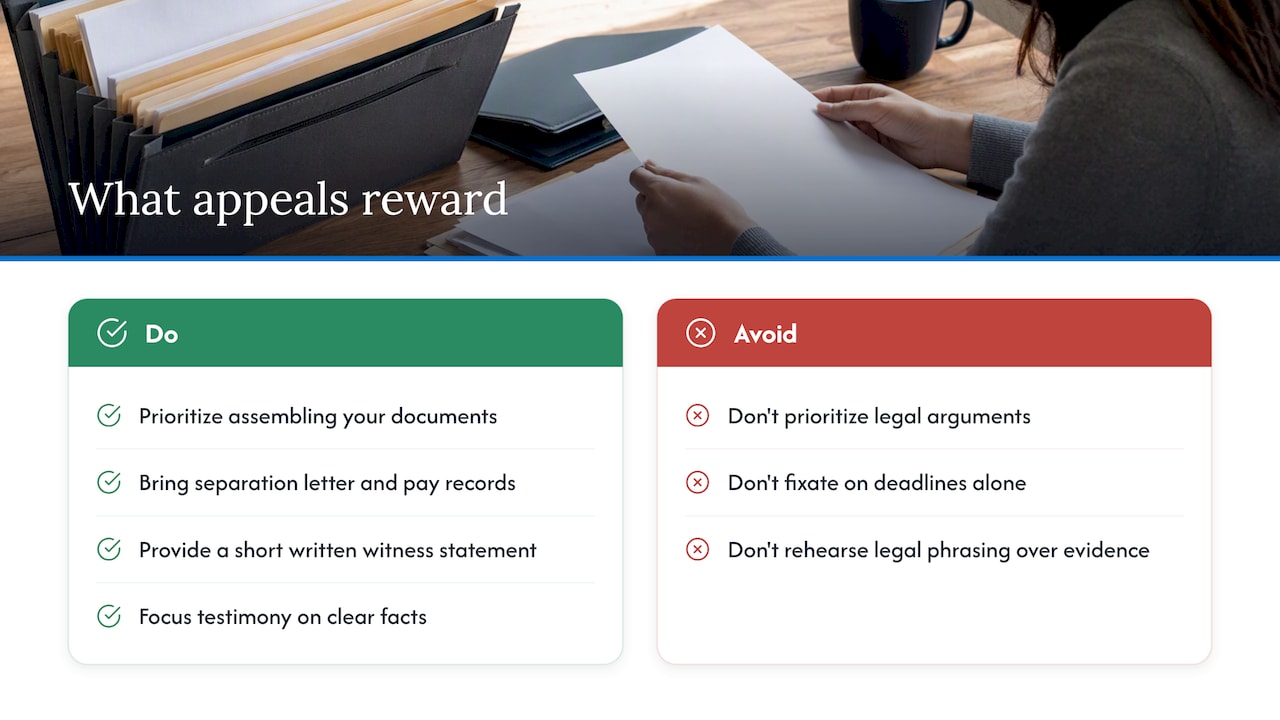
Conventional advice often fixates on deadlines alone, and deadlines matter, but they are only the entry ticket. The hearing officer’s decision rests entirely on what makes it into the record that day. Claimants who treat the hearing as a conversation, rather than a formal proceeding requiring legal phrasing, tend to communicate their facts more clearly.
If you take one thing from this guide, prioritize assembling your documents before you worry about how to phrase your testimony. A separation letter, pay records, and a short written witness statement will carry more weight than any carefully rehearsed argument.
— Max
Ongoing support for your workplace rights questions
Appeals are rarely the only workplace issue a reader is navigating; membership offers continued access to plain-language guides like this one as new questions come up, whether about wage disputes, discrimination, or separation agreements.

Our membership starts at $25 per year and gives you ongoing access to our resource library as you work through your claim and beyond. If you are dealing with a denial right now, start with your state’s appeal form today, then explore our guides for the next steps that apply to your situation.
This article is general information, not a substitute for advice from a qualified lawyer. Consult a qualified legal professional about your own circumstances before acting on anything here.
FAQ
How likely are you to win an appeal for unemployment?
Outcomes vary significantly by state and by whether the claimant or employer is the one appealing, according to Department of Labor reversal rate data. Your specific odds depend far more on the quality of your documentation and testimony than on any general statistic.
What are the 5 steps of the appeal process?
Most appeals follow filing a written appeal, receiving a hearing notice, attending the hearing where testimony and evidence are presented, receiving a written decision, and pursuing further review if needed. The exact structure and terminology differ by state agency.
How long does it take to appeal your unemployment?
Filing deadlines typically range from a limited deadline period that varies by state after your determination letter. The exact window is set by your state agency. Hearing notices generally arrive one to two weeks before the scheduled hearing date.
Do employers usually show up to unemployment appeals?
Employer participation varies by case and by state, and some employers choose not to attend. When an employer does not appear, the hearing officer typically decides based on the claimant’s testimony and submitted evidence alone, so prepare as thoroughly as if the employer will be present.
Recommended
- Employment Tribunal Explained: What U.S. Employees Should Know
- Unpaid Overtime Pay Claim Process: A Step-by-Step Guide
The post U.S. Unemployment Appeals: 4 Ways to File Before Your State Deadline appeared first on Workplace Fairness, Empower Workers.